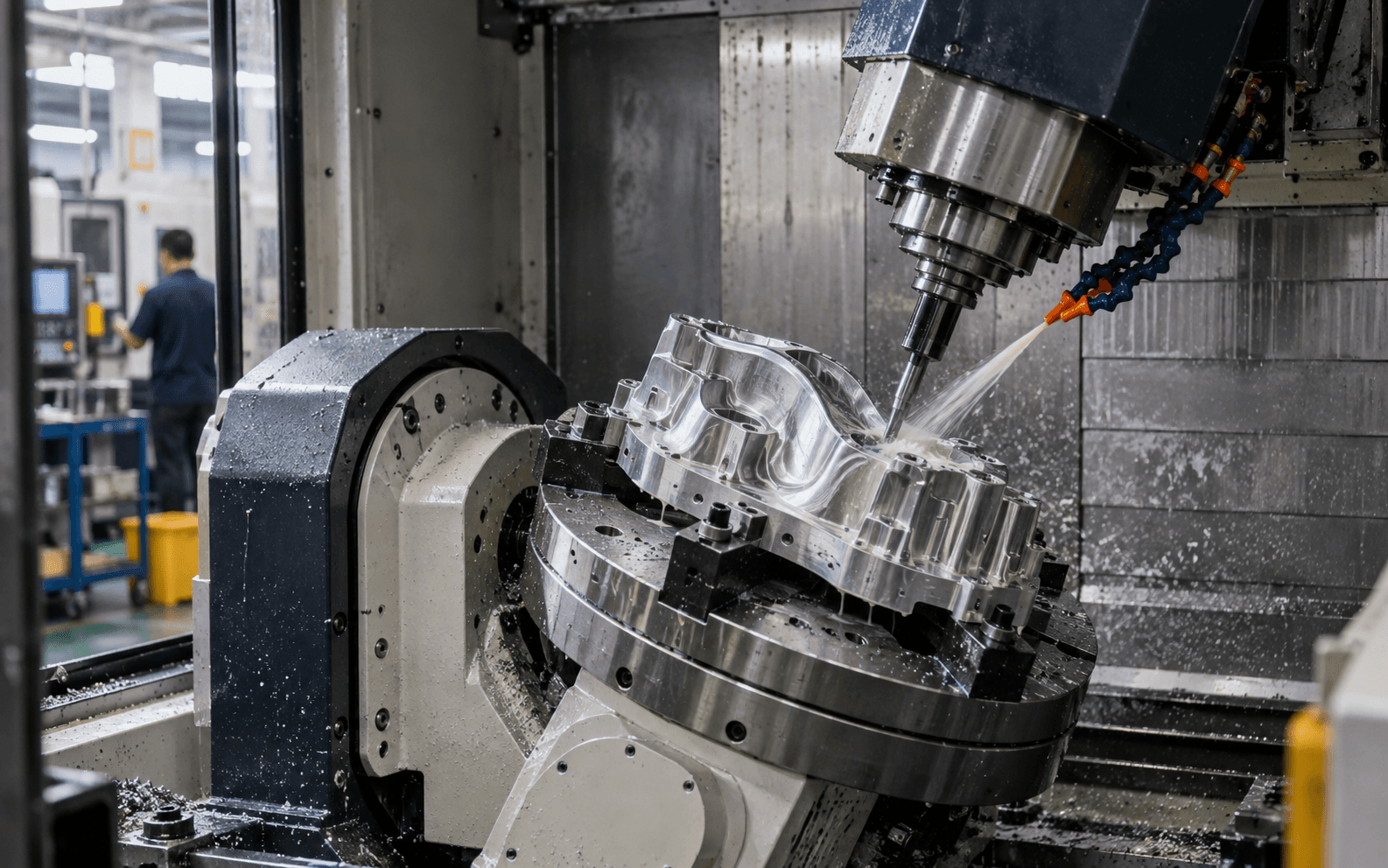
When you read CNC shop websites you'll see "3-axis", "4-axis" and "5-axis" everywhere, and 5-axis always sounds better. It's more capable, but it isn't always what your part needs, and it usually costs more per hour.
What an "axis" is
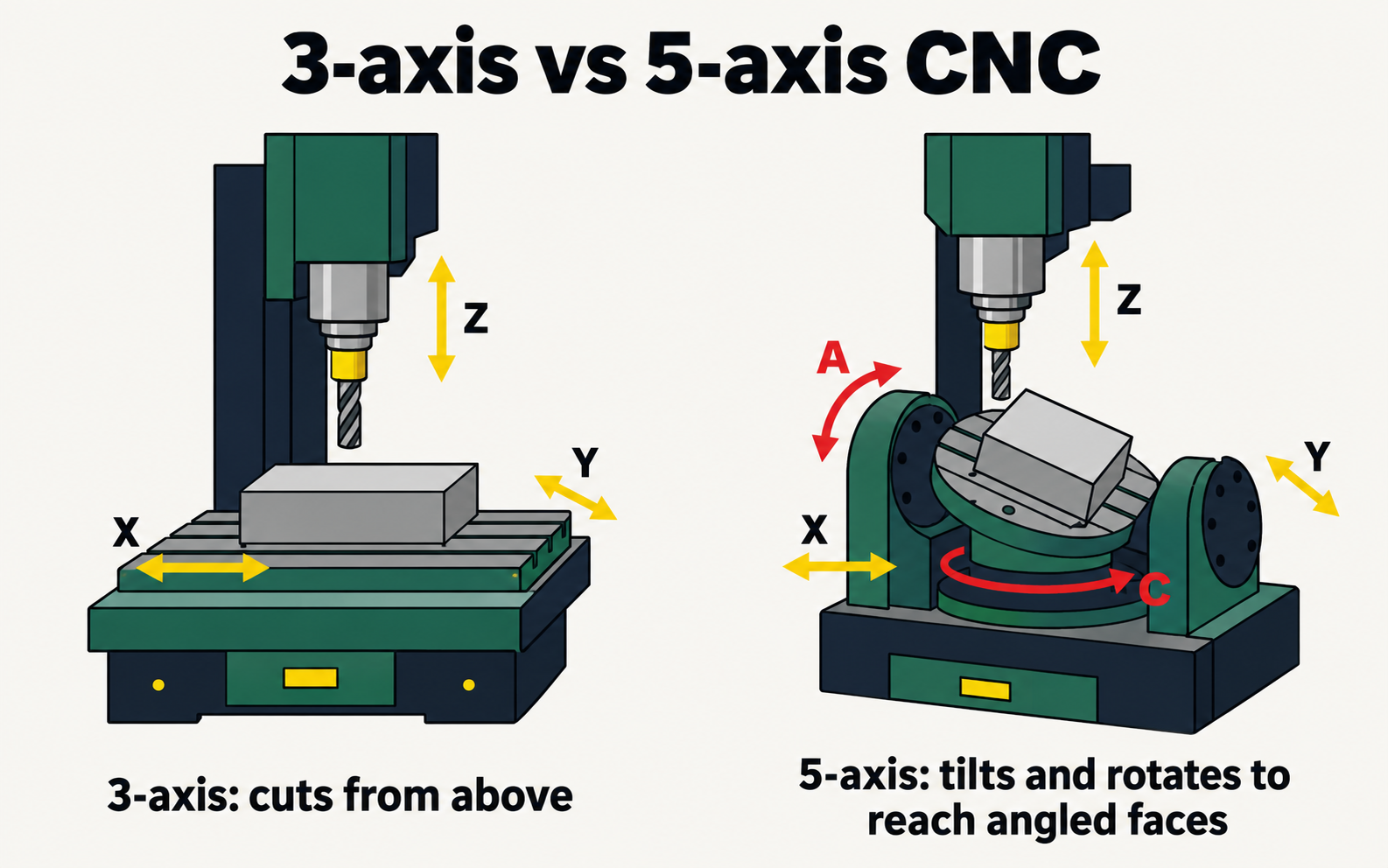
An axis is a direction the machine can move in.
- 3-axis: the cutting tool moves left–right (X), forward–back (Y) and up–down (Z). It can only cut from above, so to reach another side of the part, someone has to stop the machine, flip the part and clamp it again. That's a new setup.
- 4-axis: adds one rotation, so the part can turn like a rotisserie. That's useful for features around the sides of a part.
- 5-axis: adds two rotations, so the tool can approach the part from almost any angle, often finishing it in one or two setups.
When 3-axis is enough
Most parts that are basically "a block with pockets and holes from the top and bottom" are fine on 3-axis. That covers most enclosures, plates, brackets, heat sinks and mounting parts. 3-axis time is cheaper per hour, and many more machines are available, so lead times are often shorter.
When 5-axis is worth it
- Complex curved surfaces, like organic shapes, turbine-like blades and ergonomic grips
- Features on many sides or at odd angles, such as angled holes
- Parts that would need many setups on 3-axis. Each setup adds cost and a small risk of misalignment; 5-axis can be cheaper overall.
- Better accuracy between features cut in the same setup
How to tell which your part needs
Look at your part and ask: "Can every feature be reached straight from the top or the bottom?" If yes, 3-axis will probably do. If there are features at angles or on curved faces all around, the shop may suggest 4- or 5-axis.
You don't need to specify it yourself. Send your file and let shops propose a method. If two shops quote very differently, ask how many setups and which machine each plans to use.
Next steps
- What is CNC machining?
- How much does CNC machining cost?
- Glossary: 五轴 5-axis
- Find CNC shops (many list their 5-axis machines on their profiles)
Updated 29 September 2026