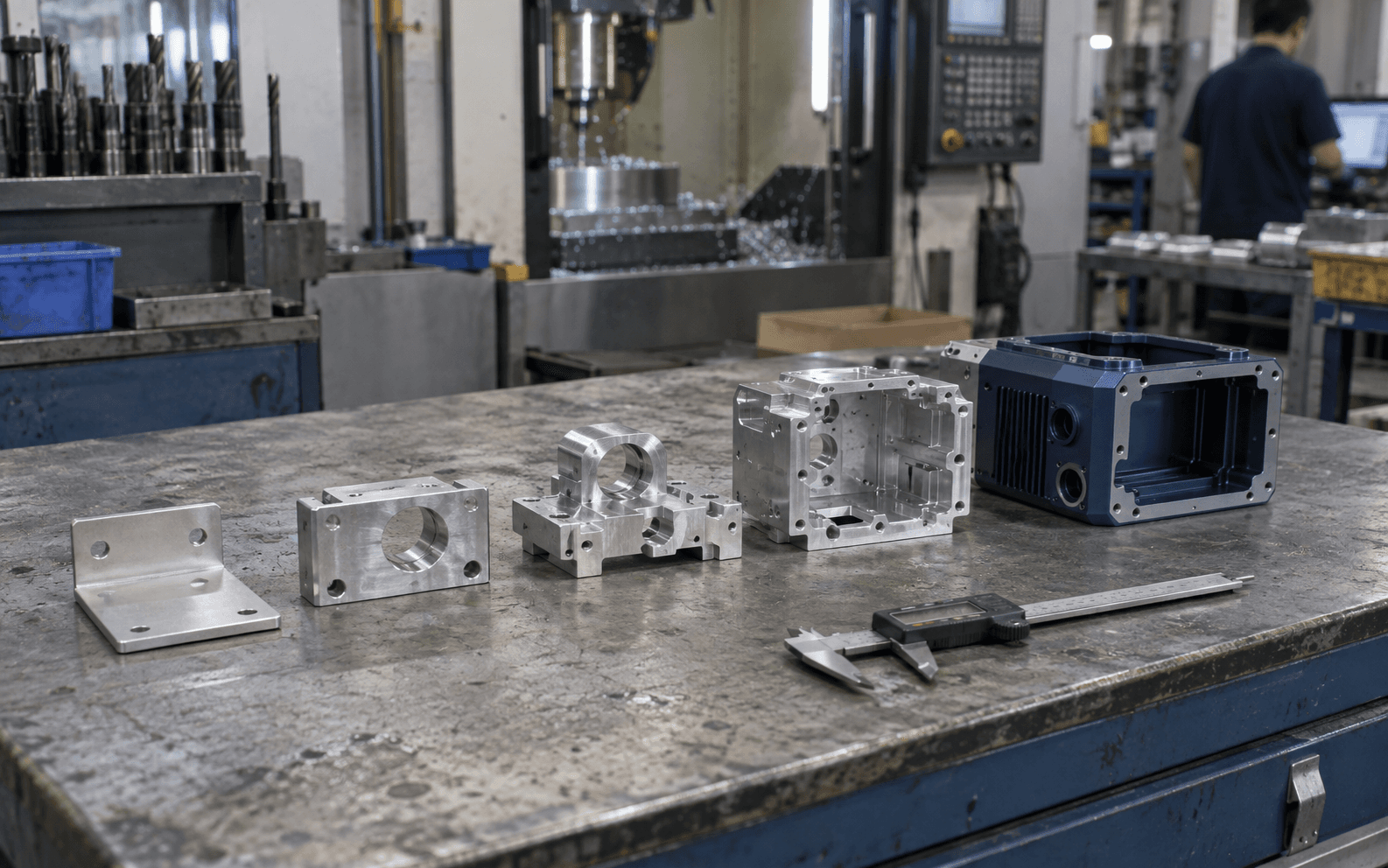
The honest answer is "it depends on the part", but it depends on a small number of things you can understand and control. Once you know them, you can read a quote, compare shops fairly, and often cut the price a lot without changing how the part works.
New to CNC? Start with What is CNC machining?
What you're actually paying for
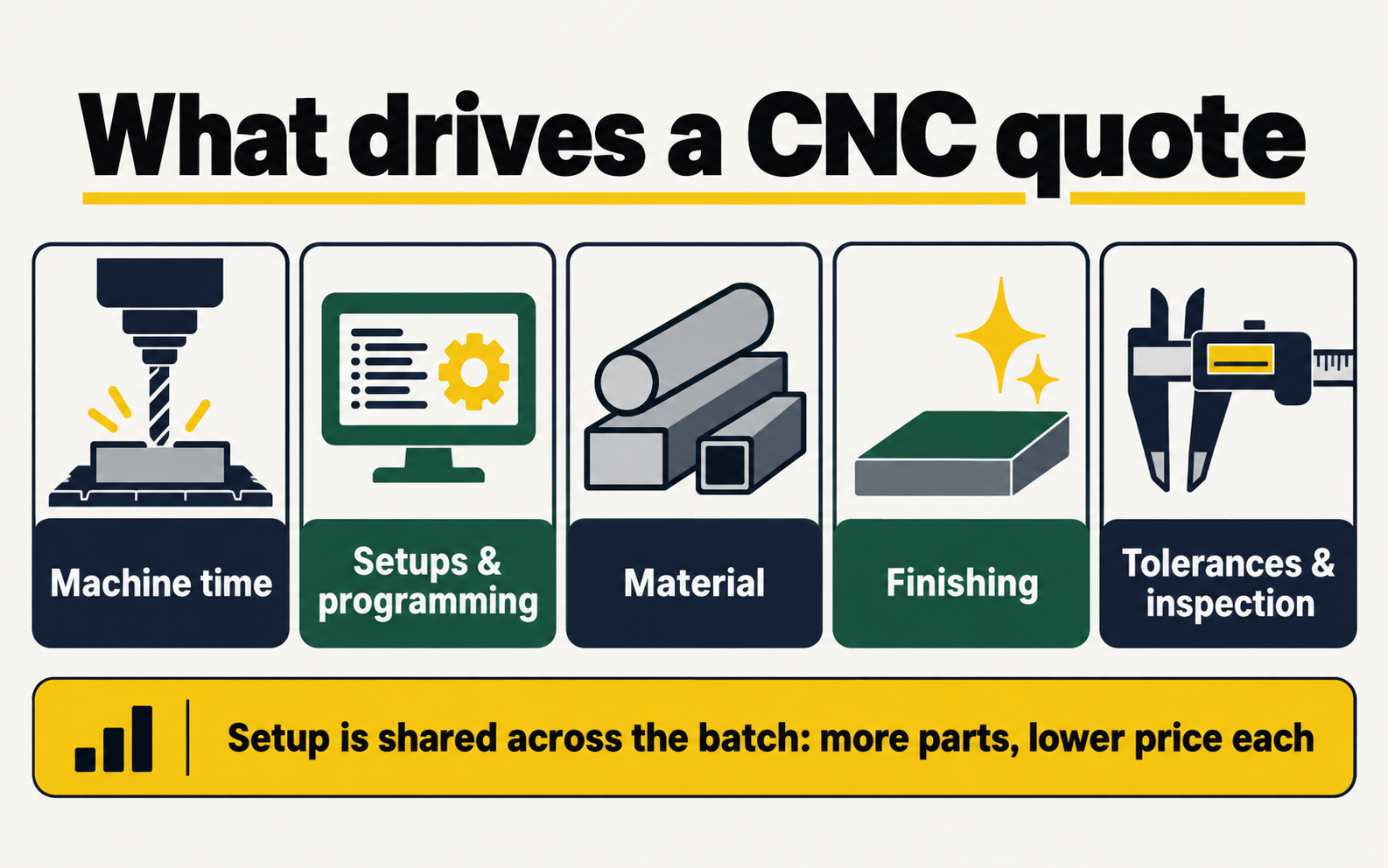
A CNC quote is mostly made of five things:
- Machine time. How many minutes the machine spends cutting your part. Complex shapes, deep pockets, small details and hard materials all take longer.
- Setup and programming. Before the first cut, an engineer writes the program and the part is clamped into the machine. Each time the part must be flipped or re-clamped to reach another side, that's another setup. This cost is the same whether you order 1 or 100, which is why single parts are expensive.
- Material. The raw block you start with, not just what's left in the final part. Aluminum is cheap; stainless steel, titanium and PEEK are not.
- Finishing. Anodizing, bead blasting, painting, silk-screen logos. Each is a separate step, often done at another shop.
- Inspection and tolerance. Tight tolerances mean slower cutting and more measuring.
Rough numbers (for orientation only)
Prices vary a lot by shop and part, so treat these as a feel for scale, not quotes:
- A small, simple aluminum part (a bracket or plate), single piece: often tens of US dollars
- The same part in a batch of 50: often much lower per piece, because setup is shared
- A complex enclosure needing several setups or 5-axis work, anodized: can be hundreds of dollars each at prototype quantities
- Stainless steel or titanium: expect several times the aluminum price for the same shape
The only way to know is to get quotes. The good news is that Shenzhen shops usually quote within a day or two.
How to lower your quote
Design changes (biggest savings)
- Loosen tolerances you don't need. Only critical features need tight numbers; mark everything else as a general tolerance.
- Add radii to inside corners. A spinning tool is round, so it can't cut a perfectly sharp inside corner. Sharp corners need tiny tools and slow cutting. A radius slightly larger than a standard tool is much cheaper.
- Avoid deep, narrow pockets. Long thin tools cut slowly and break easily.
- Design for fewer setups. If every feature can be reached from one or two sides, the part is cheaper than one that needs cutting from six.
- Use standard hole sizes and threads.
Ordering changes
- Order a few more. The jump from 1 to 5 or 10 pieces often cuts the price per part dramatically.
- Choose aluminum 6061 unless you truly need something else.
- Skip cosmetic finishing on internal parts. Nobody sees them.
- Accept a slightly longer lead time. Rush jobs cost extra.
How to compare quotes fairly
Make sure every quote states the same things:
- Material and grade (e.g. aluminum 6061-T6)
- Quantity
- Tolerances they'll hold (and whether they'll provide an inspection report)
- Finish (e.g. black anodize, bead blast)
- Lead time and shipping terms
A quote far cheaper than the rest may be using a different material, skipping finishing, or ignoring your tolerances. Ask.
Next steps
- How to prepare files for a CNC quote
- Tolerances explained for first-timers
- Find CNC machining shops in Shenzhen and Dongguan
Updated 29 September 2026