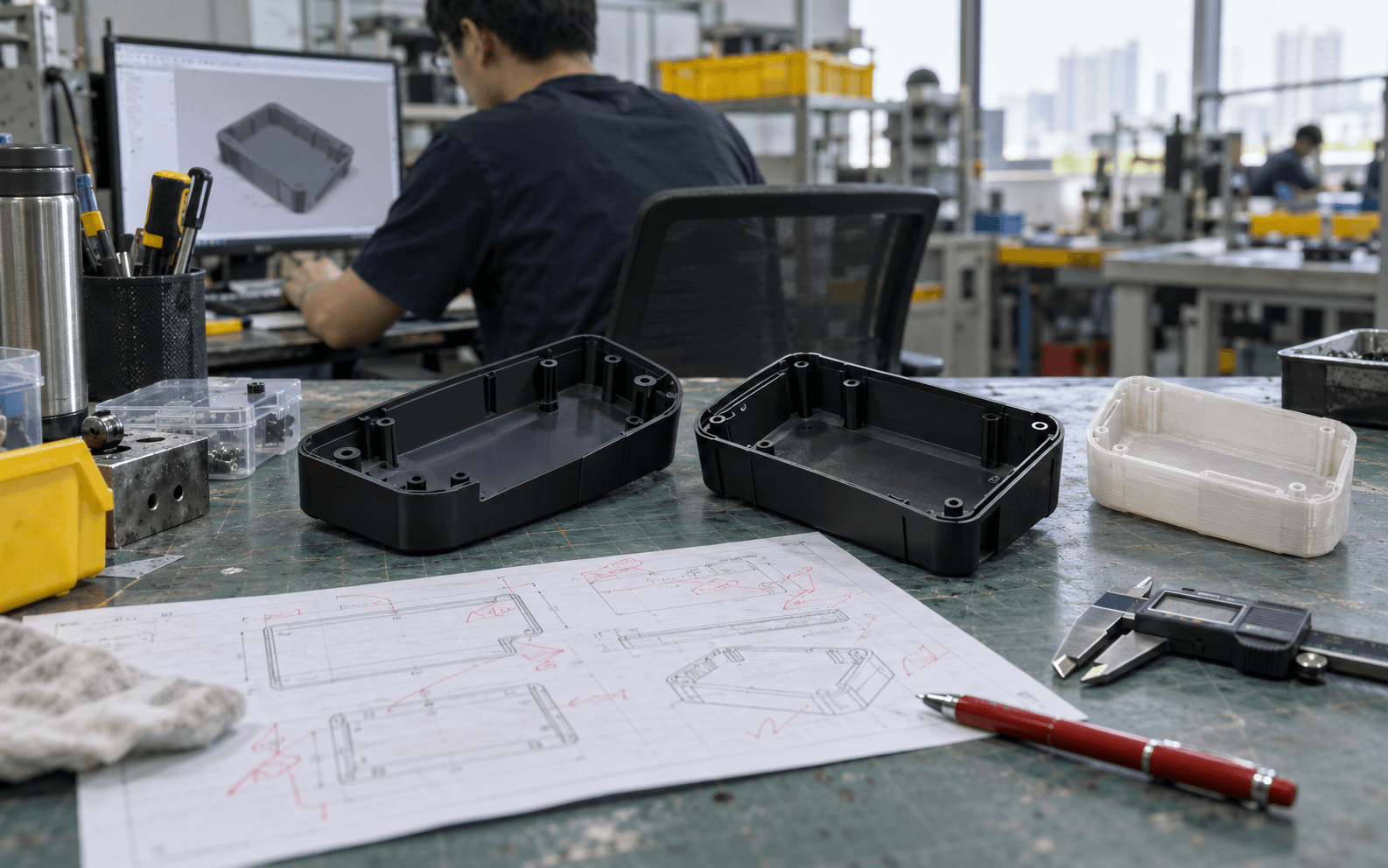
DFM stands for design for manufacturing (you'll also see "design for manufacturability"). It means shaping your product so a factory can make it easily, cheaply and the same way every time, not just so it works and looks good on your screen.
A design can be perfect in CAD and still be slow, expensive or impossible to make. DFM is the habit of asking "how will this actually be made?" while you're still designing, when changes cost nothing.
Why DFM matters so much
Most of a product's cost is locked in by design decisions. Once you've chosen the shape, the materials, the number of parts and how they fit together, the factory can only work within those choices. A cheaper factory can't fix a part that needs three extra machining steps.
Timing is the other reason. Changing a line in a CAD file is free. Changing a part after a steel mold has been cut can mean welding and re-cutting the mold (改模, gǎi mó), weeks of delay, or a new mold altogether. DFM moves problems to the point where they're cheapest to fix.
Good DFM usually gives you:
- Lower unit cost: fewer operations, less material, less scrap
- Higher yield: the share of units that come off the line good the first time
- Faster tooling: simpler molds are quicker to build and need fewer fixes
- Fewer surprises in pilot builds (see EVT, DVT, PVT explained)
The core DFM rules
Every process has its own detailed rules, but a handful apply almost everywhere.
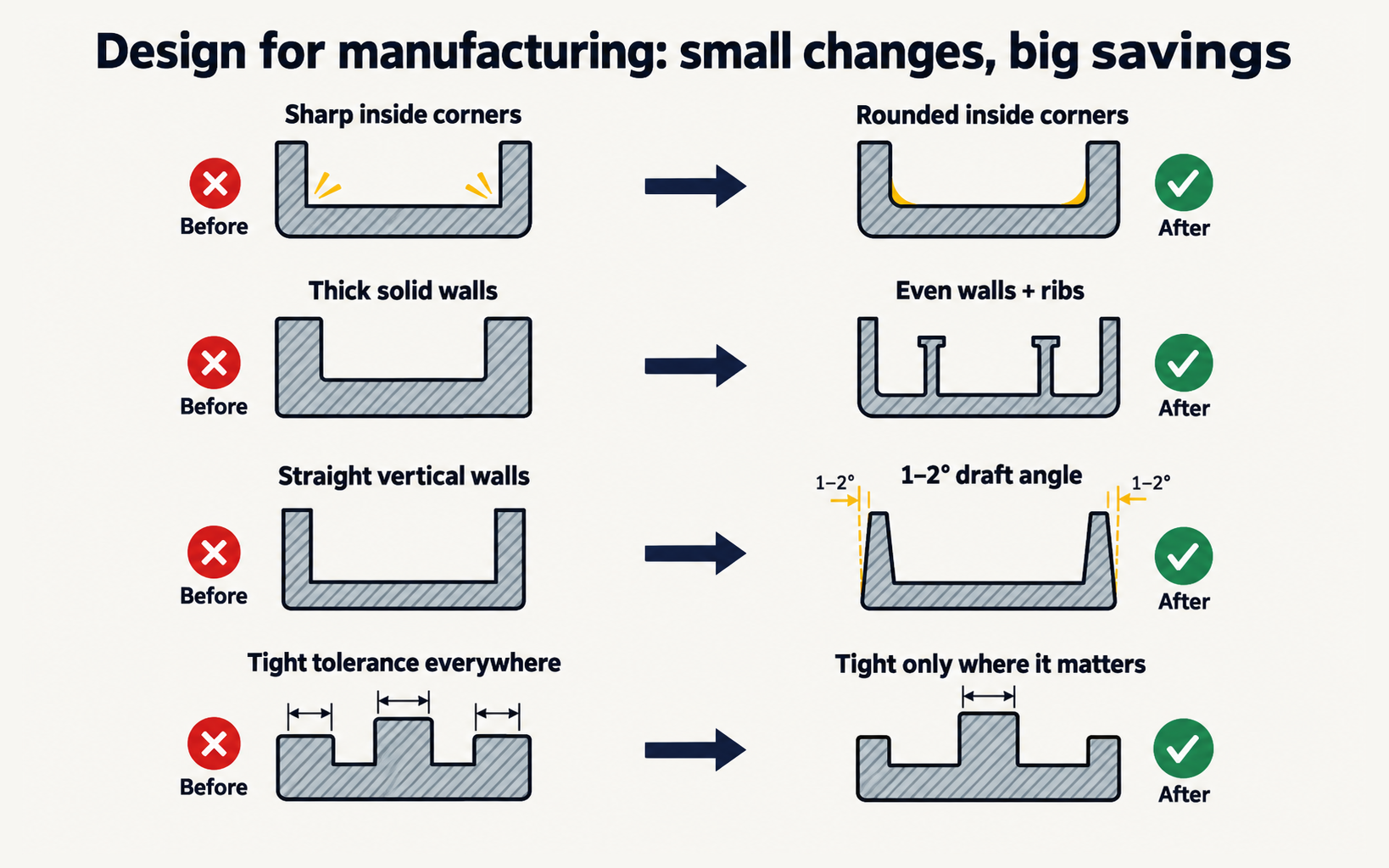
1. Pick the process first. A part designed for 3D printing often can't be molded, and a part designed for CNC machining is shaped by what a cutting tool can reach. Decide early whether a part will be injection molded, CNC machined, die cast or bent from sheet metal, then design to that process's rules.
2. Use fewer parts. Every part needs its own tooling, purchasing, stock, inspection and an assembly step. Can two parts become one? Can a clip replace a screw?
3. Keep walls even. In molded and cast parts, thick areas cool slowly and shrink, leaving dents called sink marks. Thin, even walls with ribs (thin strengthening fins) are stronger and cheaper. More in Injection molding design rules.
4. Add draft. Draft is a slight slope (often 1–2°) on walls so a part slides out of the mold instead of scraping and sticking.
5. Round inside corners. A spinning CNC cutter is round, so it can't cut a perfectly sharp inside corner. In molded parts, sharp corners concentrate stress and crack. A small radius fixes both.
6. Only make tolerances tight where they matter. A tolerance is how far a measurement is allowed to vary, such as 20 mm ± 0.1 mm. Tight tolerances need slower machining and more inspection, so they cost more. Put them only on features that must fit or seal. See CNC tolerances explained.
7. Use standard parts and materials. Common screw sizes, common plastics and widely stocked electronic components are cheaper, faster to buy, and less likely to run out. Unusual parts can hold up a whole production run.
8. Avoid undercuts unless you need them. An undercut is any shape that stops a part coming straight out of a mold, like a hook or a side hole. The mold then needs moving side-actions, which add cost and things that can go wrong.
DFM is part of a family
You'll hear several "design for" terms. They're the same idea pointed at different problems:
| Term | Stands for | The question it asks |
|---|---|---|
| DFM | Design for manufacturing | Can each part be made easily and repeatably? |
| DFA | Design for assembly | Can the parts be put together quickly without mistakes? |
| DFMA | Design for manufacturing and assembly | Both of the above, together |
| DFT | Design for test | Can the factory check every unit quickly? |
DFA and DFT get their own guide: DFA and DFT: design for assembly and test.
When to do DFM
DFM isn't a single step. It runs through the whole project:
- While designing: follow the basic rules above from the first CAD model. See the Design stage.
- Between prototypes: each prototype round shows what's hard to make or assemble. Feed that back into the design.
- Before tooling: this is the big one. Before a mold maker cuts steel, they send a formal DFM report. See the DFM & tooling stage.
- Before mass production: the contract manufacturer reviews the whole product for assembly and test, often during pilot builds.
What a DFM report from a Shenzhen supplier looks like
When you send a 3D file to a mold maker, CNC shop or PCB assembler in Shenzhen or Dongguan, many will reply with DFM feedback, often before or alongside the quote (报价, bào jià). For molds it's usually a slide deck or PDF with screenshots of your part, each marked up with an issue and a suggestion:
- walls that are too thick, with the risk of sink marks
- faces with no draft
- undercuts that will need a slide (行位, háng wèi) or lifter (斜顶, xié dǐng)
- where the plastic will enter the mold (the gate), and where the visible marks from the gate and ejector pins will land
- tolerances or textures that are hard to hold
PCB assemblers do the same for circuit boards: components too close together, missing markings, parts that are hard to buy.
How to handle it:
- Read every point and reply in writing: accept, reject with a reason, or ask a question. Don't just say "OK".
- Update your CAD and send a new revision with a new file name, so everyone knows which version is current.
- Ask for a second look after big changes.
- Don't let anyone change your design silently. A supplier might adjust a wall to make molding easier without saying so. Ask for all changes to be listed.
A supplier who sends thoughtful DFM feedback is showing you how they work. One who sends only a price for a complex part may not have looked closely.
Common DFM mistakes first-timers make
- Designing in a way that only 3D printing can produce, then expecting to mold it unchanged
- Leaving DFM until after the design is "finished"
- Specifying ±0.01 mm on every dimension because the CAD default said so
- Choosing a rare chip or a custom screw when a common one would do
- Treating the DFM report as a negotiation instead of free engineering advice
FAQ
Is DFM the same as design for manufacturability? Yes. Both terms mean the same thing.
Does DFM cost extra? Basic DFM feedback is often included with a quote from a mold maker or assembler. A deeper review by a design firm or engineering consultant is usually paid work.
Who should do DFM? Ideally your designer from day one, plus a review by the people who will actually make the part. They know their machines best.
Can I skip DFM for a small run? For 10 prototypes made by 3D printing, DFM matters less. Once you're ordering tooling or more than a few hundred units, skipping it usually costs more than it saves.
Keep reading
- DFA and DFT: design for assembly and test
- Injection molding design rules
- Product development stages: from idea to finished product
- Engineering change orders and design freeze
Next steps
- Browse design and engineering firms and product design services in the directory
- Find mold makers who review designs before tooling
- See the Design and DFM & tooling stages of the Path
- Not sure where to start? Get an intro
Updated 3 October 2026