DFM (design for manufacturing) asks whether each part can be made well. Two related ideas pick up where it stops:
- DFA, design for assembly: can a worker put all the parts together quickly, the same way every time, without mistakes?
- DFT, design for test: can the factory check every single unit, quickly, and catch the faulty ones before they're boxed?
Both matter most once you move from a handful of prototypes to hundreds or thousands of units. A step that takes you two careful minutes at your desk becomes a real cost, and a real source of mistakes, when it's repeated 5,000 times.
Why assembly and testing deserve design time
On a production line, every product passes through a series of stations: one worker fits the board, the next screws on the cover, the next tests it. Every extra step adds labour cost, and every step that can be done wrong eventually will be.
Good DFA and DFT give you:
- Lower labour cost per unit
- Higher yield: more units come off the line good the first time
- Fewer faulty products reaching customers
- Faster pilot builds, because problems are easier to find
Design for assembly: the core rules
1. Fewer parts. The best way to make assembly easy is to have less to assemble. For each part, ask: does it move relative to its neighbours? Does it need a different material? Does it need to come off for servicing? If none of these, it might merge with another part.
2. Fewer kinds of fastener. If you need screws, use one size and one head type throughout. Workers don't have to switch screwdrivers, and you can't fit the wrong screw. Better still, replace screws with snap-fits (flexible plastic clips molded into the part) where the part never needs to come apart.
3. Make parts go in only one way. A part that looks symmetrical but isn't will eventually go in backwards. Either make it fully symmetrical, so orientation doesn't matter, or make it obviously asymmetrical, with a notch, a key or a pin that stops it fitting the wrong way. This is often called error-proofing or poka-yoke, a Japanese term meaning "mistake-proofing".
4. Let parts guide themselves into place. Chamfers (angled edges), lead-ins and locating pins help a part slide into the right position without careful alignment.
5. Build from one direction. The ideal assembly stacks downwards: base first, then each part dropped in from above. Flipping the product over halfway, or reaching in from the side, slows things down.
6. Use sub-assemblies. Group parts into modules that can be built and tested separately, then joined. A tested board assembly going into a tested enclosure is easier to troubleshoot than a pile of loose parts.
7. Mind cables and glue. Loose wires are slow to route and easy to pinch. Board-to-board connectors or flexible printed cables are often quicker. Glue needs curing time and is hard to apply consistently; avoid it where a clip or screw would do.
8. Leave room for hands and tools. A screw that can only be reached at an angle with a special screwdriver will be a problem on every unit.
Design for test: what it means
Every unit coming off the line needs to be checked. DFT means designing the product so that checking is fast, reliable and doesn't need a skilled engineer.
Testing circuit boards
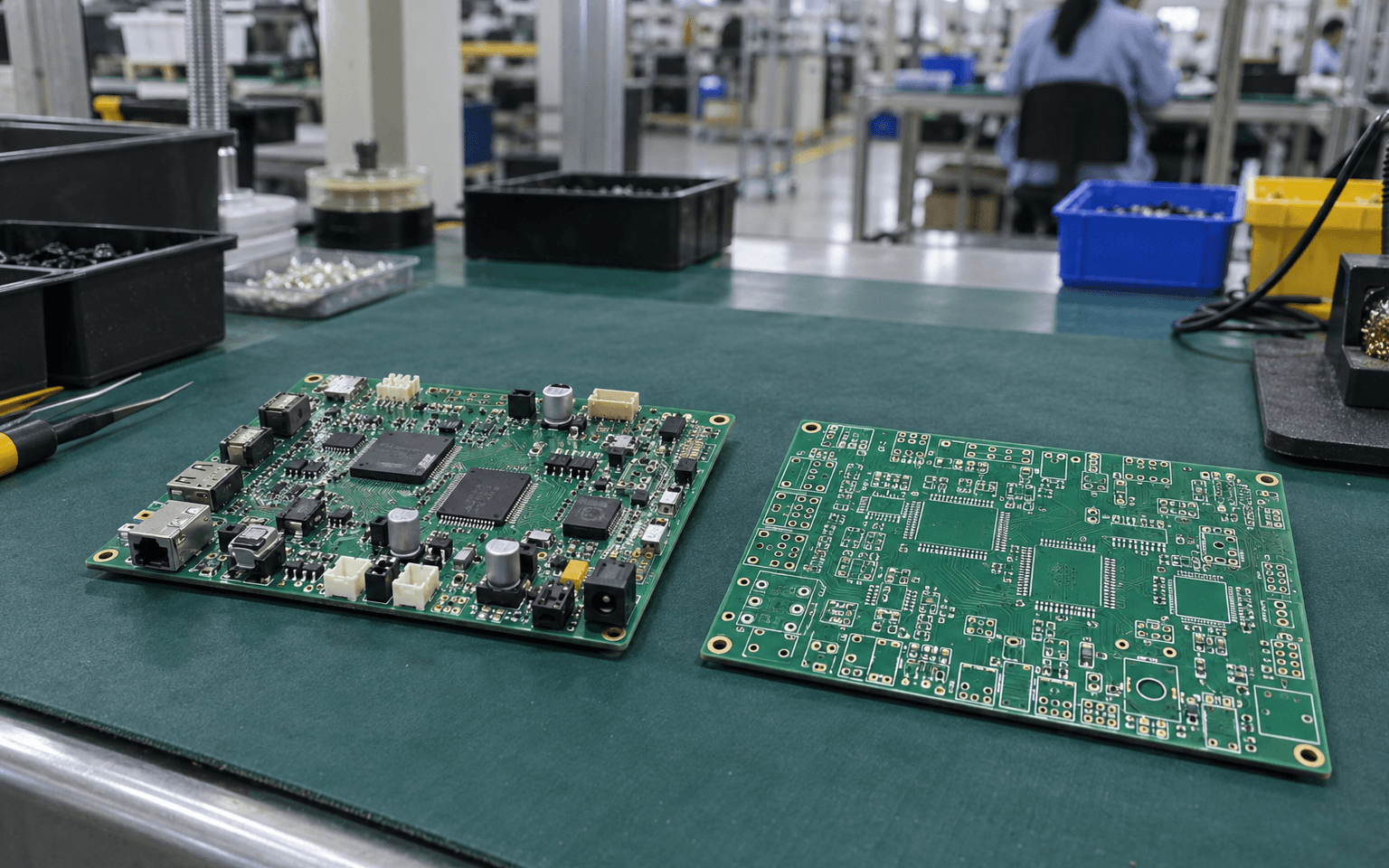
After SMT (surface-mount assembly, where machines place and solder components), boards are inspected and tested. See What is PCBA?.
- Add test points. These are small exposed copper pads connected to important signals and power rails. Test equipment presses spring-loaded pins (called pogo pins) onto them.
- Put test points on one side, spaced far enough apart for pins to reach.
- Add a programming connector or pads, so firmware can be loaded quickly on the line.
- Label things. Clear markings on the board help workers and inspectors.
Common test methods include AOI (automated optical inspection: a camera checks solder joints), flying probe testing (moving probes touch test points, good for small batches) and ICT (in-circuit test: a custom bed of pins tests the whole board at once, good for higher volumes).
Testing the finished product
The final functional test checks the assembled product does what it should: powers on, connects, charges, the buttons work, the LEDs light. To make that quick:
- Build a test mode into the firmware that runs through checks automatically and shows pass or fail.
- Make test access possible after assembly, for example through the charging port.
- Give each unit a serial number that's recorded with its test result. If a problem turns up later, you can trace which batch it came from.
Test fixtures
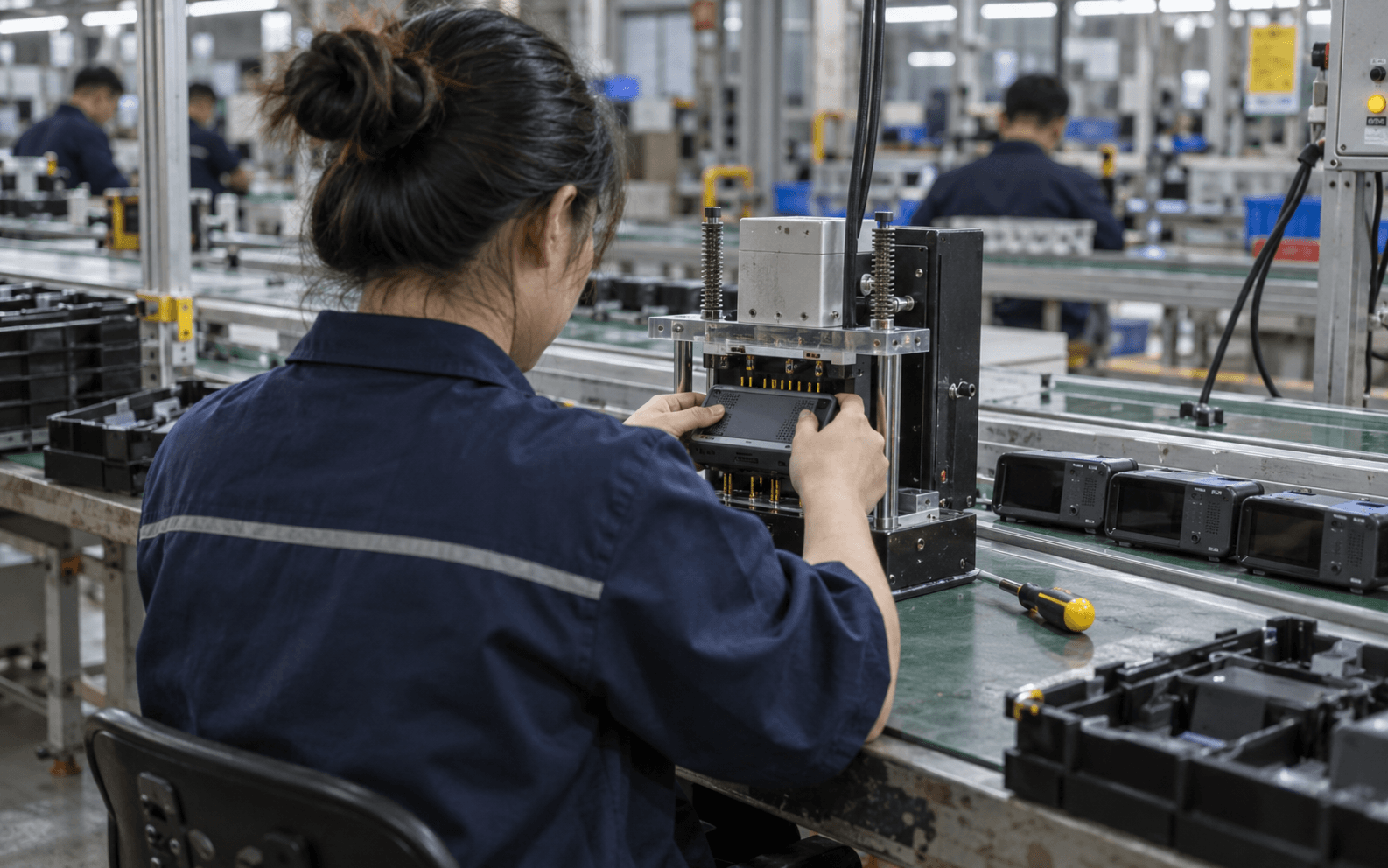
A fixture (治具, zhì jù) is a custom rig that holds the product or board in exactly the right position while it's assembled or tested. Shenzhen factories build fixtures for almost every product, and they can take as long to make as molds. Plan them during EVT, not PVT. See EVT, DVT, PVT explained.
DFA vs DFT at a glance
| DFA | DFT | |
|---|---|---|
| Question | Can it be put together quickly and correctly? | Can every unit be checked quickly and reliably? |
| Main tools | Fewer parts, snap-fits, error-proofing, sub-assemblies | Test points, programming pads, test firmware, fixtures |
| Who reviews it | Contract manufacturer's process engineers | Contract manufacturer's test engineers |
| Best time | During design and prototypes | During electronics design and EVT |
How to get DFA and DFT feedback
- Ask your contract manufacturer for an assembly review before EVT. They know their line and their workers.
- Watch someone assemble a prototype who has never seen it before. Every hesitation is a DFA problem.
- Ask your PCB assembler for a DFT check of your board layout before you order a production batch. See How to order PCB assembly.
- Write a simple test plan: what gets tested at each station, how, and what counts as a pass.
FAQ
What's the difference between DFM and DFA? DFM looks at making each individual part. DFA looks at putting the parts together. Together they're often called DFMA.
Do I need DFT for a small batch? Even for 100 units, a few test points and a test mode save hours. At 1,000 units, they're essential.
Who builds the test fixtures? Usually the contract manufacturer or a specialist fixture maker, based on your board files and test plan. Clarify who pays for them and who owns them.
Keep reading
- What is DFM? Design for manufacturing explained
- Prototype to production: what changes from 10 units to 1,000
- What is PCBA?
- Quality inspection explained
Next steps
- Browse contract manufacturers and PCB assembly shops in the directory
- See the EVT · DVT · PVT stage of the Path
- Glossary: 治具 fixture, 良率 yield, 贴片 SMT
Updated 3 October 2026