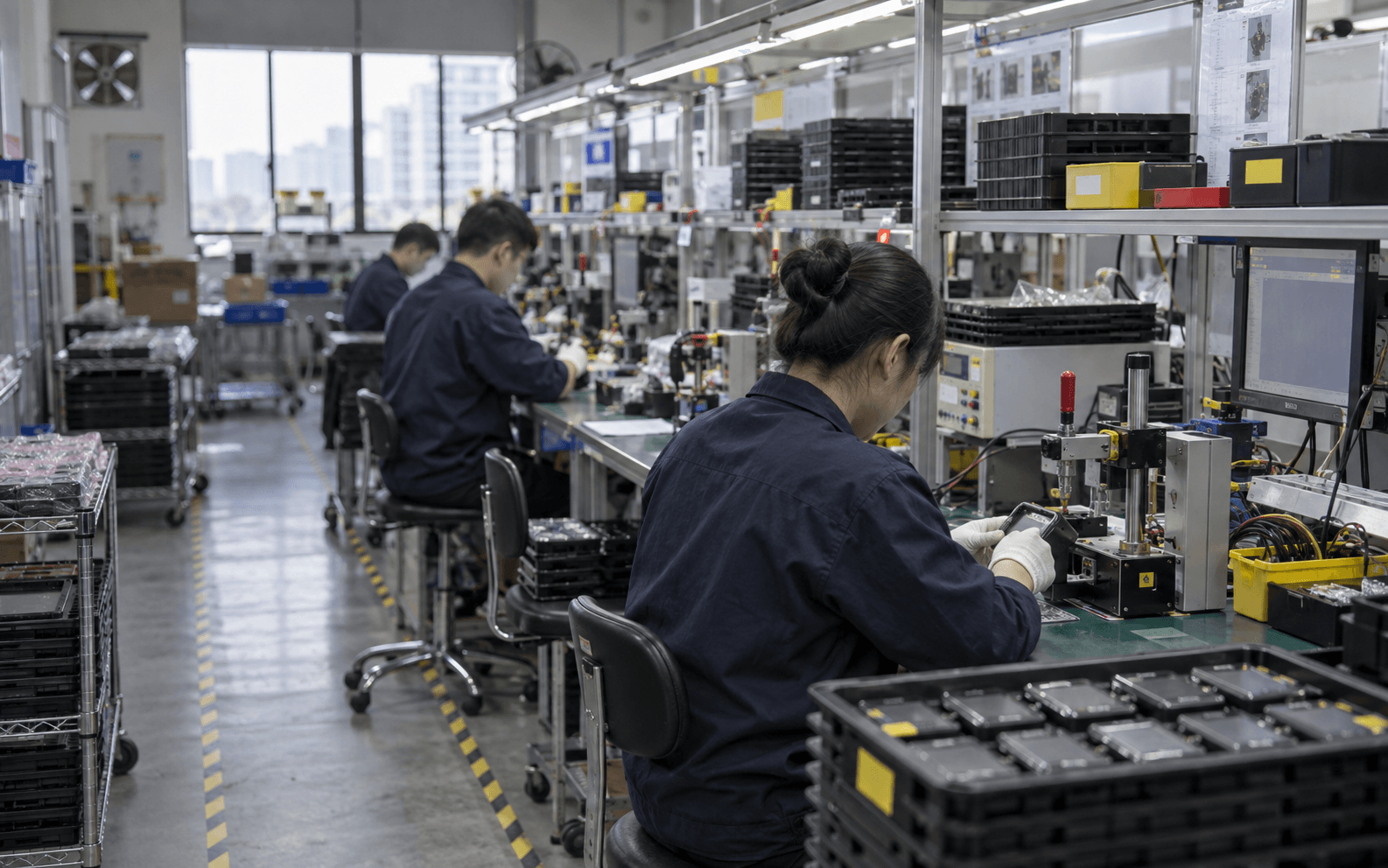
You have a prototype that works on your desk. The goal is thousands of identical units, built by a factory, that all work, pass safety tests, and arrive undamaged. Getting from one to the other is rarely a single step.
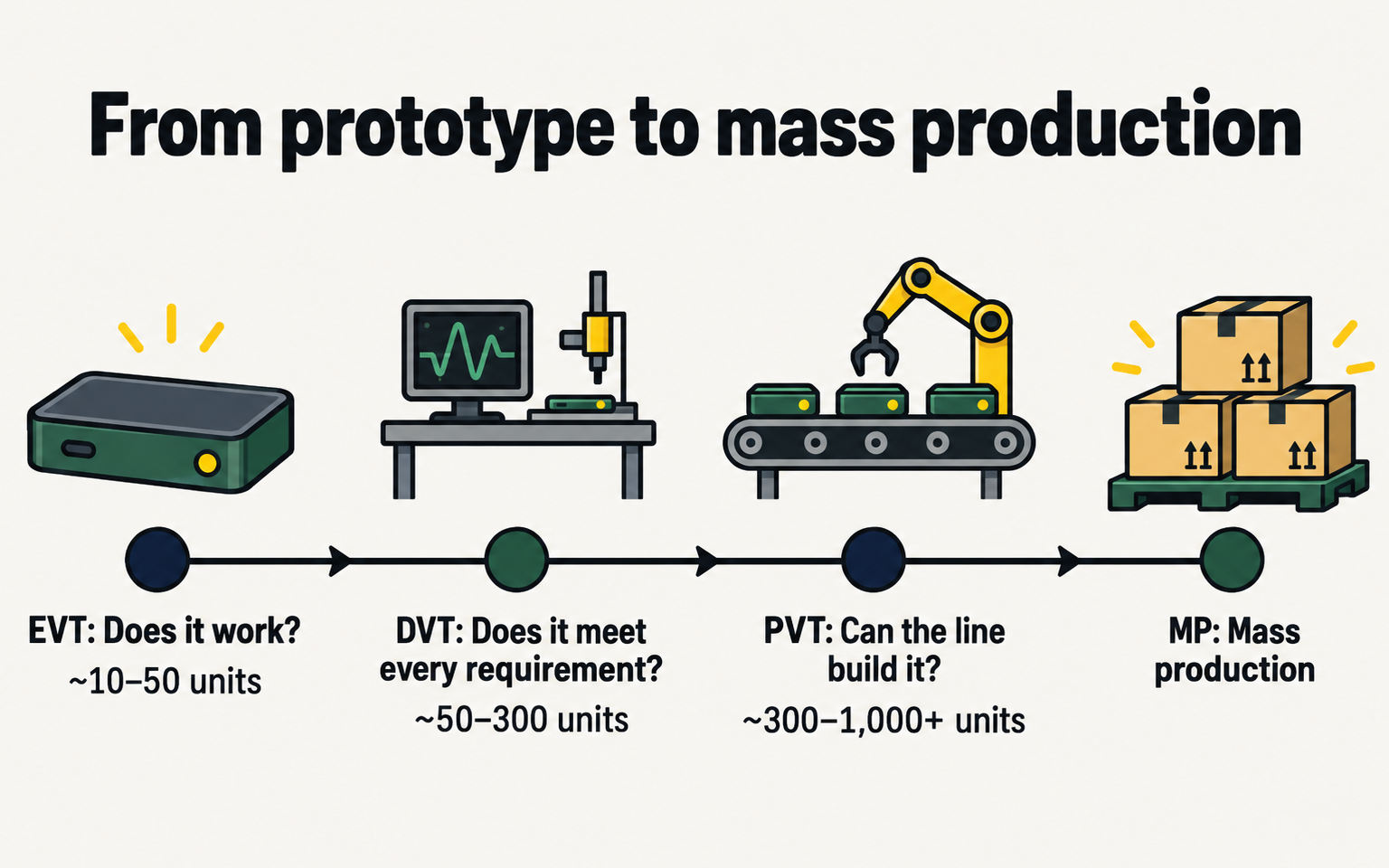
Most hardware companies get there through three test builds, usually called EVT, DVT and PVT. Each one makes a small batch of units to answer one big question before you spend money on the next stage. Chinese factories call these trial builds 试产 (shì chǎn, "trial production").
This guide explains each build in plain terms. If you're new to manufacturing, read it before you talk to a factory. You'll understand what they're asking you, and why.
A few terms first
- Contract manufacturer (CM): a factory that builds your product to your design. You own the design; they supply the building, people, machines and assembly line. Chinese: 代工厂 (dài gōng chǎng).
- BOM (bill of materials): the complete list of every part in your product, from the screws to the chips, with quantities and part numbers. The factory buys and builds from this list.
- Tooling: the custom molds and fixtures made just for your product, like injection molds for plastic parts. It's expensive and slow to make, so you want your design settled first. (See How to get an injection mold made in China.)
- Fixture (治具 zhì jù): a custom holder or rig used on the production line, for example to hold a board while it's tested, or to press two parts together the same way every time.
- Yield: the percentage of units that come off the line working and looking right the first time. 95% yield means 5 in every 100 need fixing or scrapping.
- Certification: official testing that your product is safe and doesn't interfere with other electronics. Examples are FCC for the USA and CE for Europe. You usually can't sell without it.
The three builds at a glance
| Build | The question it answers | Roughly how many units | How the parts are made |
|---|---|---|---|
| EVT: Engineering Validation Test | "Does our design actually work?" | ~10–50 | Mostly prototype methods (3D printing, CNC, early circuit boards) |
| DVT: Design Validation Test | "Does it meet all our requirements, reliably, and can it pass certification?" | ~50–300 | Real production tooling (molded parts) and production circuit boards |
| PVT: Production Validation Test | "Can the factory build it at full speed, at good quality?" | ~300–1,000+ | Final tooling, on the real production line, with real workers and fixtures |
These numbers vary a lot by product. A simple gadget might build 20 units at EVT, while a complex device might build a few hundred at DVT. Think of them as rough scale, not rules.
EVT: "Does it work?"
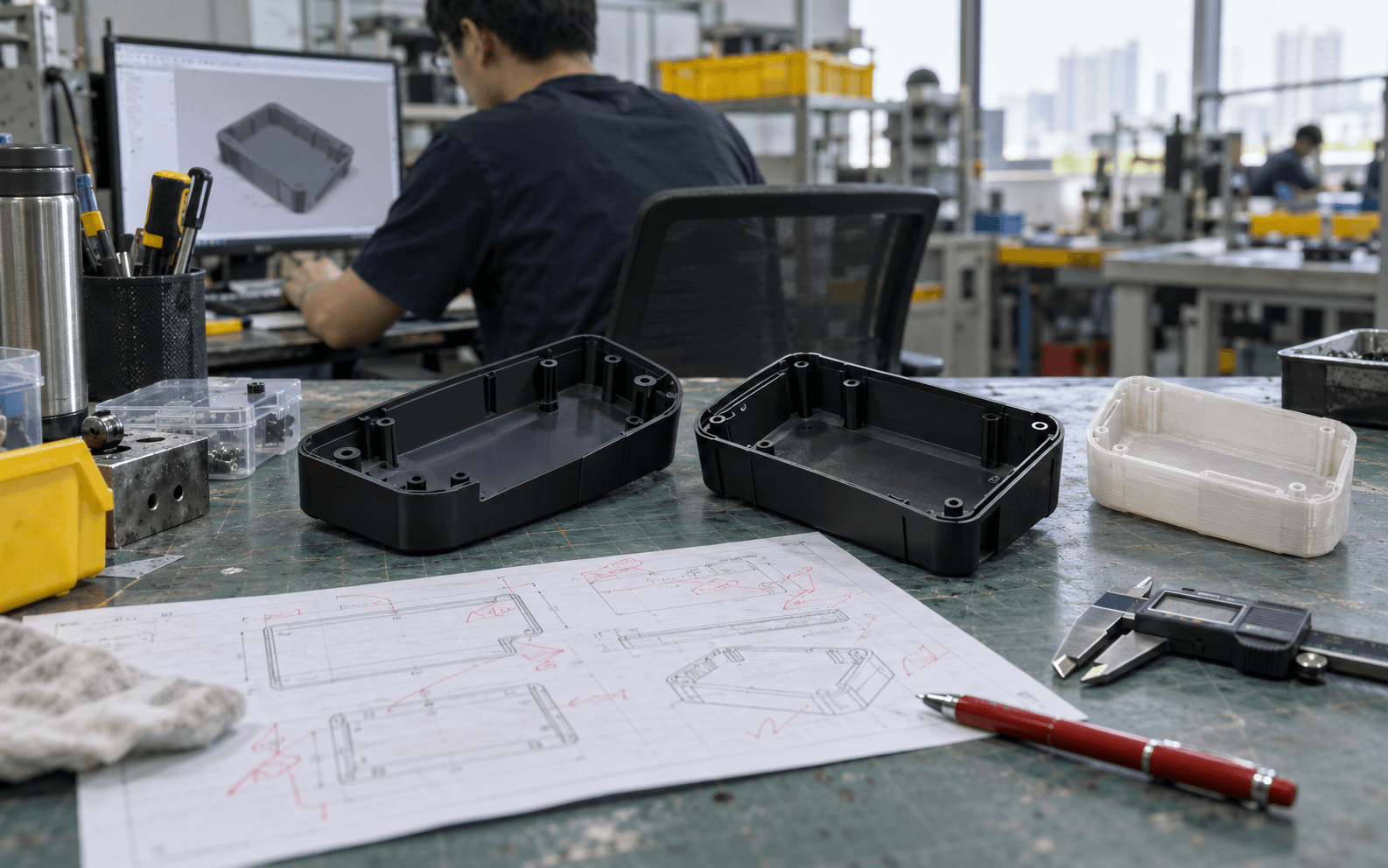
What happens: you and the factory (or your engineers) build a small batch using mostly prototype parts. Enclosures are often 3D printed or CNC machined, not molded yet, and circuit boards are early versions.
What you test: the core functions. Does it power on? Does Bluetooth connect? Does the battery last? Does it get too hot? Does the software run on the real hardware?
Why it matters: this is the cheapest point to find design mistakes. Changing a CAD file costs nothing; changing a steel mold later costs thousands.
What usually goes wrong: prototype parts behave differently from final ones. A CNC-machined case is stiffer and more precise than a molded one, so something that fits at EVT may not fit later. Expect a list of design changes to come out of EVT. That's normal, and it's the point.
DVT: "Does it meet every requirement, every time?"
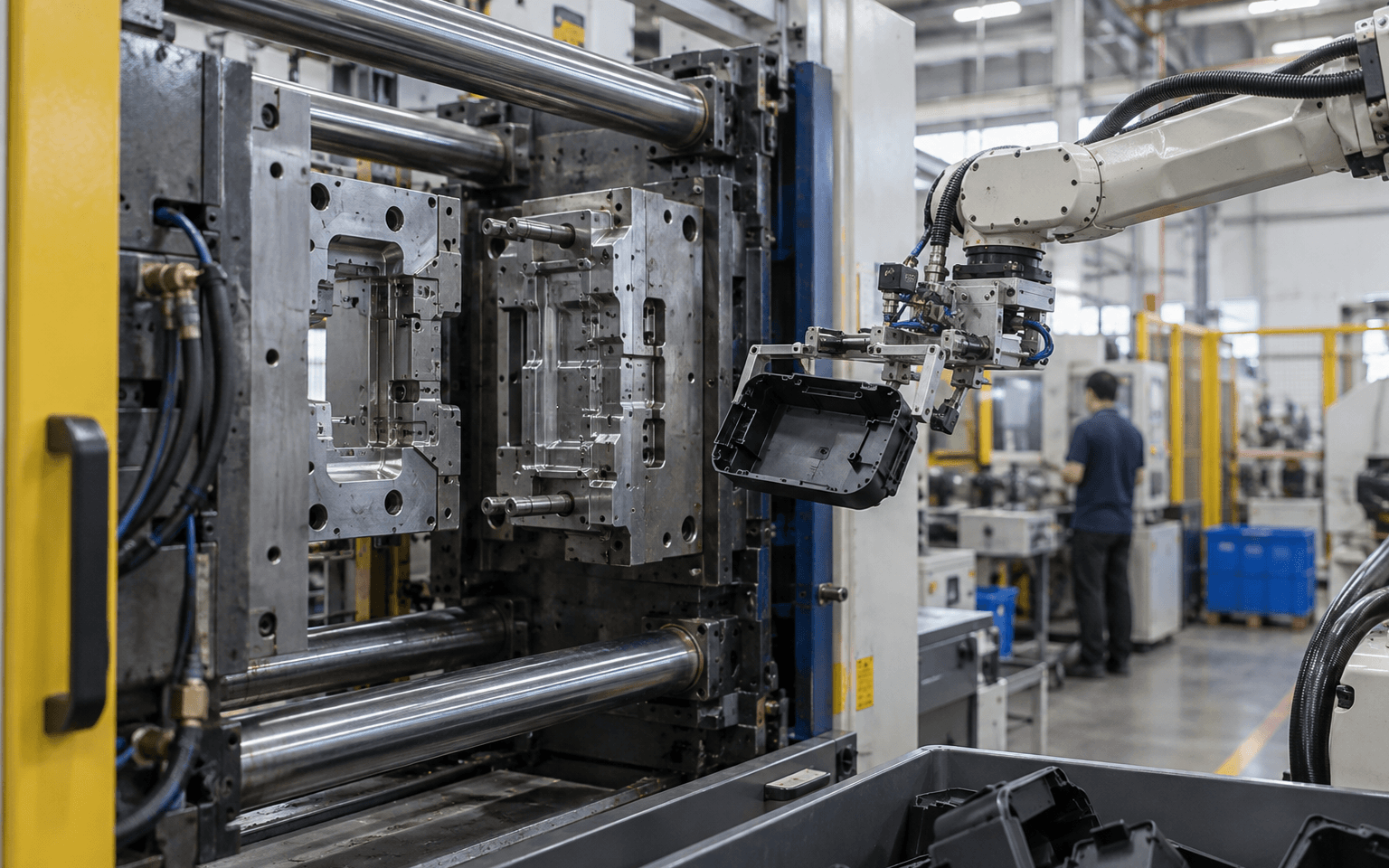
What happens: your design is now nearly final, and the production molds have been made. Plastic parts are real molded parts, usually from the first mold trials (called T1 or T2). Circuit boards are production versions.
What you test: everything in your product requirements, including:
- Reliability: drop tests, button-press life (say 100,000 presses), hinge cycles
- Environment: hot, cold and humid conditions
- Certification: you send units to a test lab for FCC, CE and similar. This is often done at DVT, because certification must be done on units that match what you'll sell.
- Cosmetics: colours match, no scratches or marks on visible surfaces
Why it matters: DVT is your last chance to fix design problems before committing to mass production.
What usually goes wrong:
- The molds need more fixes than expected, which pushes the schedule back
- The product fails EMC testing (electromagnetic compatibility: whether it gives off, or is disturbed by, radio interference), often because of how the circuit board or cables are laid out
- Parts from different suppliers don't quite fit together
Output of DVT: a frozen design, test reports, and approved samples.
PVT: "Can the factory build it properly, at speed?"
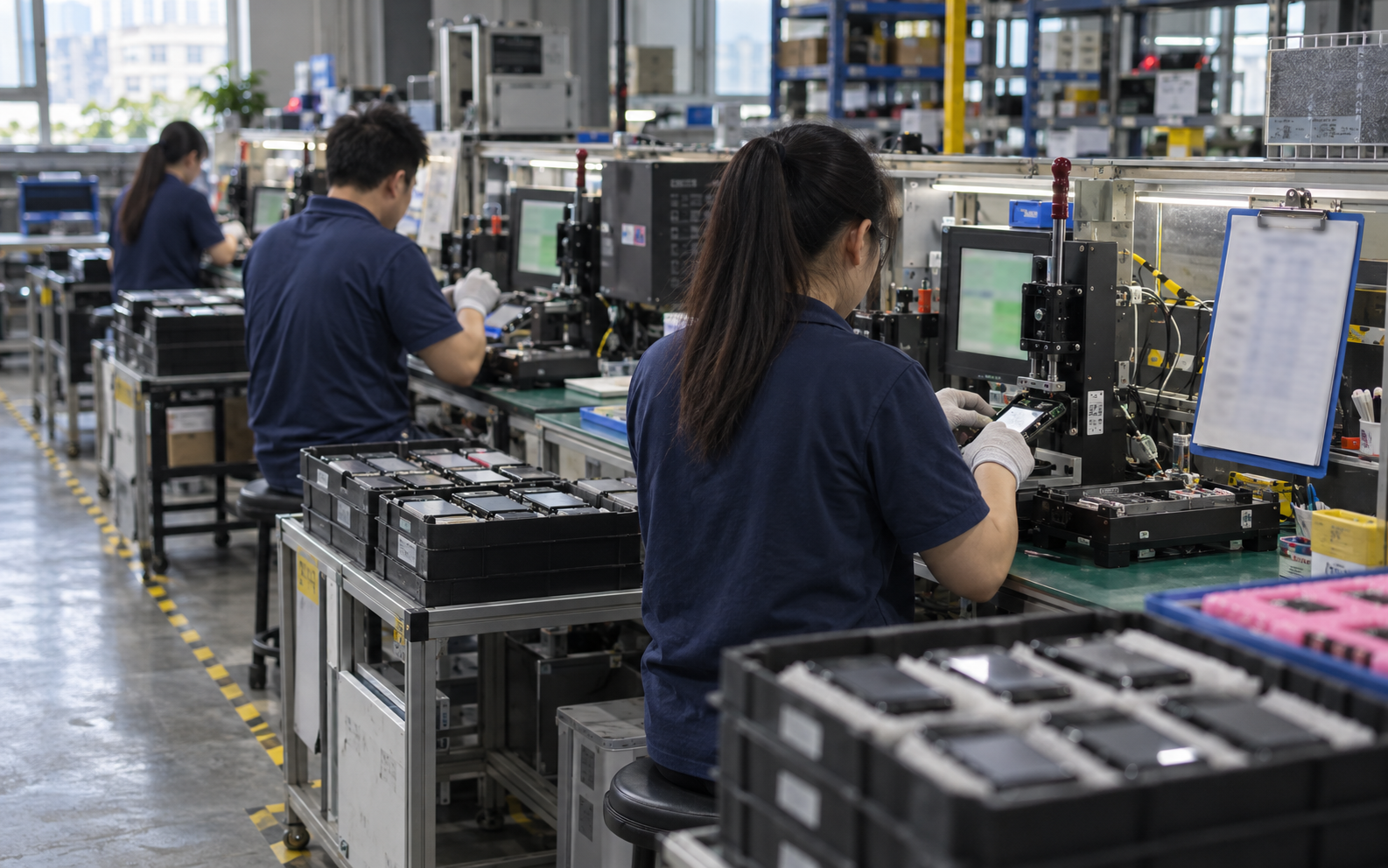
What happens: the factory builds a larger batch on the real production line, with its real workers, final fixtures and test stations, at the speed it will run in mass production.
What you measure:
- Yield: what percentage come off the line good?
- Cycle time: how long each step takes, which tells you how many units per day
- Defects: what goes wrong most often, and why
Why it matters: a design can be perfect and still be hard to build consistently. PVT tests the process, not the product.
Output of PVT: approval to start mass production (量产 liàng chǎn, often shortened to "MP") and a golden sample (金样 jīn yàng). That's a unit everyone signs off as "this is exactly right", and every future unit is compared against it.
What usually goes wrong: test fixtures that don't catch real faults, workers needing clearer instructions, and packaging, labels or manuals only discovered to be missing at the last minute.
How long does all this take?
It varies widely, but for a first-time consumer electronics product, going from EVT through PVT often takes several months. Much of the waiting is for molds (DVT needs them) and certification (labs have queues). Starting these early is the easiest way to save time.
Practical tips
- Be there, or send someone. For DVT and PVT especially, have someone on the factory floor, whether you, a team member, or a hired inspection company. Photos and reports don't replace seeing problems yourself.
- Start fixtures early. Test fixtures can take as long as molds. Don't leave them until PVT.
- Book your certification lab during DVT, not after it.
- Write down what "good" means, in English and Chinese, before each build: which surfaces must be flawless, which functions must pass, and what limits count as a pass. It prevents arguments later.
- Freeze your BOM before PVT. Swapping a component after PVT (even a "compatible" one) can mean re-testing, sometimes a whole new DVT.
Where to find help
- Contract manufacturers and startup-focused partners: in the directory, filter by Contract manufacturing or the NPI partner chip. NPI (New Product Introduction) partners specialise in guiding first-time teams through exactly these builds.
- Test and certification labs: see the Certification stage of the Path.
- Inspection and quality-control firms: see the Quality stage.
Words you'll hear
| Chinese | Pinyin | Meaning |
|---|---|---|
| 试产 | shì chǎn | Trial / pilot build |
| 量产 | liàng chǎn | Mass production |
| 金样 | jīn yàng | Golden sample |
| 治具 | zhì jù | Fixture / jig |
| 良率 | liáng lǜ | Yield |
| 物料清单 | wù liào qīng dān | BOM (bill of materials) |
See the full glossary.
Updated 29 September 2026