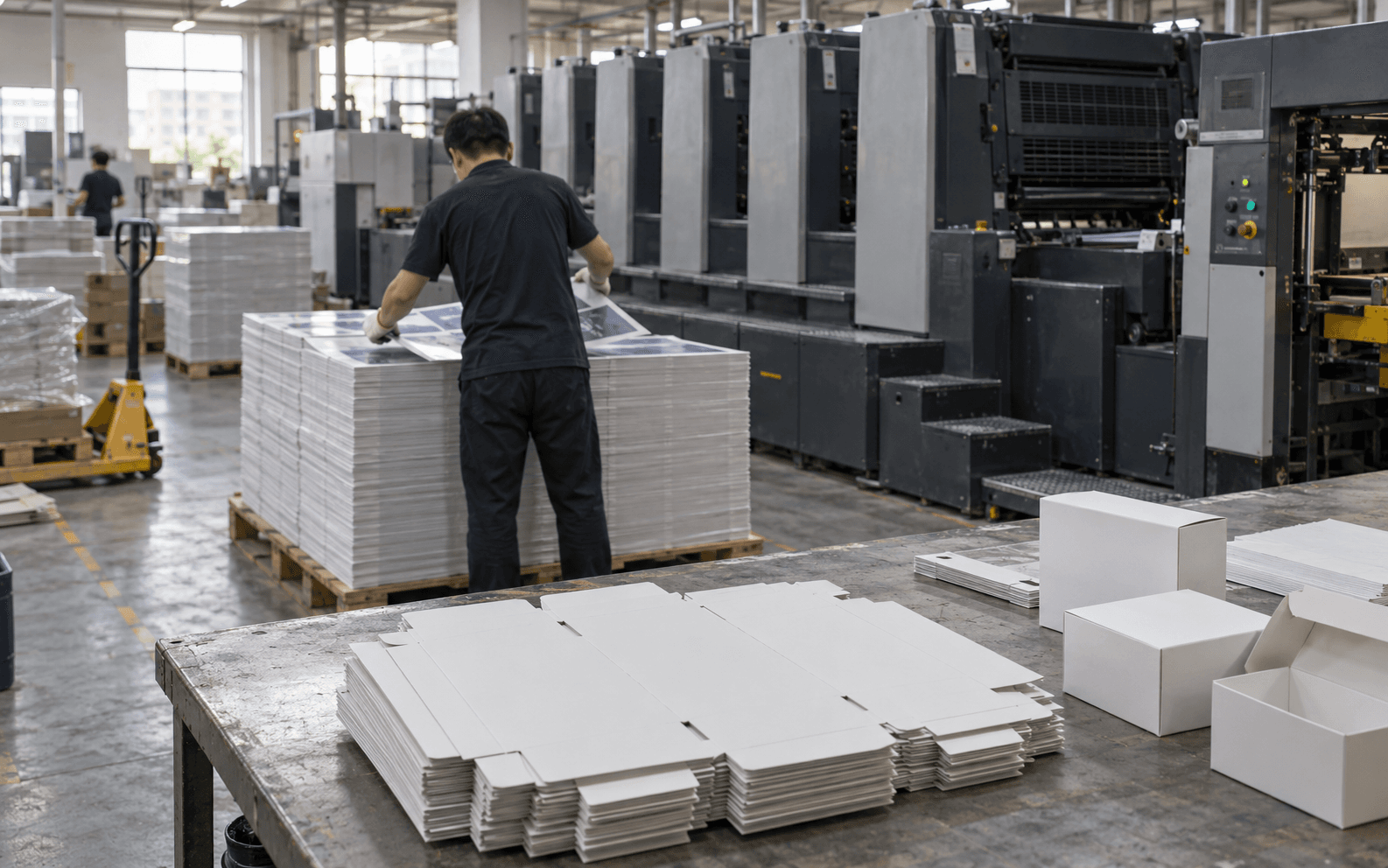
Your product works, the enclosure is tooled, and now someone asks: "What about the box?" For a lot of first-time hardware teams, packaging turns up late and then quietly delays the launch, because a printed box has its own samples, its own minimum order and its own lead time.
This guide walks through how a custom retail box is actually made, in the order it happens, so you can plan it alongside the product instead of after it.
What "packaging" includes for a hardware product
When a factory quotes "packaging" (包装, bāozhuāng), it can mean several separate items:
- The retail box (彩盒, cǎihé, literally "colour box"): the printed box the customer sees.
- The insert (内托, nèituō): the tray or foam that holds the product still inside the box.
- Printed extras: manual, quick-start card, warranty card, stickers.
- Labels: barcode, serial number and regulatory marks.
- The shipping carton (外箱, wàixiāng): the plain brown corrugated box that holds several retail boxes for transport.
Each one can come from a different supplier. A packaging printer (印刷厂) usually makes the box and paper parts; inserts may come from a foam or pulp specialist. Your assembly factory then packs everything.
The process, step by step
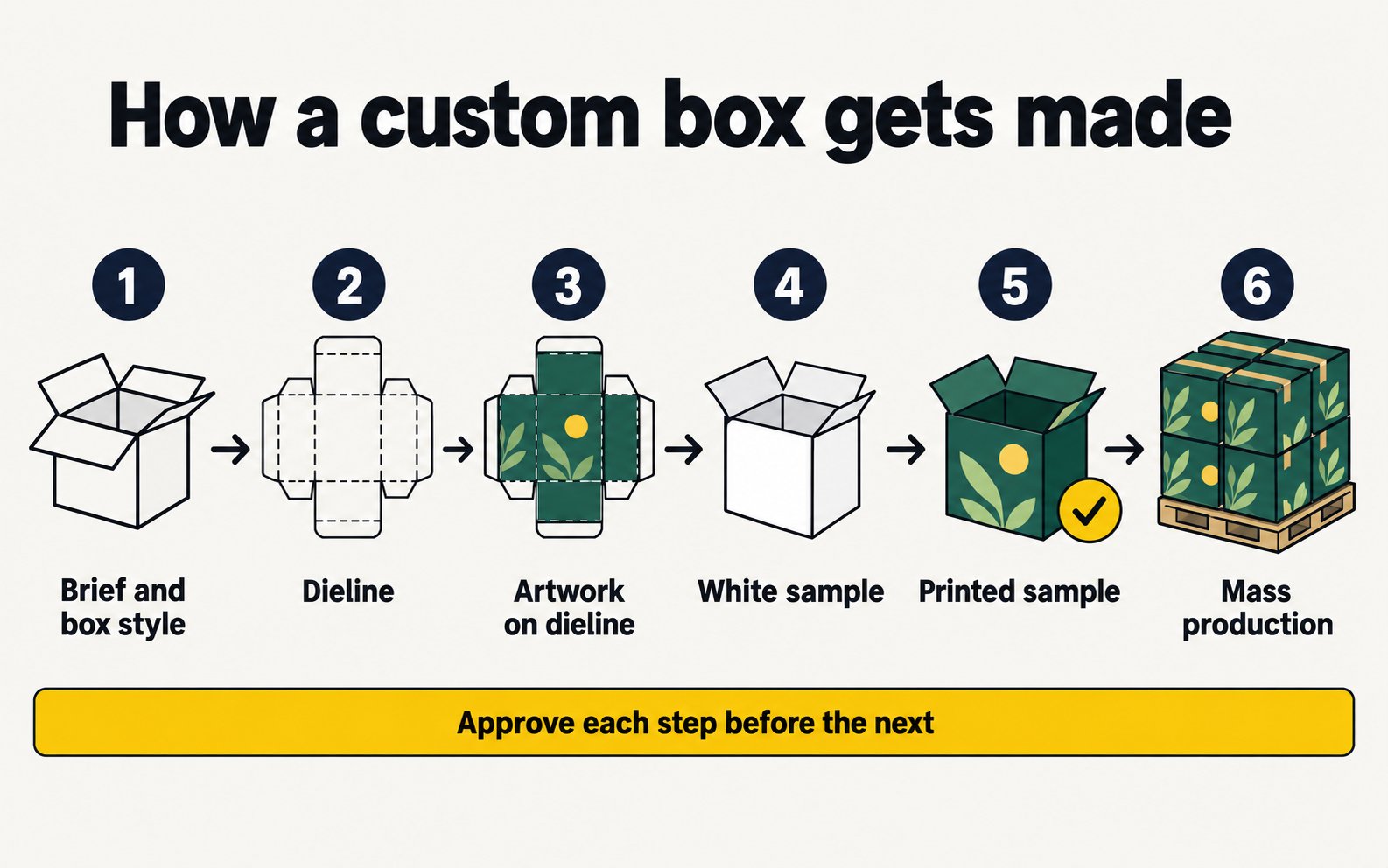
1. Brief and box style
Start by deciding what the box must do. Is it sitting on a retail shelf, or shipped straight to a customer's door? How heavy and fragile is the product? What do you want it to feel like when opened?
That choice drives the structure: a thin folding carton, a corrugated mailer, or a thick rigid box. Our rigid box vs folding carton guide compares them.
2. Dieline
A dieline (刀版, dāobǎn) is the box drawn flat, as if you unfolded it on a table. It shows where the board is cut and where it folds. The factory usually draws it for you once they have your product dimensions, which is the safer route. Everything else is built on this drawing. See What is a dieline?
3. Artwork on the dieline
Your designer places the graphics onto the dieline in a separate layer, keeping text away from folds and extending background colour past the cut line (this extra margin is called bleed). Finishes like foil or spot UV each get their own layer, so the factory knows exactly where they go.
4. White sample
Before anything is printed, ask for a white sample (白样, báiyàng): the real box made from the real board, but blank. Put your product and insert in it. Check the fit, the closing feel, and how it survives a drop. This is the cheapest moment to change the structure.
5. Printed sample
Next comes a printed sample (印刷样 or 彩样, cǎiyàng) with real ink and finishes. This is where you check colour, foil, embossing and text. Sign off on one and keep it as the reference for production, just like a golden sample for the product itself.
6. Mass production
In the factory, the box usually goes through these stations:
- Printing sheets of board, mostly on an offset press.
- Coating or lamination to protect the print.
- Special finishes: foil, embossing, spot UV.
- Die-cutting: a steel-rule die stamps out each box shape and presses the fold lines.
- Gluing or assembly: folding cartons are glued on a machine and shipped flat; rigid boxes are mostly wrapped and assembled by hand.
- Quality check and packing into cartons.
Box structures in brief
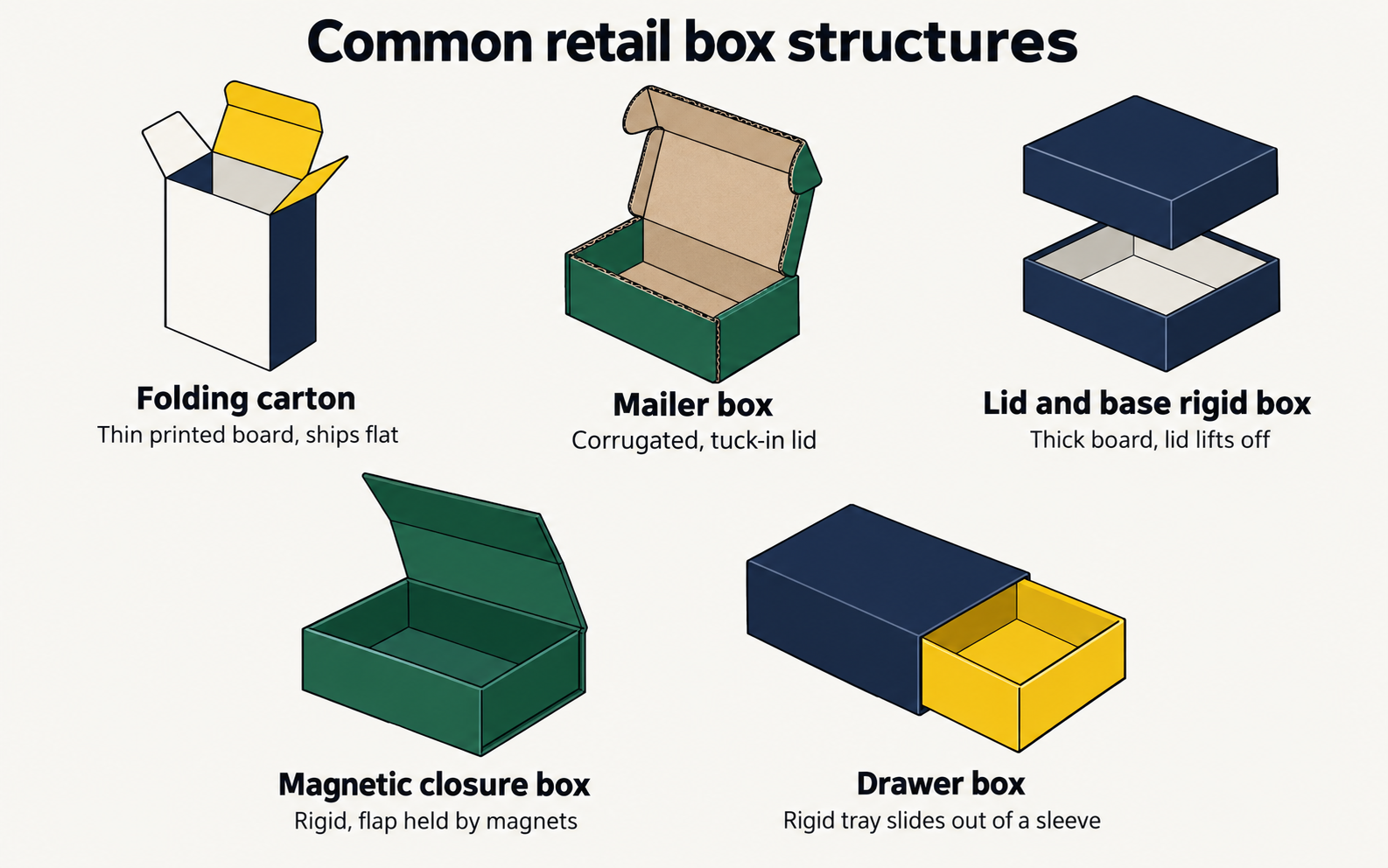
- Folding carton: printed paperboard that ships flat. Cheapest and lightest. Most consumer electronics on a shop shelf use one.
- Mailer box: corrugated board with a tuck-in lid. Good for direct-to-consumer shipping.
- Rigid box (精装盒, jīngzhuānghé): thick greyboard wrapped in printed paper. Styles include lid-and-base (天地盖, tiāndìgài), magnetic flap and drawer. Premium feel, higher cost, ships assembled so it takes more freight space.
Printing in brief
Most boxes are printed offset in CMYK, the four process inks (cyan, magenta, yellow, black) that combine to make most colours. When a brand colour must match exactly, printers add a Pantone or spot colour (潘通色), mixed as its own ink. Digital printing needs no printing plates, so it suits short runs. Details are in Offset vs digital printing for boxes.
Finishes in brief
Finishes are what make a box feel premium. The common ones:
- Lamination (覆膜, fùmó): a thin film over the print, in gloss, matte or soft-touch.
- Spot UV (局部UV): shiny clear coating on selected areas only.
- Hot foil stamping (烫金, tàngjīn): metallic foil pressed on with a heated die.
- Embossing and debossing (击凸 / 压凹): raised or pressed-in shapes.
Each finish is a separate pass on a machine, and most need their own tool, so each one adds cost. Read Spot UV, soft-touch and lamination, What is hot foil stamping?, Hot foil vs cold foil and Embossing vs debossing.
Inserts in brief
Electronics move around in a box unless something holds them. Common inserts are EVA foam, paperboard, molded pulp (纸浆模塑) and thermoformed plastic trays. Molded pulp and plastic trays need their own mold, which affects cost and lead time. See Packaging inserts for electronics.
MOQs, cost and lead time
Minimum order quantity (起订量, MOQ) for printed boxes is commonly in the hundreds or low thousands (typical, confirm with your supplier). The reason is set-up: plates, dies, machine make-ready and waste sheets cost about the same whether you print 500 boxes or 5,000. Small orders are possible, but the price per box is high.
What drives the price:
- Structure: rigid boxes cost far more than folding cartons, partly because of hand assembly.
- Size and board: bigger boxes and thicker board use more material.
- Number of finishes: every foil, emboss or spot UV adds a tool and a pass.
- Special colours: each Pantone ink adds a plate and set-up.
- Insert type: foam and paperboard are cut with dies; pulp and plastic need a mold.
- Quantity: set-up costs spread over more boxes.
Lead time for printed folding cartons is often about 2–4 weeks after you approve the printed sample, and rigid boxes usually take longer (typical, confirm with your supplier). Add time for the white sample and printed sample rounds before that. In practice, start packaging while you're still in EVT, DVT and PVT, not after.
What to send a packaging supplier
- Product dimensions and weight (or a sample unit)
- Box style, and any reference box you like
- Quantity, plus a price at 2–3 quantity levels
- Board or material preference, if you have one
- Finishes you want, and where
- Insert type, or ask them to propose one
- Whether they should also make the manual, labels and shipping carton
- Destination market, so required markings fit (see Packaging labels and markings)
Our RFQ guide covers the general format.
FAQ
How long does custom packaging take? Allow time for a white sample, a printed sample and then production. Production alone is often 2–4 weeks for folding cartons (typical); samples add rounds on top.
Can I order just 100 boxes? Often yes, especially with digital printing, but the unit price will be much higher than at 1,000 or more.
Who designs the dieline? Usually the box factory. You or your designer then place artwork onto it.
Should the contract manufacturer source the packaging? Many can, and it simplifies logistics. If you go direct to a printer, make sure the printer ships to your assembly factory on time.
Key words
| English | Chinese | Pinyin |
|---|---|---|
| Retail box | 彩盒 | cǎi hé |
| Rigid box | 精装盒 | jīng zhuāng hé |
| Lid-and-base box | 天地盖 | tiān dì gài |
| Insert | 内托 | nèi tuō |
| Dieline | 刀版 / 刀版图 | dāo bǎn |
| White sample | 白样 | bái yàng |
| Shipping carton | 外箱 | wài xiāng |
Keep reading
- What is a dieline? Dielines, white samples and printed proofs
- Rigid box vs folding carton vs mailer box
- Packaging inserts for electronics
- Offset vs digital printing for boxes
- Quality inspection explained
Next steps
- Read the packaging hub
- Browse packaging suppliers in Shenzhen and Dongguan
- See the Packaging stage of the Path
- Plan freight with Shipping from Shenzhen: sea vs air
- Not sure where to start? Get an intro
Updated 3 October 2026