When you ask for a box quote, the factory has to decide how to print it. For most retail boxes the choice is offset or digital. The answer depends mostly on how many boxes you need and how exact your colours must be.
New to packaging? Start with How custom packaging is made.
Offset printing in plain words
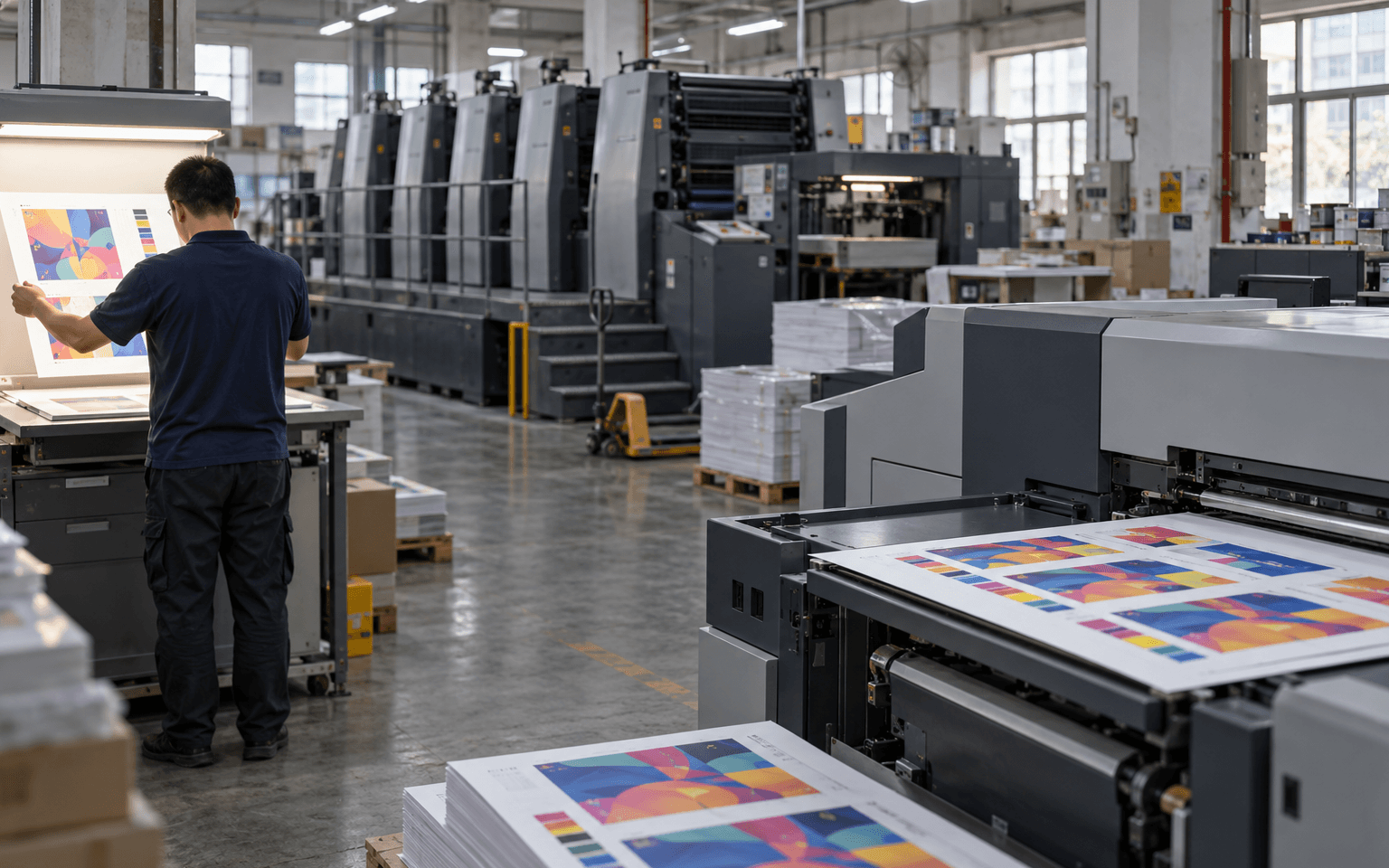
Offset printing (胶印, jiāoyìn) is the workhorse of box printing. Each colour gets its own printing plate. The plate picks up ink, transfers ("offsets") it onto a rubber blanket, and the blanket presses it onto the board. A typical press has four or more units in a row, one for each ink.
- Set-up is the expensive part: making plates and getting the press running with good colour uses time and waste sheets.
- After set-up, it's fast and cheap per sheet, with excellent sharpness and colour consistency.
Digital printing in plain words
Digital printing (数码印刷, shùmǎ yìnshuā) works more like a very large office printer: the image goes straight from the file to the sheet, using toner or inkjet. There are no plates.
- Almost no set-up, so short runs and samples are affordable.
- Each box costs about the same whether you print 50 or 500, so it gets relatively expensive at higher quantities.
- Every box can be different, which is handy for variations or personalisation.
Side by side
| Offset (胶印) | Digital (数码印刷) | |
|---|---|---|
| Plates | Yes, one per colour | None |
| Set-up cost | Higher | Very low |
| Cost per box at high quantity | Low | Stays fairly flat |
| Best for | Hundreds to millions | Samples and short runs |
| Pantone spot colours | Yes, mixed as real ink | Usually approximated from process colours |
| Colour consistency over long runs | Excellent | Good, varies by machine |
| Finishes after printing | Full range | Many, but check with the supplier |
| Changing artwork | New plates needed | Just send a new file |
Where's the crossover? It depends on box size, board and the printer's equipment. Published guides put it anywhere from a few hundred to a couple of thousand boxes. The simplest approach: ask for quotes at two or three quantities, both ways.
What about corrugated and shipping cartons?
Two more methods come up:
- Flexographic printing (柔印, róuyìn) uses flexible rubber-like plates. It's common for brown shipping cartons with one or two simple colours. Chinese carton factories may call this 水印 (shuǐyìn, water-based ink printing).
- Litho-lamination (裱坑, biǎokēng): a sheet is printed offset, then glued onto corrugated board. This is how high-quality printed mailer boxes are often made.
CMYK vs Pantone: two ways to make a colour
CMYK (four-colour process, 四色, sìsè)
Almost all printed photos and graphics are made from four inks: cyan, magenta, yellow and black (K). Tiny dots of each overlap, and your eye blends them into thousands of colours. It's efficient: four plates can print almost any artwork.
The limit: some colours can't be reached with CMYK, including very bright oranges, some vivid blues and greens, fluorescent colours and metallics. And because the colour is built from dots, it can shift slightly from run to run.
Pantone or spot colour (专色, zhuānsè)
A spot colour is mixed in advance as its own ink and printed on its own plate. The most common system is Pantone (潘通色, pāntōng sè): a numbered colour book that printers worldwide use.
Use a spot colour when:
- Your brand colour must match exactly, every run.
- The colour is outside the CMYK range.
- You have a large flat area of one colour, where CMYK dots might look uneven.
Each spot colour adds a plate and set-up cost. Many boxes use CMYK plus one Pantone for the brand colour.
Note the suffix: Pantone codes ending in C are for coated paper and U for uncoated. The same number looks different on each, so say which one you mean.
How to get colours right
- Design in CMYK, not RGB. Screens show RGB colours, which are often brighter than ink can print. Convert early so there are no surprises.
- Name your spot colours with exact Pantone codes (including C or U). Don't rely on "the blue in my logo file".
- Send a physical reference if colour matters: a Pantone chip, a printed piece you like, or a previous box.
- Remember the board and finish change colour. Uncoated, kraft and coated boards print differently, and lamination shifts colour slightly. Your reference should be on similar material.
- Don't judge colour on a monitor. Approve colour on the printed sample made on your real board, under a consistent light. Printers often use a viewing booth with D50 light, the standard for judging print.
- Agree a colour tolerance. Some printers measure colour difference as ΔE ("delta E"). Our colour and finish guide explains this.
- Sign the approved sample and keep one each. It becomes the colour target for every reorder.
Chinese printers sometimes talk about 跟色 (gēnsè), matching colour on press to the approved sample. If you or an agent attend the press run, that's what you're checking.
FAQ
Is digital printing good enough for retail boxes? For short runs, launch batches and samples, often yes. For large runs or strict brand colours, offset is usually better.
Why does my printed box look darker than my screen? Screens emit light and use RGB; print reflects light and uses CMYK. Some colours simply can't be reproduced in ink, and coatings change the look further.
Do I need Pantone for my box? Only if a colour must match precisely or can't be printed in CMYK. Otherwise CMYK keeps cost down.
How many Pantone colours can I use? It depends on how many printing units the press has. Each spot colour takes one, alongside the four CMYK units.
Key words
| English | Chinese | Pinyin |
|---|---|---|
| Offset printing | 胶印 | jiāo yìn |
| Digital printing | 数码印刷 | shù mǎ yìn shuā |
| Four-colour (CMYK) | 四色 | sì sè |
| Spot colour | 专色 | zhuān sè |
| Pantone | 潘通 | pān tōng |
| Flexo printing | 柔印 | róu yìn |
| Colour matching on press | 跟色 | gēn sè |
Keep reading
- How custom packaging is made (pillar)
- What is a dieline? Dielines, white samples and printed proofs
- Spot UV, soft-touch and lamination
- Hot foil vs cold foil stamping
- How to specify colour and finish
Next steps
- Read the packaging hub
- Browse packaging suppliers
- See the Packaging stage of the Path
- Glossary: 潘通色 Pantone
- Not sure where to start? Get an intro
Updated 3 October 2026