Your first production quote arrives, and next to the price it says "FOB Shenzhen". Another supplier writes "EXW". A freight forwarder asks whether you want "DDP". These three-letter codes decide who pays for each part of the journey, and who's responsible if something goes wrong. Getting them wrong can mean paying for shipping twice, or being surprised by a customs bill.
This guide explains them in plain words. It's general information, not legal or customs advice.
What Incoterms are
Incoterms (short for International Commercial Terms) are a set of standard trade rules published by the International Chamber of Commerce (ICC). Each rule is a three-letter code that says:
- Who pays for each step: packing, loading, export customs, main freight, insurance, import customs, duties and final delivery.
- Where the risk passes from seller to buyer: the point after which, if goods are lost or damaged, it's the buyer's problem (and the buyer's insurance claim).
The version most contracts use at the time of writing is Incoterms 2020. Always write the version next to the code, for example "FOB Yantian, Incoterms 2020", and check whether a newer edition applies to your contract.
An analogy: think of passing a parcel along a relay team. Each Incoterm marks the exact spot on the track where the seller hands the baton to you. Before that spot, the seller pays and carries the risk. After it, you do.
What Incoterms don't cover: the price, payment terms, when ownership legally passes, or what happens if the goods are faulty. Those belong in your contract.
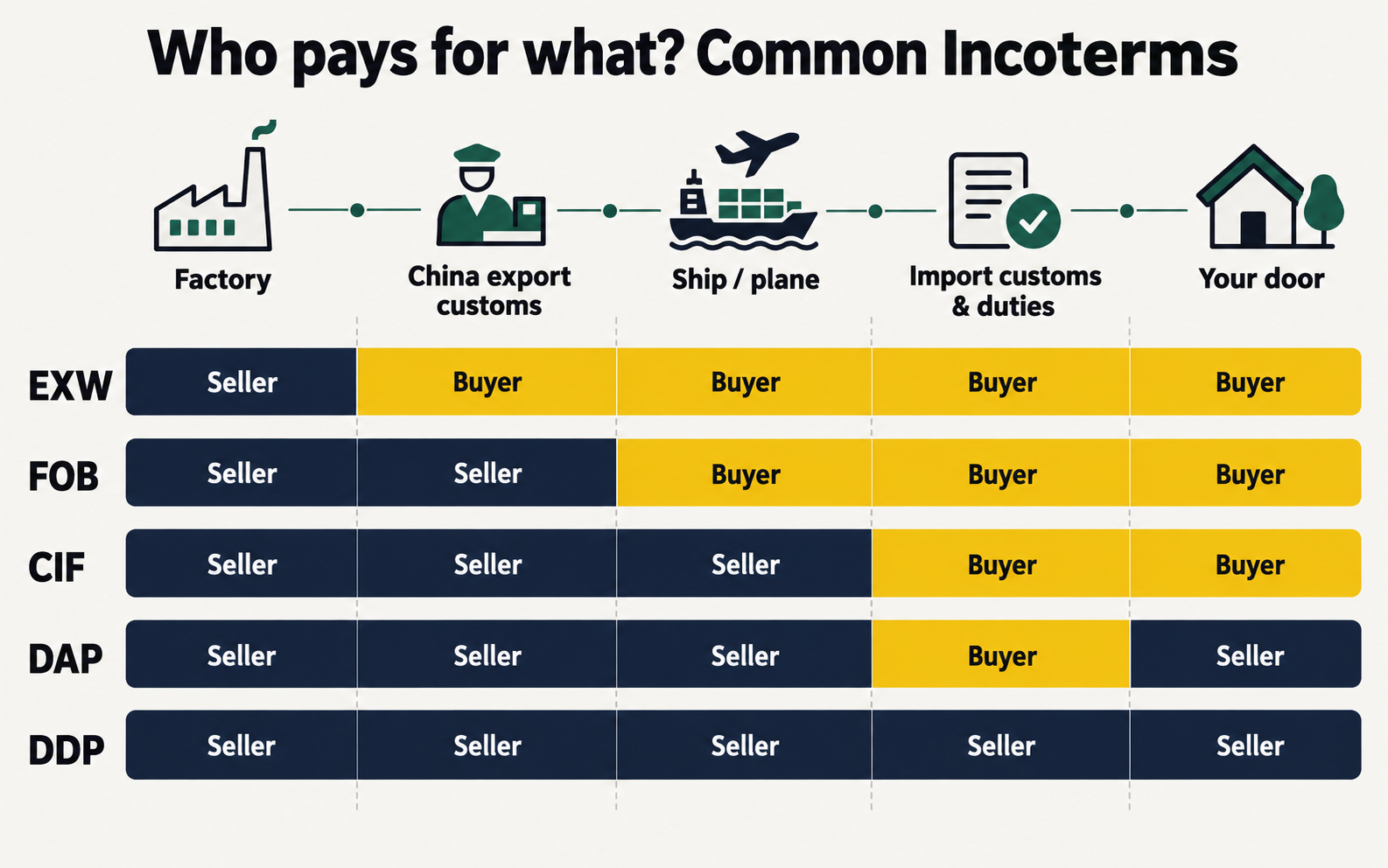
The terms you'll meet most often
EXW: Ex Works
The seller makes the goods available at their own factory or warehouse. That's it. You (or your forwarder) arrange everything else: pickup, loading, export customs clearance in China, freight, import and delivery.
- Pros: the lowest quoted price; full control of shipping.
- Watch out: export clearance from China normally needs a registered exporter. A foreign buyer can't easily do this alone, so in practice the factory or forwarder often handles it anyway. Many advisers suggest FCA instead for this reason.
FCA: Free Carrier
The seller clears the goods for export and hands them to your chosen carrier at an agreed place (for example, their factory dock or your forwarder's warehouse in Shenzhen). Risk passes at that handover.
- Good for: any transport mode, including air and courier. Often a cleaner choice than EXW.
FOB: Free On Board
The seller clears export and loads the goods on board the ship at a named port, for example "FOB Shenzhen" or "FOB Yantian" (Yantian and Shekou are major Shenzhen container ports). Risk passes once the goods are on board. You pay the sea freight and everything after.
- Very common in quotes from Chinese suppliers.
- Watch out: FOB is meant for sea and inland waterway transport. For air freight and courier, FCA is the correct term, although you'll still see "FOB" used loosely. Clarify what the supplier actually means.
CIF: Cost, Insurance and Freight
The seller pays the freight and a basic level of insurance to your destination port. But here's the catch: risk still passes to you when the goods are loaded in China, just like FOB. If something goes wrong at sea, you claim on the insurance the seller bought.
- Watch out: the default insurance level is minimal, and you have less control over the shipping line. Destination port charges are usually yours.
DAP: Delivered at Place
The seller pays to deliver the goods to a named place in your country (your office, your warehouse), ready to unload. You handle import customs clearance and pay duties and taxes.
DDP: Delivered Duty Paid
The seller does everything: freight, import customs clearance in your country, duties and taxes, and delivery to your door. It's the most "hands-off" term for the buyer.
- Pros: simplest for first-timers; one all-in price.
- Watch out: the seller (or their agent) acts as the importer, so ask who is the importer of record (the party legally responsible to your country's customs). Check that duties and taxes are correctly declared, because underdeclaring can create problems that land on you or your goods later. Also, the convenience is built into the price.
Side-by-side
| Term | Seller delivers to | Export clearance | Main freight | Import duties | Risk passes |
|---|---|---|---|---|---|
| EXW | Their factory | Buyer* | Buyer | Buyer | At factory |
| FCA | Your carrier, named place | Seller | Buyer | Buyer | At handover |
| FOB | On board ship, China port | Seller | Buyer | Buyer | On board |
| CIF | Your port (paid) | Seller | Seller | Buyer | On board in China |
| DAP | Your named place | Seller | Seller | Buyer | At your place |
| DDP | Your named place | Seller | Seller | Seller | At your place |
*In practice often handled by the factory or forwarder.
Which should a first-timer choose?
There's no single right answer. Common patterns:
- Samples and small courier shipments: suppliers often quote a delivered price, or you use your own courier account. Clarify who pays duties on arrival.
- First production shipments with a freight forwarder you trust: FOB (sea) or FCA (air), so you control the freight and can compare forwarder quotes.
- You have no forwarder and want simplicity: DDP, as long as you understand who the importer of record is and that taxes are declared properly.
Whatever you choose, write the named place exactly ("FCA Supplier warehouse, Bao'an, Shenzhen"), and ask your freight forwarder to confirm what their quote includes. Forwarders are the people who book space, handle paperwork and often clear customs for you. See Shipping from Shenzhen: sea vs air.
Common mistakes
- Comparing an EXW quote with a DDP quote as if they were the same.
- Forgetting destination charges (port fees, customs brokerage, local delivery) under FOB or CIF.
- Assuming CIF means the seller carries the risk until arrival.
- Not stating the Incoterms version or the exact named place.
Keep reading
- Shipping from Shenzhen: sea vs air
- How to write an RFQ
- Quality inspection explained
- How to choose a factory in China
Next steps
- Find logistics and freight services in the directory
- Read the contract manufacturing hub
- See the Logistics stage of the Path
- Glossary: 外贸 export trade
- Not sure where to start? Get an intro
Updated 29 September 2026