Run your thumb across a premium box and you'll often feel the logo before you see it. That raised or pressed-in shape is embossing or debossing. It adds a sense of quality without adding a single colour.
New to packaging? Start with How custom packaging is made.
The difference in one line
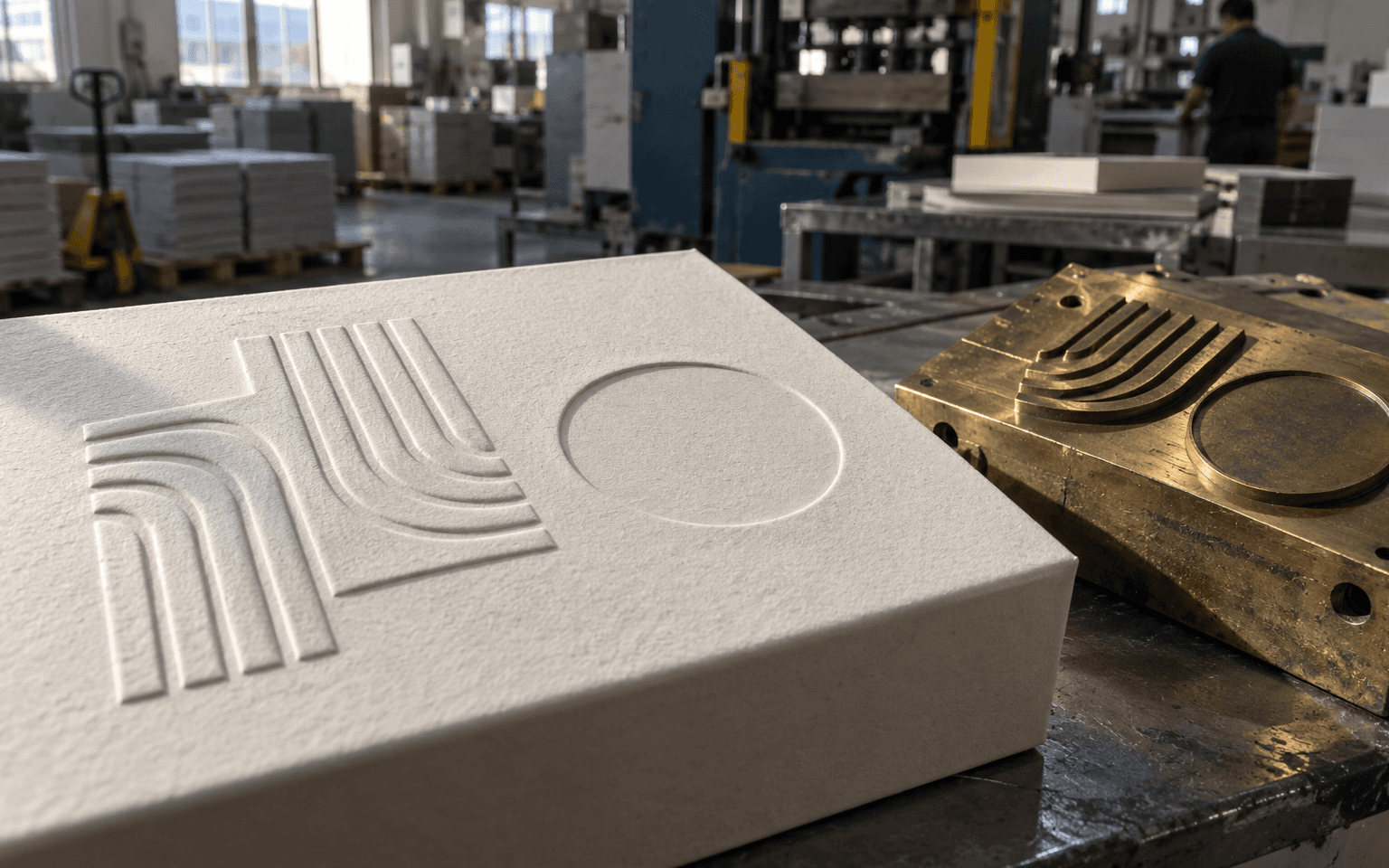
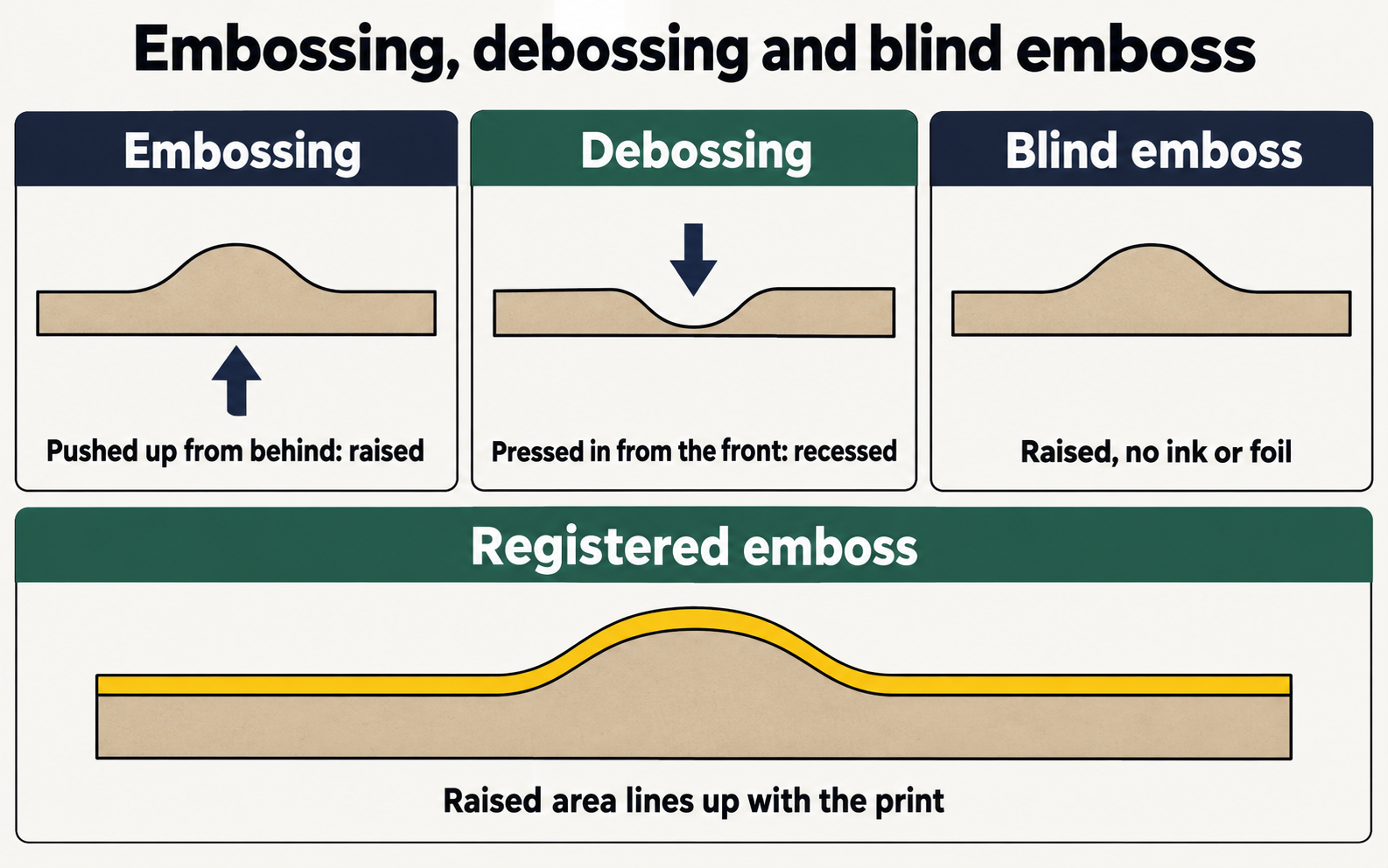
- Embossing (击凸, jītū) pushes the design up, so it stands above the surface.
- Debossing (压凹, yā'āo) presses the design down, so it sits below the surface.
Factories also say 凹凸 (āotū, "concave-convex") for the whole family of effects.
How it's done
Both use a matched pair of dies (阴阳模, yīnyángmó): one with the shape cut in, one with the shape standing out. The board goes between them and a press squeezes them together. No ink is involved; the board itself is reshaped.
For embossing, the shape is pushed up from the back. For debossing, it's pressed in from the front. It's a separate step after printing and lamination, just like hot foil stamping.
One thing first-timers don't expect: the other side changes too. An embossed logo on a folding carton leaves a matching dent on the inside of the box, and a debossed logo leaves a bump. Usually nobody minds, but if the inside is printed or visible, check it on the sample.
Blind, registered and foil emboss
- Blind emboss: raised with no ink or foil on it. The design is only visible through light and shadow. Very understated, often used on dark or matte boxes. With a Chinese factory, simply say you want 击凸 with no print or foil on that area.
- Registered emboss: the raised area lines up exactly with a printed shape, like a printed logo that also stands up. You can describe it as 对位击凸 (duìwèi jītū, "aligned emboss"). It needs accurate alignment, so allow a little tolerance in the design.
- Foil emboss: hot foil plus embossing, so the shiny logo is also raised. Can be done in two steps or in one with a combination die (立体烫金).
- Deboss with foil or spot UV: a pressed-in logo filled with foil or a gloss coat, a common look on rigid box lids.
Emboss or deboss: which to choose?
| Embossing (击凸) | Debossing (压凹) | |
|---|---|---|
| Effect | Raised, catches light on top | Recessed, shadow inside the shape |
| Feel | Stands out under the thumb | Subtle, pressed-in |
| Best for | Bold logos, simple shapes, larger text | Simple marks on thick or rigid board |
| Inside of box | Dent on the reverse | Bump on the reverse |
| Board | Needs board that stretches without cracking | Works well on thick boards and rigid box wraps |
| Pairs well with | Foil, registered print | Foil or spot UV filling the recess |
Neither is "better". Embossing is more eye-catching; debossing is quieter. Many designers pick whichever reads better on their artwork once they see a physical sample.
Design rules that save you a reprint
- Keep shapes simple. Bold logos and larger text work best. Tiny text and hairlines lose definition. Ask the factory for their minimum line width and text height.
- Stay away from folds and edges. Keep embossed areas a few millimetres from crease lines and cut edges, or the box may not fold cleanly.
- Mind the board. Thicker, more flexible boards emboss more deeply. Very stiff or heavily coated surfaces can crack along sharp edges, and laminated film can whiten at the edges of a deep emboss. Ask for a test on your actual board and lamination.
- Depth is limited. How high or deep you can go depends on board and design; the factory will tell you what's realistic.
- Multi-level (sculpted) embossing gives a rounded, 3D shape instead of a flat raised plateau. It needs a more complex, hand-finished die and costs more.
- Put the emboss area on its own artwork layer as a solid shape, labelled clearly.
What drives the cost
Embossing and debossing are usually priced as a die charge plus a per-box charge. The cost goes up with:
- Die size and complexity: sculpted multi-level dies cost more than flat single-level ones.
- Combining with foil (two dies and two passes, or one more expensive combination die).
- Registration: aligning emboss to print takes more set-up and checking.
- Small quantities, because set-up is spread over fewer boxes.
Dies can usually be reused on reorders. Ask the factory to keep them.
Check it on the printed sample
Embossing is a feel, not a colour, and a PDF proof can't show it. Approve depth, sharpness and alignment on a physical printed sample. See how packaging proofing works.
FAQ
Is embossing more expensive than debossing? They're priced in a similar way: a die plus a pass. Cost depends more on size, depth, complexity and whether foil is added than on the direction.
What is blind embossing? Embossing with no ink or foil on the raised area, so it's seen only through shadow.
Can you emboss a corrugated mailer box? It's harder, because the fluted middle layer crushes. Some suppliers can do it on the outer liner. Folding cartons and rigid boxes give much crisper results.
Can you emboss on soft-touch lamination? Often yes, but the film may stretch or mark at sharp edges. Test first.
Key words
| English | Chinese | Pinyin |
|---|---|---|
| Embossing | 击凸 | jī tū |
| Debossing | 压凹 | yā āo |
| Emboss/deboss in general | 凹凸 | āo tū |
| Matched male/female dies | 阴阳模 | yīn yáng mó |
| Registered emboss | 对位击凸 | duì wèi jī tū |
| Foil + emboss | 立体烫金 | lì tǐ tàng jīn |
Keep reading
- How custom packaging is made (pillar)
- What is hot foil stamping?
- Spot UV, soft-touch and lamination
- Rigid box vs folding carton vs mailer box
Next steps
- Read the packaging hub
- Browse packaging suppliers
- See the Packaging stage of the Path
- Glossary: 击凸 embossing, 压凹 debossing
- Not sure where to start? Get an intro
Updated 3 October 2026