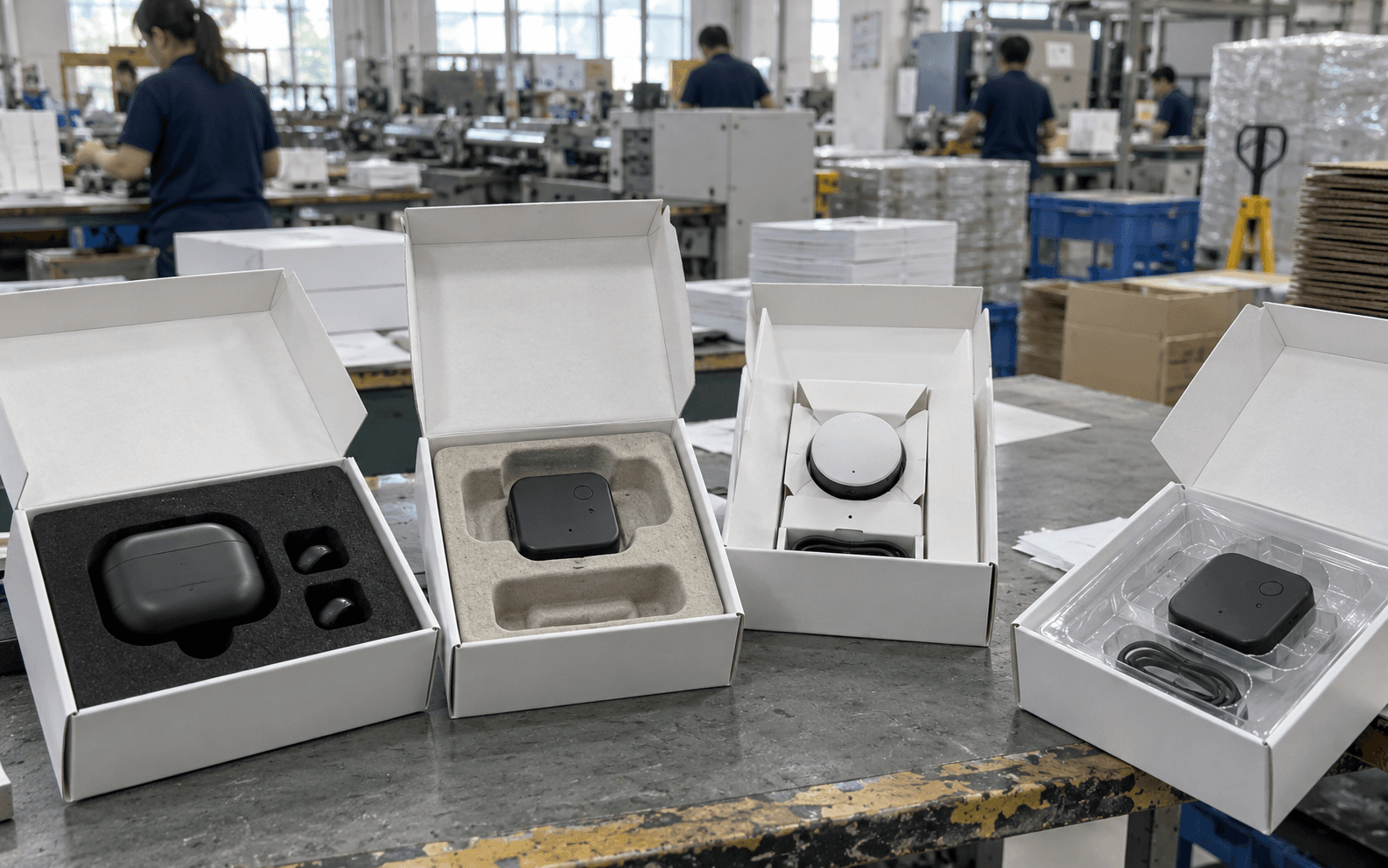
The shiny gold logo on a perfume box, the silver product name on a headphone box: that bright, mirror-like metal is almost always hot foil stamping. Ink can't really do it. Even "metallic" inks look flat and grey next to foil.
On a Chinese quote you'll see it as 烫金 (tàngjīn, "hot gold"), even when the foil is silver. Silver is sometimes written 烫银 (tàngyín).
New to packaging? Start with How custom packaging is made.
How it works
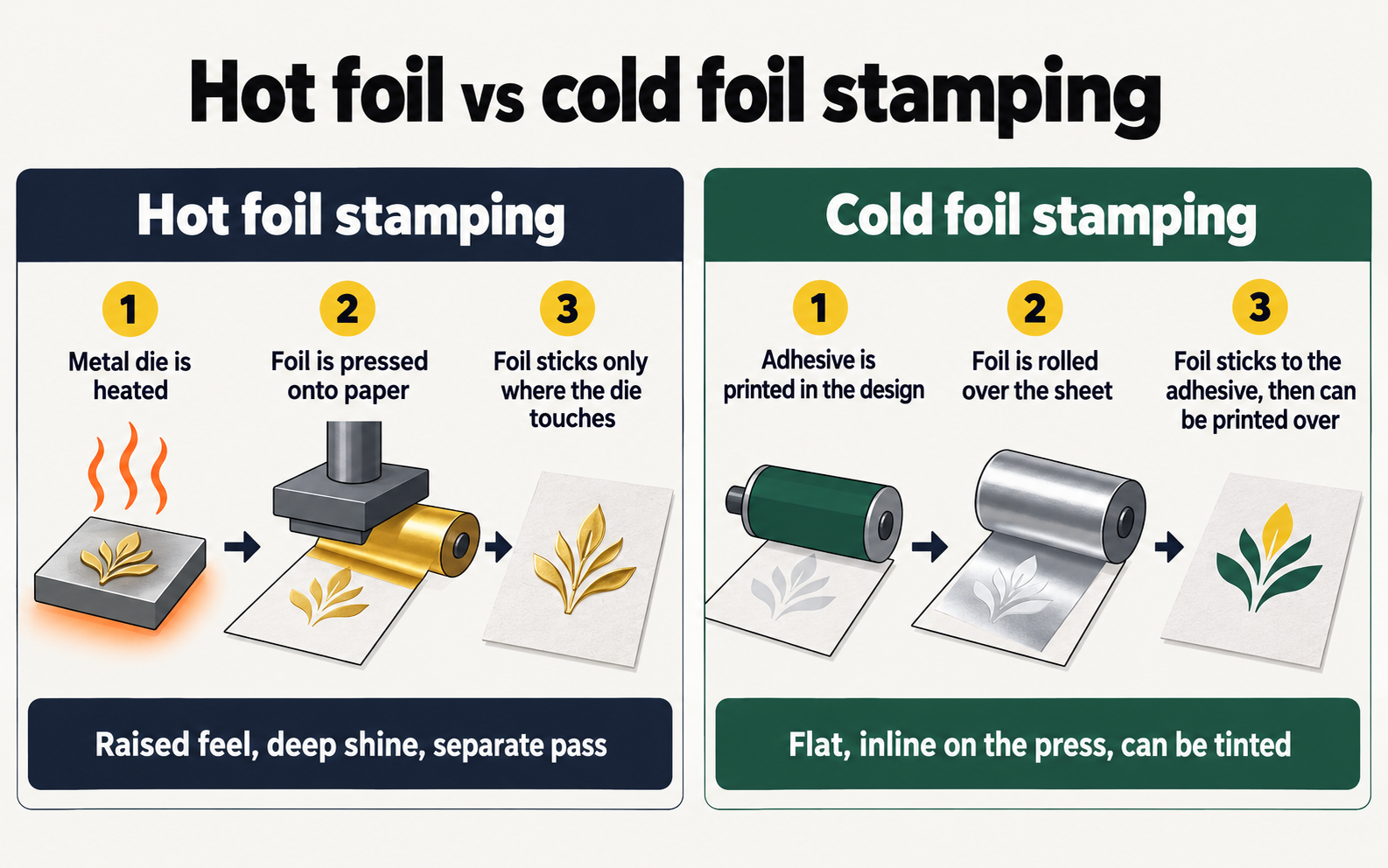
Hot foil stamping needs three things:
- A die: a metal plate with your design raised on it, like a rubber stamp made of metal. In Chinese, 烫金版 (tàngjīnbǎn).
- Foil: a roll of very thin film carrying a metallic layer and a heat-activated glue. Chinese factories often call it 电化铝 (diànhuàlǚ).
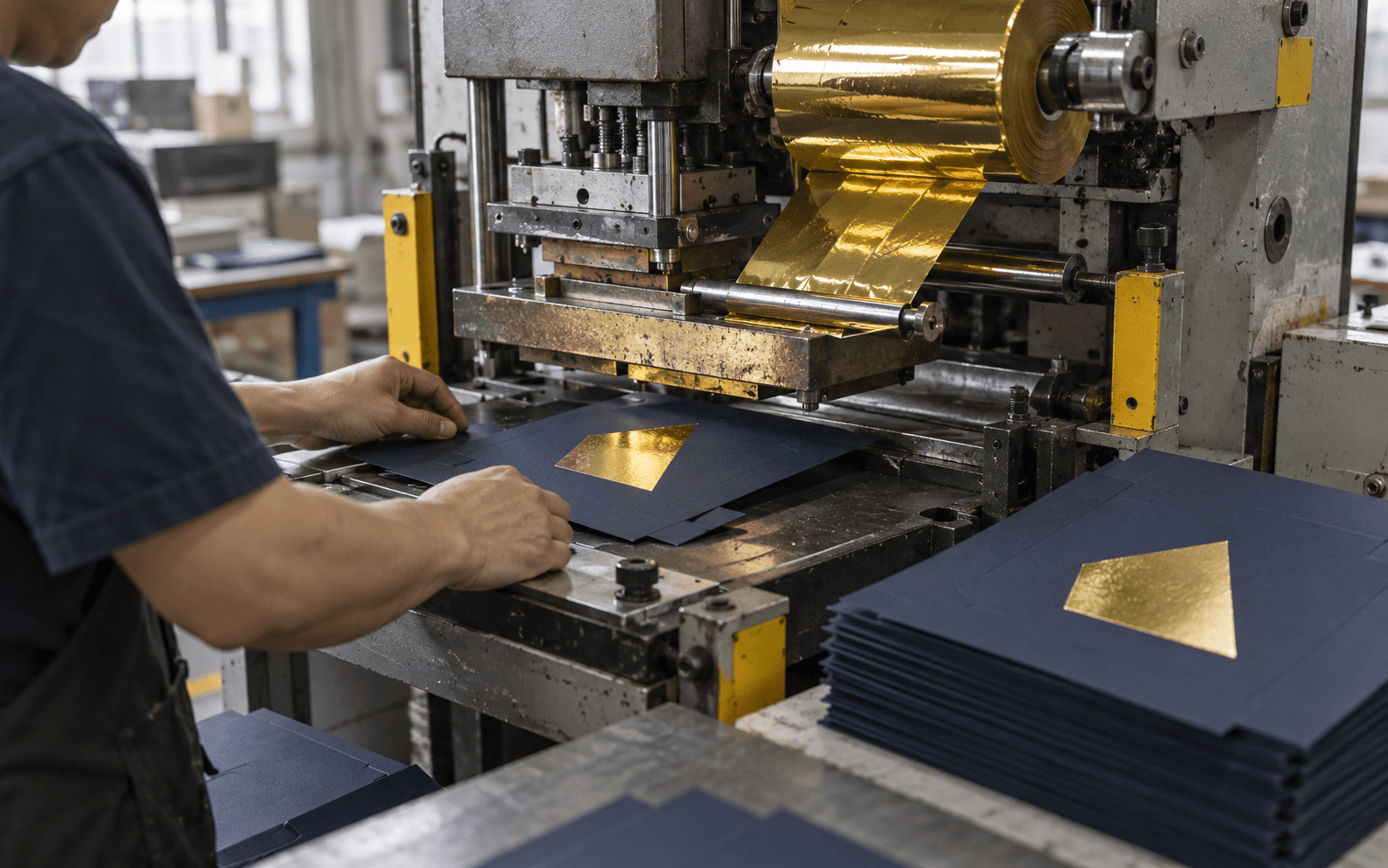
- Heat and pressure: a stamping machine heats the die and presses it through the foil onto the board.
Where the hot die touches, the glue melts and the metal layer lets go of its carrier film and sticks to the board. Everywhere else, the foil stays on the film and winds away as waste. The result is a crisp, very shiny design that sits very slightly pressed into the surface.
It's a separate step after printing (and usually after lamination), done on its own machine.
Foil types you can ask for
- Metallic: gold, silver, rose gold, copper and many other shades. Gloss is standard; matte or brushed versions exist.
- Holographic (镭射, léishè): a rainbow, laser-like effect.
- Pigment foils: solid non-metallic colours such as white, black or red, used when you want a crisp, opaque colour on dark board.
Ask your supplier to show you their foil swatch book, and choose from a physical sample, not a screen.
Which designs foil well
Hot foil is best at logos, short text, lines and simple shapes. A few rules of thumb:
- Very fine lines and tiny text can fill in or break up. Ask the factory for their minimum line width and text size, and test it on the printed sample.
- Large solid areas are harder. Big flat panels of foil can show small bubbles, specks or patchy shine. If you want a big foil area, ask whether it's better done as a foil board, a metallised paper, or cold foil.
- Gaps between foil and print need some tolerance. Foil is a separate pass, so it can land a fraction off the printed artwork. Don't design a thin printed outline that must sit exactly around a foil logo.
- One die per foil colour. Gold and silver on the same box means two dies and two passes.
- Surface matters. Foil sticks well to most coated boards and to many matte laminations. Textured or soft-touch surfaces may need a specific foil; ask before you design.
Foil plus embossing
Hot foil is often combined with embossing, raising the foiled logo above the surface. This can be done as two steps (foil, then emboss with a matching die) or in one step with a sculpted combination die. In Chinese you may hear 立体烫金 (lìtǐ tàngjīn, "3D foil"). It looks premium but adds tooling and needs careful alignment.
Hot foil vs other "shiny" options
| Option | What it looks like | When it makes sense |
|---|---|---|
| Hot foil (烫金) | Real metal shine, very slightly pressed in | Logos and text on premium boxes |
| Cold foil | Flat metallic, can be printed over in colours | Larger metallic areas, long press runs |
| Metallic ink | Duller, grey-ish shine | Lowest cost, no extra tool |
| Spot UV | Clear gloss, no metal colour | Subtle shine on matte boxes |
What drives the cost
Hot foil is usually priced as a one-time die charge plus a per-box stamping charge. The die charge depends on its size and material. Chinese factories commonly offer zinc (锌版) or copper (铜版) dies; copper is generally sharper and lasts longer, and costs more.
Things that push the price up:
- Larger foil area (bigger die, more foil)
- More foil colours (one die and one pass each)
- Combining foil with embossing
- Special foils such as holographic
- Small quantities, because set-up is spread over fewer boxes
On reorders the die can often be reused, so ask the factory to keep it and note it on your order.
How to specify it
- Put each foil area on its own layer in your artwork file, as 100% of one solid swatch colour, named something like "FOIL-GOLD".
- State the foil colour with the supplier's foil code from their swatch book.
- Say whether it's foil only or foil plus emboss.
- Check the foil on the printed sample (彩样, cǎiyàng), not only on a digital proof. A PDF can't show shine. See how packaging proofing works.
FAQ
Is foil stamping the same as hot stamping? Yes. "Foil stamping", "hot stamping", "hot foil" and "foil blocking" (common in the UK) all describe the same process.
Does hot foil scratch off? It's quite durable on a coated or laminated box, but sharp objects can scratch it. It holds up better than metallic ink.
Can you hot foil on kraft or recycled board? Often yes, though rough surfaces give a less perfect shine. Ask for a test on your actual board.
Is hot foil recyclable? The foil layer is extremely thin. Recycling rules differ by country, so check the guidance for your market if this matters to your brand.
Key words
| English | Chinese | Pinyin |
|---|---|---|
| Hot foil stamping | 烫金 | tàng jīn |
| Silver foil | 烫银 | tàng yín |
| Foil die | 烫金版 | tàng jīn bǎn |
| Hot stamping foil | 电化铝 | diàn huà lǚ |
| Holographic | 镭射 | léi shè |
| Foil + emboss | 立体烫金 | lì tǐ tàng jīn |
Keep reading
- How custom packaging is made (pillar)
- Hot foil vs cold foil stamping
- Embossing vs debossing
- Spot UV, soft-touch and lamination
Next steps
- Read the packaging hub
- Browse packaging suppliers
- See the Packaging stage of the Path
- Glossary: 烫金 hot foil stamping, 击凸 embossing
- Not sure where to start? Get an intro
Updated 3 October 2026