Turn over almost any electronics box and you'll find a cluster of small symbols, a barcode and some fine print. Some of it is legally required, some is required by retailers, and some is just helpful. For a first product, it's easy to design a beautiful box and then discover there's no room left for the marks it needs.
This guide explains the common ones in plain words so you can plan space for them early.
Important: this is general background, not legal advice. Requirements depend on your product type, your sales markets and current regulations, and they change. Confirm what applies with your test lab, certification consultant, importer or retailer before you print.
New to packaging? Start with How custom packaging is made.
Product marks vs packaging marks
Many regulatory marks belong on the product itself first. Packaging and the manual are often where information goes when the product is too small, or where it must be repeated. So treat the box as one part of a system: product label, box, manual and shipping carton together.
Conformity marks
These show the product meets the rules of a market. You can only use them after the product actually meets those rules, which usually involves testing and documentation. See the Certification stage of the Path.
- CE mark (Europe): shows the manufacturer declares the product meets the applicable EU rules (for electronics, typically things like electrical safety, EMC, radio and RoHS). It normally goes on the product; if that's not possible, on the packaging and accompanying documents.
- UKCA mark (Great Britain): the UK's own conformity mark. Whether CE is also accepted in Great Britain depends on the product type and current UK rules, so check.
- FCC (United States): most electronics must meet FCC rules on radio-frequency emissions. Devices with radios (Wi-Fi, Bluetooth, cellular) need an FCC ID on the product or, in some cases, an electronic label. The FCC logo itself is optional for many devices. Required compliance statements often go in the manual.
- Other markets have their own marks, such as Canada's ISED requirements or Japan's radio certification. List your markets early.
Environmental and recycling symbols
- Crossed-out wheelie bin (WEEE symbol): tells EU consumers not to throw the product in household rubbish. It normally goes on the product; on packaging, the manual or warranty if the product is too small. A black bar under the bin shows the product was placed on the market after 2005.
- Battery symbols: batteries have their own separate-collection marking, sometimes with chemical symbols. Battery rules in the EU are being updated, so check the latest requirements for your product.
- Recycling symbols for the packaging itself: the Mobius loop (three chasing arrows) says a material is recyclable or contains recycled content. Plastic parts often carry a resin code (a number 1–7 in a triangle). Paper and board are sometimes marked with a material code like "PAP 21".
- Country-specific packaging labels: some countries require their own recycling information on packaging. France, for example, requires the Triman logo with sorting instructions, and Italy has mandatory environmental labelling of packaging. Check each market you sell into.
- The Green Dot: a symbol linked to packaging recycling schemes in some countries. Only use it if you're part of a scheme that licenses it.
Don't add symbols "just in case". Using a mark you aren't entitled to can cause problems with customs or retailers.
Identity and traceability information
Markets commonly expect the packaging or product to show:
- Manufacturer name and contact address (and often a website or email).
- Importer name and address, for imported goods in some markets such as the EU. Your importer or EU representative will tell you what to print.
- Model name or number, and batch or serial number, so the product can be identified and traced.
- Country of origin, for example "Made in China". US customs, for instance, generally requires imported goods to be marked with their country of origin.
Barcodes
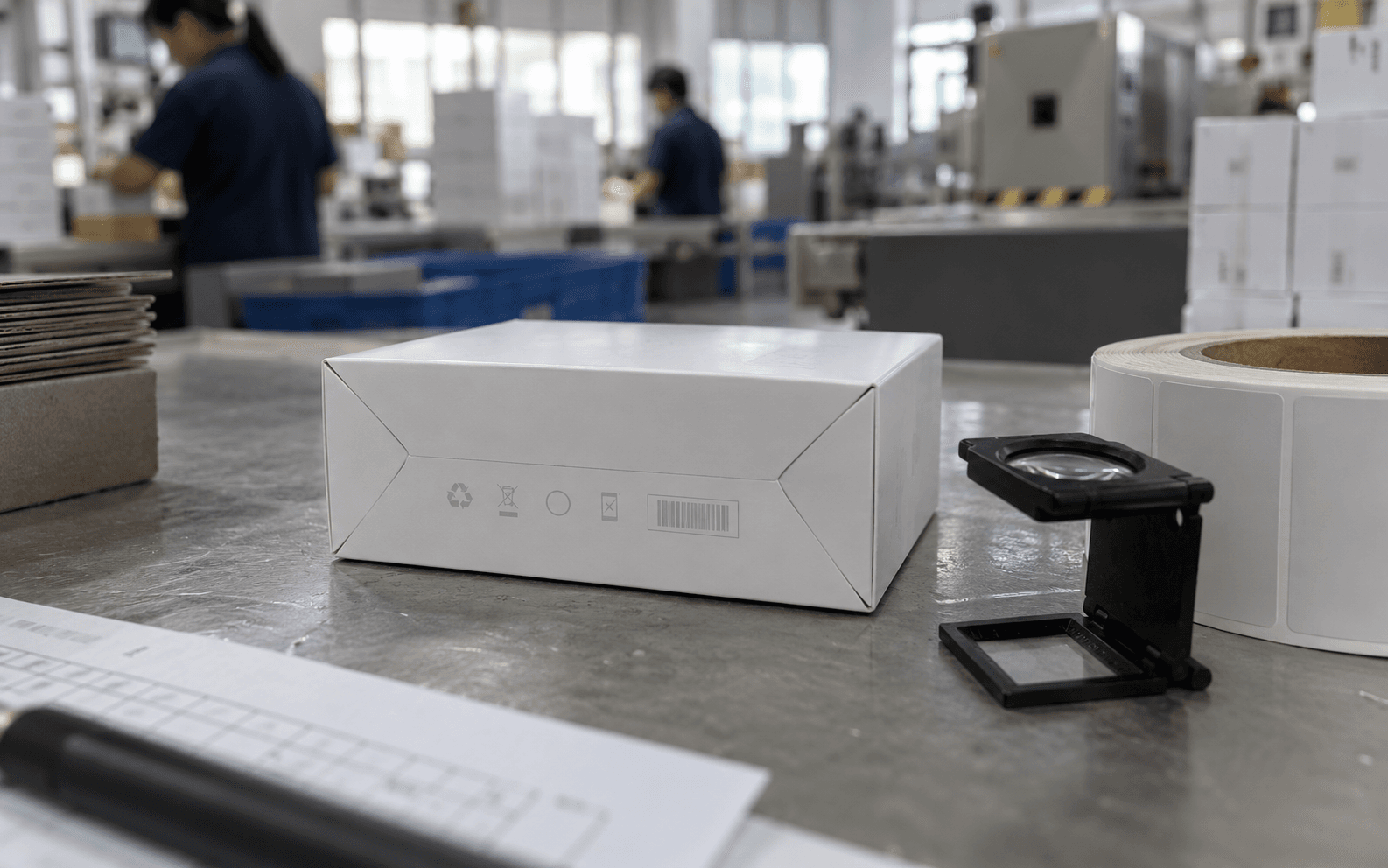
Retailers and marketplaces scan a barcode (条码, tiáomǎ) to identify each product. The number behind it is a GTIN (Global Trade Item Number), shown as a UPC (common in the US and Canada) or EAN (common elsewhere).
- Get your numbers from GS1, the organisation that issues them, or as your retailer requires. Numbers bought from unofficial resellers can be rejected by large retailers.
- Each product variant (colour, region, bundle) needs its own number.
- Print it large enough, dark on a light background, with clear white space around it (the "quiet zone"). Don't place it over a fold, over foil, or on a curved edge. Ask the factory to check scanning on the printed sample.
Handling symbols and carton marks
The plain shipping carton (外箱) carries its own information, often called carton marks or shipping marks (箱唛, xiāngmài):
- product name and model, quantity per carton
- gross and net weight, carton dimensions
- carton number (e.g. "3 of 40"), country of origin
- handling symbols such as This Way Up, Fragile and Keep Dry, standardised in ISO 780.
Products with lithium batteries have extra shipping labels and documents. Your freight forwarder will tell you what's needed for air or sea (see Shipping from Shenzhen: sea vs air).
Planning it into your box
- List your markets before artwork starts.
- Ask your test lab or certification consultant which marks and statements apply.
- Ask your retailer or marketplace for their packaging and barcode requirements.
- Reserve a panel (usually the bottom or back) for regulatory information, and leave room for multiple languages if needed.
- Get vector files of each symbol from the official source, not from a web image search.
- Check minimum sizes for each mark; some rules set them.
- Proof everything on the printed sample, including barcode scans. See how proofing works.
FAQ
Do I have to put the CE mark on the box? Usually it must be on the product. The box and documents become important when the product is too small or as an extra place to show it. Check with your certification partner.
Is the FCC logo required? For many devices it's now optional, but an FCC ID is required on radio devices. Confirm for your product.
Can I just copy the symbols from another product's box? No. Each mark depends on your product's own testing, materials and markets.
Key words
| English | Chinese | Pinyin |
|---|---|---|
| Barcode | 条码 / 条形码 | tiáo mǎ / tiáo xíng mǎ |
| Carton marks | 箱唛 | xiāng mài |
| Shipping carton | 外箱 | wài xiāng |
| Label / sticker | 标签 / 贴纸 | biāo qiān / tiē zhǐ |
| Certification | 认证 | rèn zhèng |
| Country of origin | 原产地 | yuán chǎn dì |
Keep reading
- How custom packaging is made (pillar)
- What is a dieline? Dielines, white samples and printed proofs
- Rigid box vs folding carton vs mailer box
- Quality inspection explained
Next steps
- Read the packaging hub
- Browse packaging suppliers and testing and certification labs
- See the Packaging stage and Certification stage of the Path
- Not sure where to start? Get an intro
Updated 3 October 2026