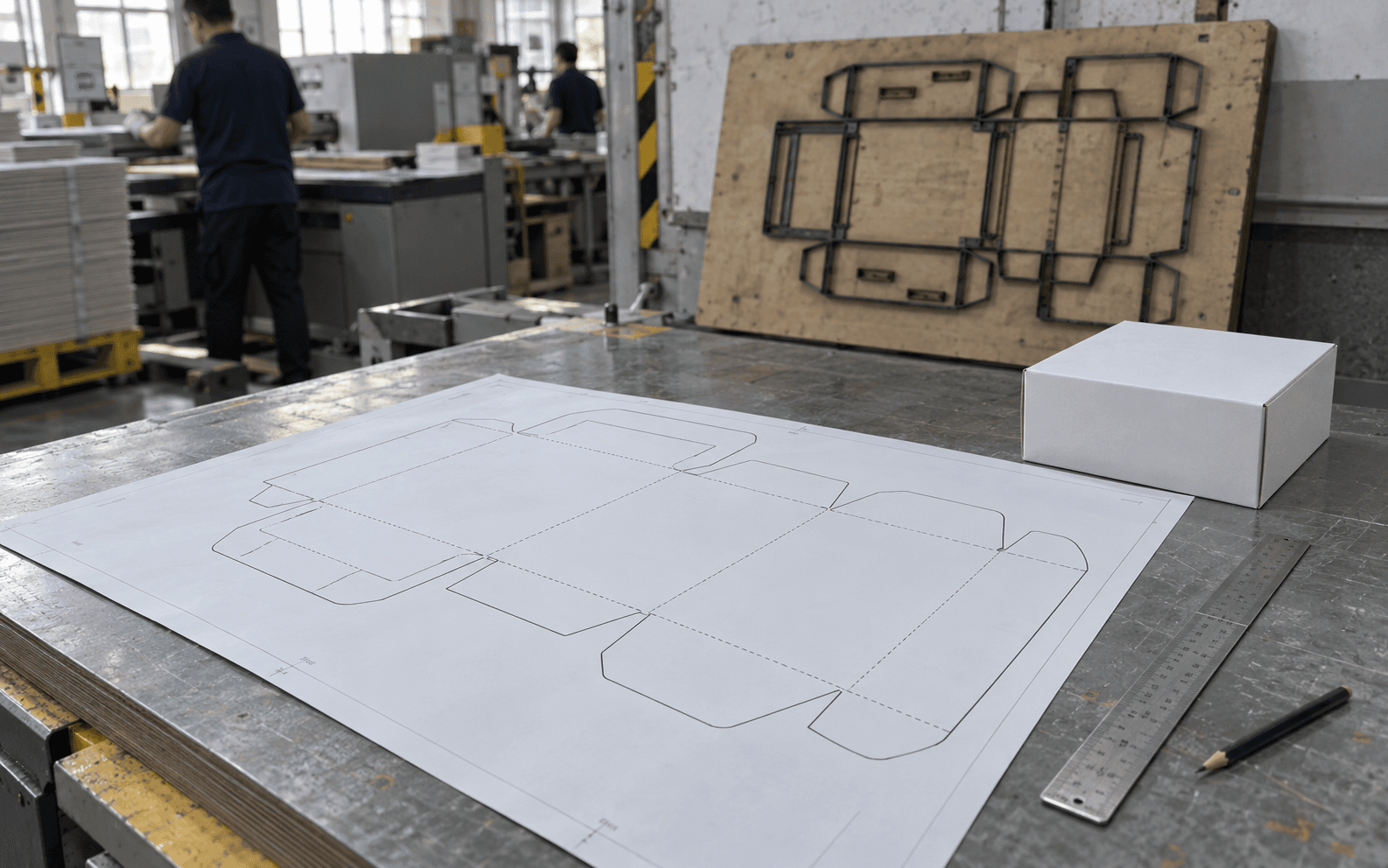
Every printed box starts as a flat drawing called a dieline. Get it right and the artwork wraps neatly around the box. Get it wrong and your logo ends up split across a fold, or the product doesn't fit.
This guide explains what a dieline is, how to work with one, and how box samples and proofs are approved, step by step. New to packaging? Start with How custom packaging is made.
What is a dieline?
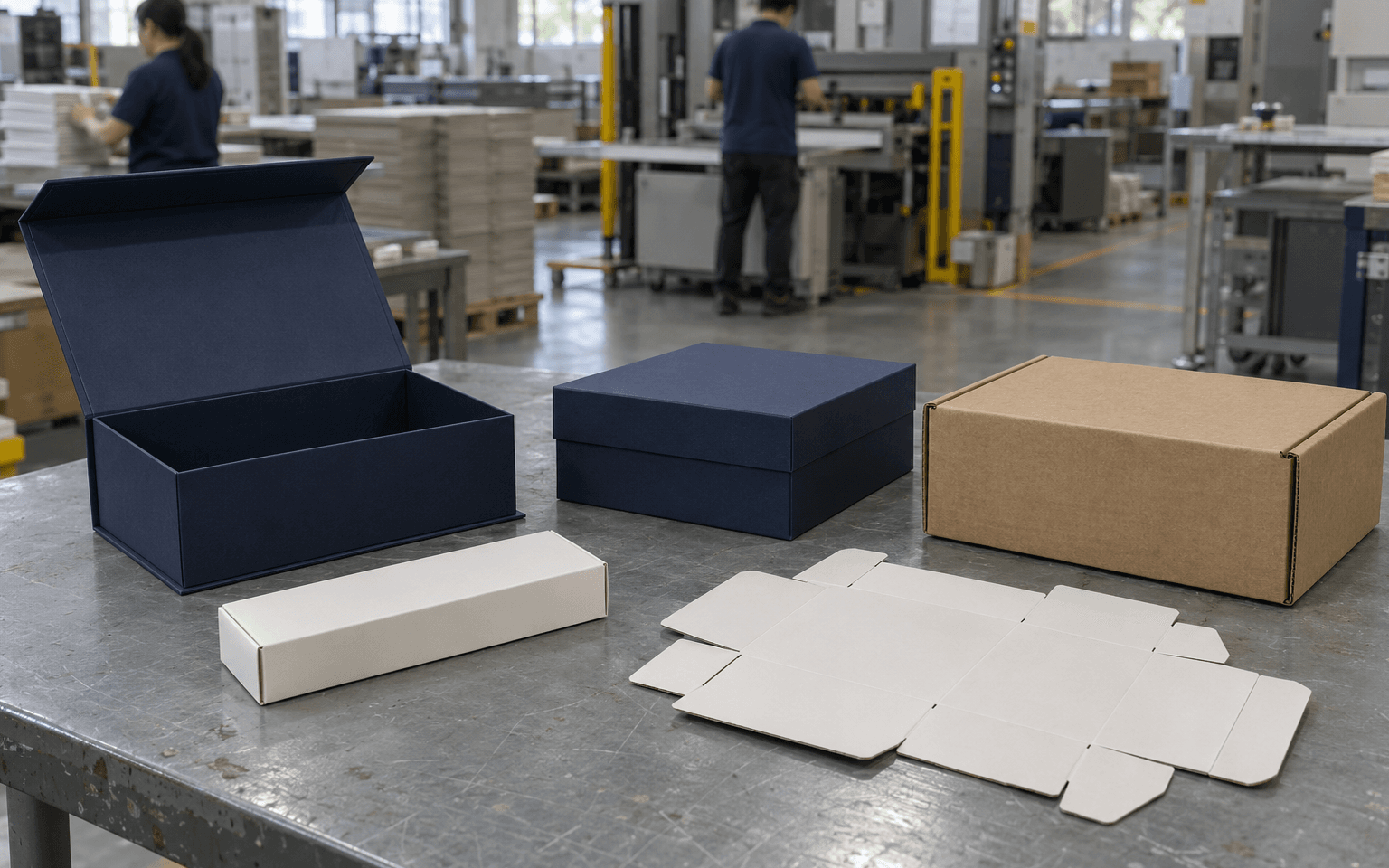
A dieline is the box drawn flat, as if you carefully unfolded it and laid it on a table. It shows every panel, flap and tab, and marks:
- where the board will be cut,
- where it will be creased (pressed so it folds cleanly),
- and where glue goes.
It's called a dieline because it's used to make the cutting die: a wooden board with sharp steel rules bent into the box outline, which stamps out each box like a cookie cutter. In Chinese, the drawing is 刀版图 (dāobǎntú) and the die itself is 刀模 (dāomó) or 啤板 (píbǎn, from Cantonese).
Reading a dieline
Every factory has its own colour conventions, so always check the legend on their file. Common elements:
| Line or area | What it means | Typical look |
|---|---|---|
| Cut line | Board is cut through here | Solid line |
| Crease or fold line | Board is pressed to fold here | Dashed line |
| Perforation | Tear-off line, like a tear strip | Dash-dot line |
| Bleed | Extra artwork beyond the cut line | Outer boundary, often 3 mm out |
| Safe zone | Keep text and logos inside this | Inner boundary |
| Glue area | Where panels are glued; no ink or coating | Shaded or hatched |
Bleed matters because cutting is never perfectly exact. If background colour stops exactly at the cut line, a tiny shift leaves a white edge. Extending it past the line (a few millimetres; 3 mm is common, confirm with your printer) hides that. In Chinese this is 出血 (chūxuè).
The safe zone is the opposite: keep important text a few millimetres inside the cut and fold lines so nothing gets trimmed or lands on a fold.
Who makes the dieline?
Usually the box factory. You give them the product's dimensions (or a real unit), the box style and the board, and their structural team draws it. That's the safest route, because they know how their board and machines behave. Some factories, and online box makers, also offer standard templates.
Two details to get right when you brief them:
- Inside vs outside dimensions. Box sizes are usually given as inside dimensions (内尺寸, nèichǐcùn): length × width × height of the space inside. Board thickness adds to the outside size. Always say which you mean.
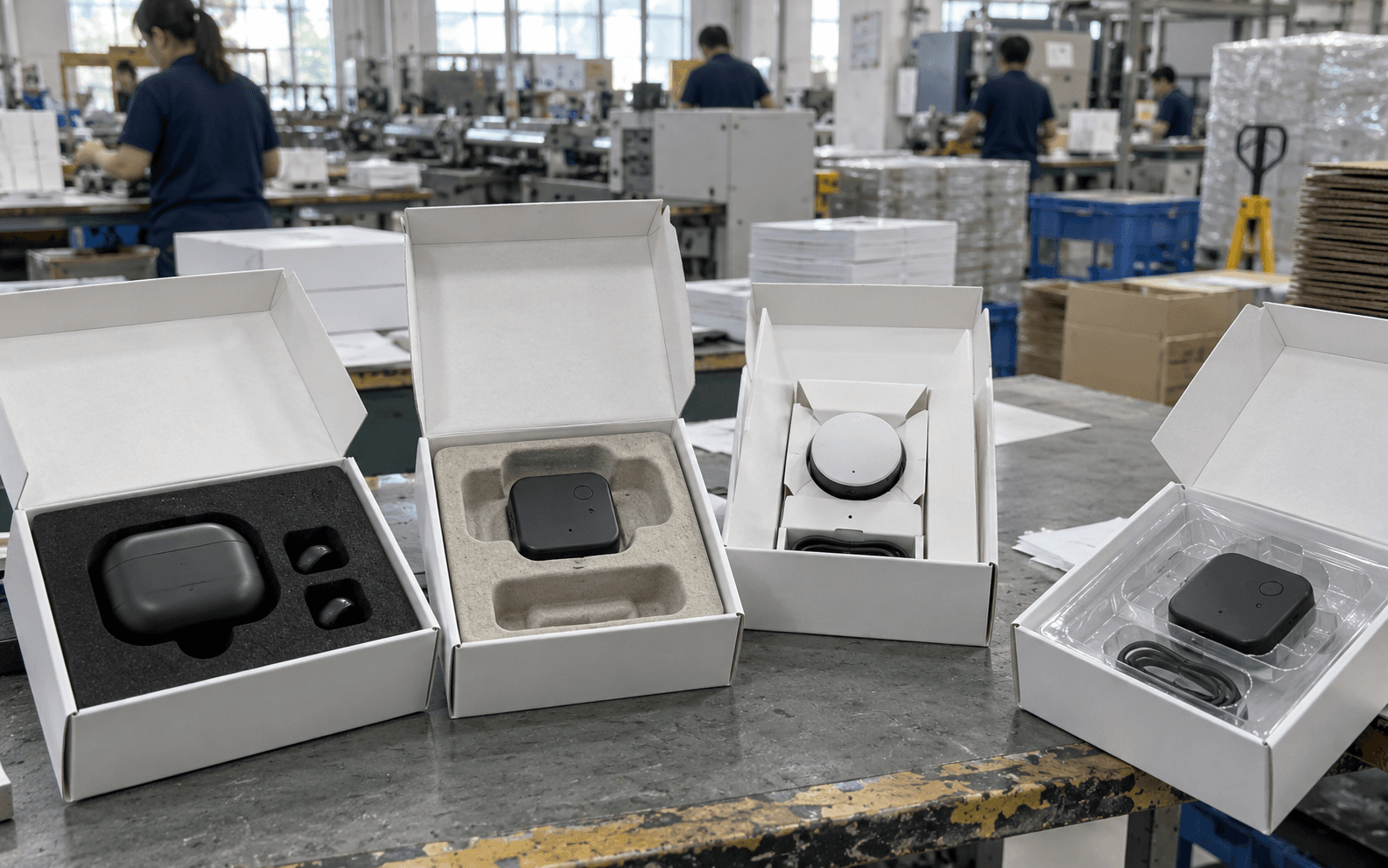
- Leave room for the insert. The box size depends on the insert, not just the product. Design them together (see Packaging inserts for electronics).
Putting artwork on the dieline
- Get the factory's file. Usually AI or PDF; some Chinese factories work in CorelDRAW (CDR) or send DXF. Ask for AI or PDF if your designer uses Adobe tools.
- Keep the dieline on its own layer, locked and set not to print.
- Artwork on a separate layer, extended into the bleed.
- Each special finish on its own layer: foil, spot UV, emboss, white ink. Use a solid spot swatch and name it clearly. See Spot UV, soft-touch and lamination.
- Check orientation. Text on the top flap, back panel and bottom often ends up upside down. Print the dieline on paper, cut it out and fold it: the fastest check there is.
- Leave glue areas clear of ink and coating so glue sticks.
- Convert to CMYK and name any Pantone colours. See Offset vs digital printing for boxes.
- Outline fonts and embed images at print resolution, as the factory asks.
How proofing works: from PDF to signed sample
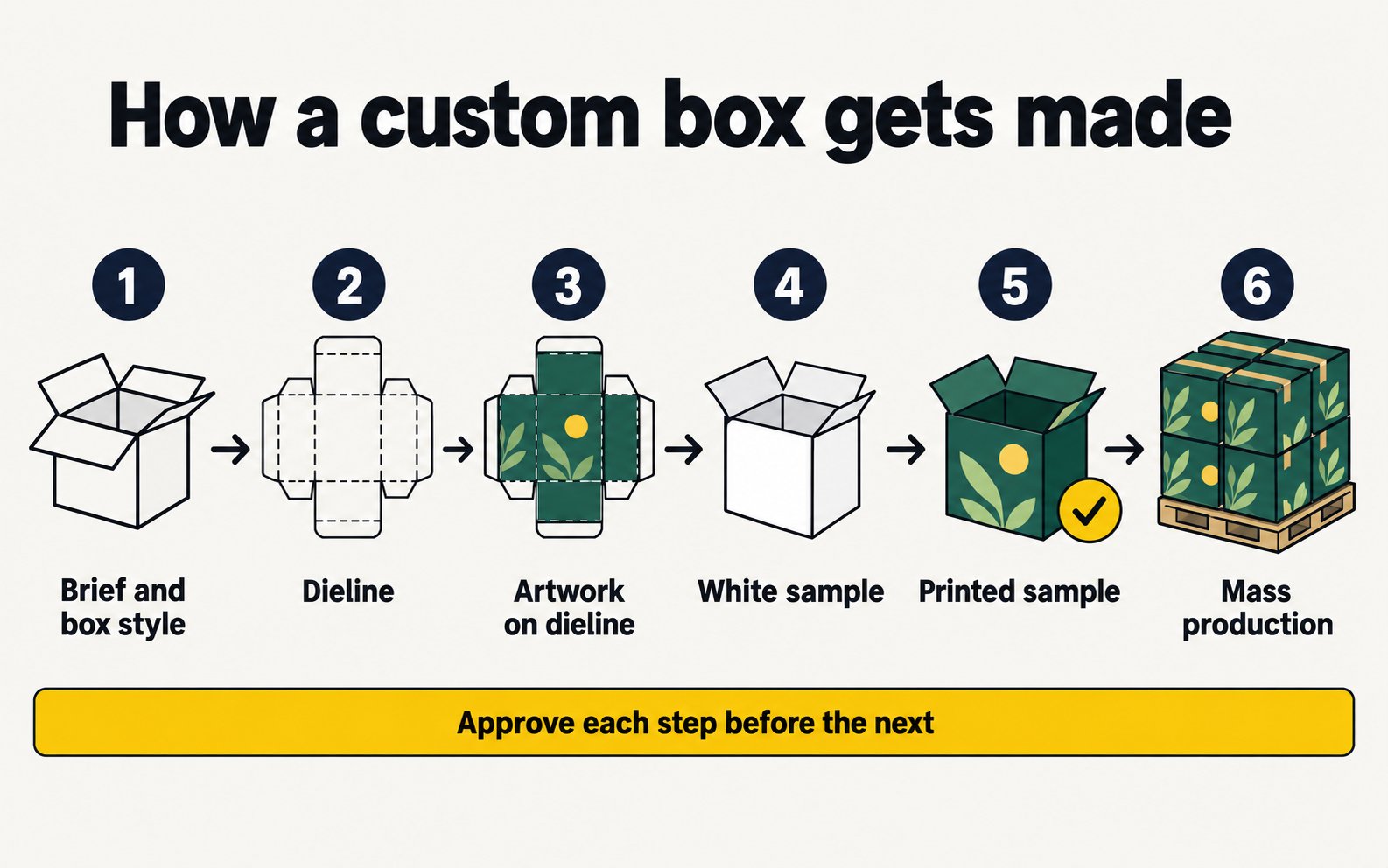
Proofing is a ladder. Each step is cheaper to fix than the next.
1. PDF proof (电子稿, diànzǐgǎo)
The factory sends back your artwork placed on their final dieline, sometimes with their prepress changes. Check text, barcodes, positions and every finish layer. A PDF can't show colour accurately, or foil, or feel.
2. White sample (白样, báiyàng)
A white sample is the real box structure in the real board, with no printing. It's for fit and function:
- Does the product and insert fit snugly?
- Do the flaps close well? Does the lid lift easily?
- Does it survive a drop?
- Is it the right size for the shipping carton?
This is the cheapest point to change the structure. Ask for two or three if you want to test variations.
3. Digital proof (数码样, shùmǎyàng)
Some factories offer a box printed on a digital press. It's useful for checking layout and overall look, but colours and finishes won't exactly match the final offset run.
4. Printed sample (彩样 or 印刷样)
The full box with real printing and finishes, ideally on the production press and board. This is where you approve colour, foil, emboss, spot UV and overall quality. View it under consistent light, compare it to your colour references, and mark up anything you want changed.
5. Signed sample (签样, qiānyàng)
When it's right, sign and date one or more samples. The factory keeps one and you keep one. It becomes the standard every production box is checked against, like a golden sample. At the production stage, you or an inspector can compare boxes against it (see Quality inspection explained).
Timing and cost
- White samples are often quick to make, while printed samples take longer because plates, dies and finishing tools may be needed (typical, confirm with your supplier).
- Factories often charge for samples. Some credit the cost against a production order; ask.
- Every change after a printed sample can mean new plates or tools, and another sample round. Most delays come from late artwork changes, so lock text and regulatory marks early (see Packaging labels and markings).
FAQ
What's the difference between a dieline and a mockup? A dieline is the flat technical drawing used for production. A mockup is a 3D render or physical model showing what the finished box will look like.
Can I make my own dieline? You can, with packaging CAD tools or templates, but the factory will usually redraw or adjust it for their board and machines. Starting from their dieline saves time.
Is a white sample free? Policies vary. Expect to pay something, especially for rigid boxes.
Key words
| English | Chinese | Pinyin |
|---|---|---|
| Dieline drawing | 刀版图 | dāo bǎn tú |
| Cutting die | 刀模 / 啤板 | dāo mó / pí bǎn |
| Bleed | 出血 | chū xuè |
| Inside dimensions | 内尺寸 | nèi chǐ cùn |
| PDF proof | 电子稿 | diàn zǐ gǎo |
| White sample | 白样 | bái yàng |
| Printed sample | 彩样 / 印刷样 | cǎi yàng / yìn shuā yàng |
| Signed sample | 签样 | qiān yàng |
Keep reading
- How custom packaging is made (pillar)
- Rigid box vs folding carton vs mailer box
- Offset vs digital printing for boxes
- Packaging labels and markings for electronics
Next steps
- Read the packaging hub
- Browse packaging suppliers
- See the Packaging stage of the Path
- Glossary: 刀版 dieline, 白样 white sample, 签样 sample sign-off
- Not sure where to start? Get an intro
Updated 3 October 2026