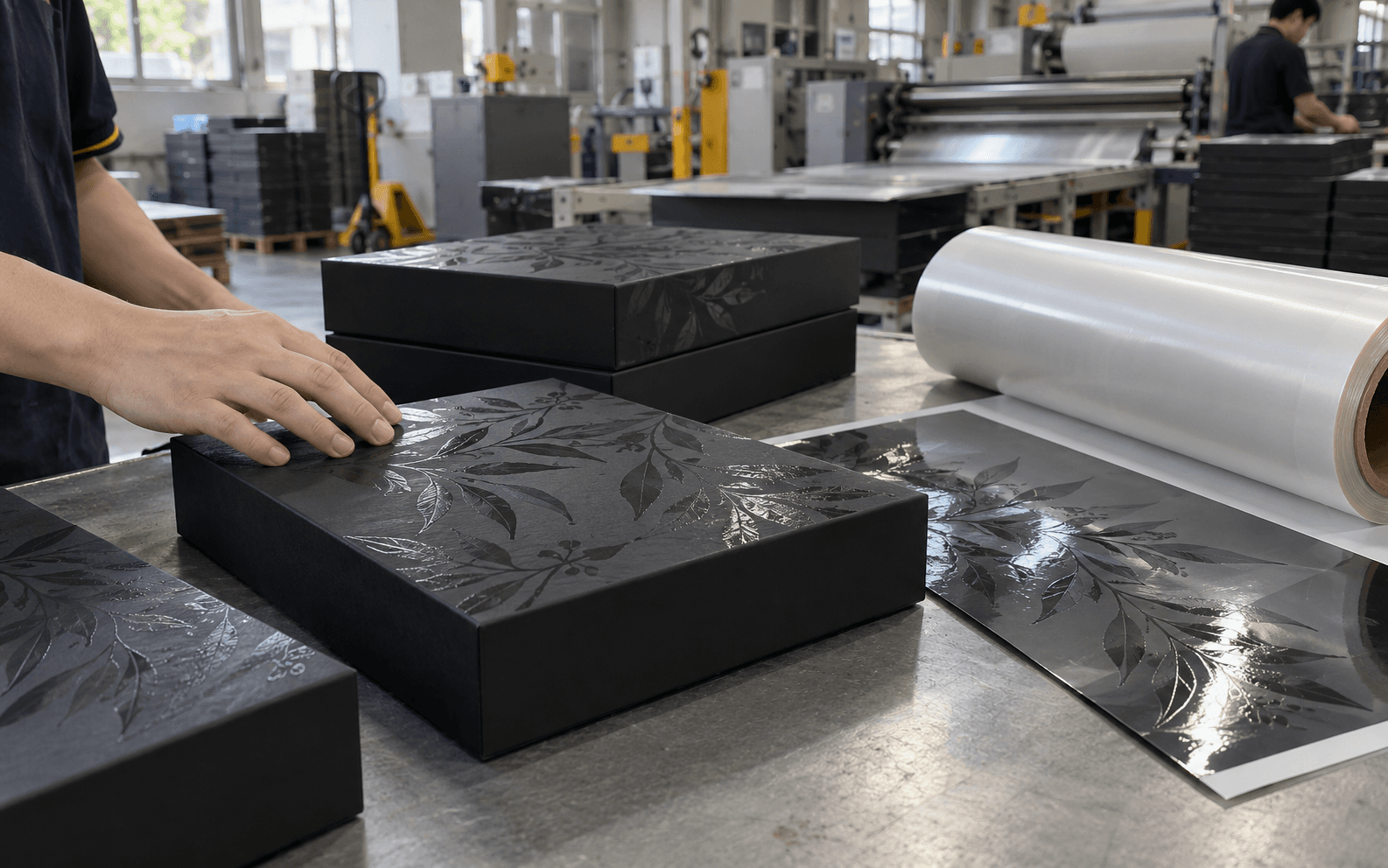
Two boxes can have identical artwork and still feel completely different in the hand. One is shiny and slippery, one is chalky and matte, one feels almost like velvet with a glossy logo that catches the light. The difference is the coating or lamination on top of the print.
This guide explains the common options, what they protect against, and how to ask for them. New to packaging? Start with How custom packaging is made.
Coating vs lamination: the basic split
- A coating is a liquid spread over the printed sheet and dried or cured. It's thin and becomes part of the surface. In Chinese factories, putting on a coating is often called 过油 (guò yóu, "passing oil").
- A lamination (覆膜, fùmó, also 过膜) is a thin plastic film glued over the print. It's thicker and tougher, and it's the only option that really changes how the box feels.
Rule of thumb: coatings are cheaper and lighter; laminations protect better and feel more premium.
Laminations
Gloss lamination (光膜, guāngmó)
Shiny and reflective. Colours look bright and saturated. It resists moisture and scuffs well. The downside is glare, which can make small text harder to read, and a look some brands find less premium.
Matte lamination (哑膜, yǎmó)
Low shine, calm and modern. It's the most common "premium" base for electronics boxes. Colours look a little softer and darker than on gloss. Matte film can show scuffs and fingerprints, especially on dark colours, so ask about a scratch-resistant matte film (防刮哑膜, fángguā yǎmó) if your box will be handled a lot.
Soft-touch lamination (触感膜 or 肤感膜, chùgǎnmó / fūgǎnmó)
A matte film with a velvety, slightly rubbery feel. It's what people mean by a box that "feels expensive". It also makes spot UV and foil stand out strongly. It costs more than standard matte, can pick up marks and skin oils, and should be tested with your foil and embossing.
There's also soft-touch coating, a liquid version. It's usually cheaper than the film but generally less durable. If a quote just says "soft touch", ask which one.
Coatings
Varnish (光油 / 哑油, guāngyóu / yǎyóu)
An ink-like clear layer, often applied on the printing press itself, in gloss, satin or matte. It gives light protection and is the cheapest finish.
Aqueous coating (水油, shuǐyóu)
A water-based clear coat, applied on press and dried with heat. It protects against rubbing and fingerprints a little better than varnish, dries fast and is widely used on folding cartons.
UV coating (UV油, 过UV)
A clear coat that hardens instantly under ultraviolet light. Usually very glossy and harder than aqueous. Can be applied over the whole sheet or only in chosen areas (that's spot UV).
Spot UV (局部UV, júbù UV)
Spot UV puts a clear, glossy UV coat on selected areas only, such as a logo, the product name or a pattern. On a matte or soft-touch background, those areas shine; on a gloss background, the effect almost disappears.
Variations you'll hear:
- Raised spot UV (立体UV or 厚UV): a thicker layer you can feel with a fingertip.
- Textured or frosted spot UV (磨砂UV, móshā UV): a gritty, sandpaper-like texture instead of shine.
- Reverse UV (逆向UV): a cheaper press-based way to get a gloss-and-matte contrast without separate spot UV. Less crisp, but useful on big runs.
How to specify it: make a separate artwork layer (often called a mask) where black = UV and white = no UV. No gradients, and allow a little tolerance, because spot UV can land slightly off the print.
Comparison table
| Finish | Chinese | Look | Feel | Protection | Relative cost |
|---|---|---|---|---|---|
| Varnish | 光油 / 哑油 | Gloss or matte | Like paper | Light | Lowest |
| Aqueous | 水油 | Gloss or matte | Like paper | Light to moderate | Low |
| UV coating | UV油 | Very glossy | Smooth, hard | Moderate | Low to medium |
| Gloss lamination | 光膜 | Shiny | Smooth, slick | High | Medium |
| Matte lamination | 哑膜 | Low shine | Smooth, dry | High (shows scuffs) | Medium |
| Soft-touch lamination | 触感膜 / 肤感膜 | Deep matte | Velvety | High | Higher |
| Spot UV | 局部UV | Gloss on chosen areas | Smooth or raised | Decorative | Adds a step |
"Relative cost" is a general ranking, not a price. Board, size, quantity and your factory's equipment all change the numbers.
Popular combinations for electronics boxes
- Matte lamination + spot UV logo: clean, modern, budget-friendly premium.
- Soft-touch + hot foil: the classic "luxury" combination. See What is hot foil stamping?
- Soft-touch + blind deboss: very understated. See Embossing vs debossing.
- Aqueous or varnish only: for simple folding cartons, inner boxes and price-sensitive products.
Practical tips
- Order matters. Lamination usually goes on before foil, emboss and spot UV. Confirm the sequence for your combination, because not every foil sticks to every film.
- Dark colours across folds. Heavy dark ink can crack along fold lines and show white board. Lamination often helps; ask the factory how they handle it.
- Recycling. Plastic film laminations can make paper boxes harder to recycle in some systems. If sustainability claims matter, ask about paper-friendly coatings and check the rules for your market.
- Judge on a real sample. A screen can't show sheen or feel. Approve finishes on the printed sample (see how proofing works).
- Specify colour carefully. Laminations shift colour slightly. Our colour and finish guide covers how to agree on a target.
FAQ
What's the difference between spot UV and gloss lamination? Gloss lamination covers the whole surface with shiny film. Spot UV adds gloss only to chosen areas, usually on a matte background, to create contrast.
Does soft-touch lamination scratch? It resists light scuffing reasonably well but can show marks and fingerprints. Scratch-resistant versions exist; ask for a sample.
Is lamination better than coating? It protects better and feels more premium, but costs more and adds plastic. Many simple cartons only need aqueous coating.
Can you put spot UV on soft-touch? Yes, and it's one of the most popular combinations.
Key words
| English | Chinese | Pinyin |
|---|---|---|
| Lamination | 覆膜 / 过膜 | fù mó / guò mó |
| Gloss film | 光膜 | guāng mó |
| Matte film | 哑膜 | yǎ mó |
| Soft-touch film | 触感膜 / 肤感膜 | chù gǎn mó / fū gǎn mó |
| Coating ("pass oil") | 过油 | guò yóu |
| Aqueous coating | 水油 | shuǐ yóu |
| Spot UV | 局部UV | jú bù UV |
Keep reading
- How custom packaging is made (pillar)
- What is hot foil stamping?
- Embossing vs debossing
- Offset vs digital printing for boxes
Next steps
- Read the packaging hub
- Browse packaging suppliers
- See the Packaging stage of the Path
- Glossary: 覆膜 lamination, 局部UV spot UV
- Not sure where to start? Get an intro
Updated 3 October 2026