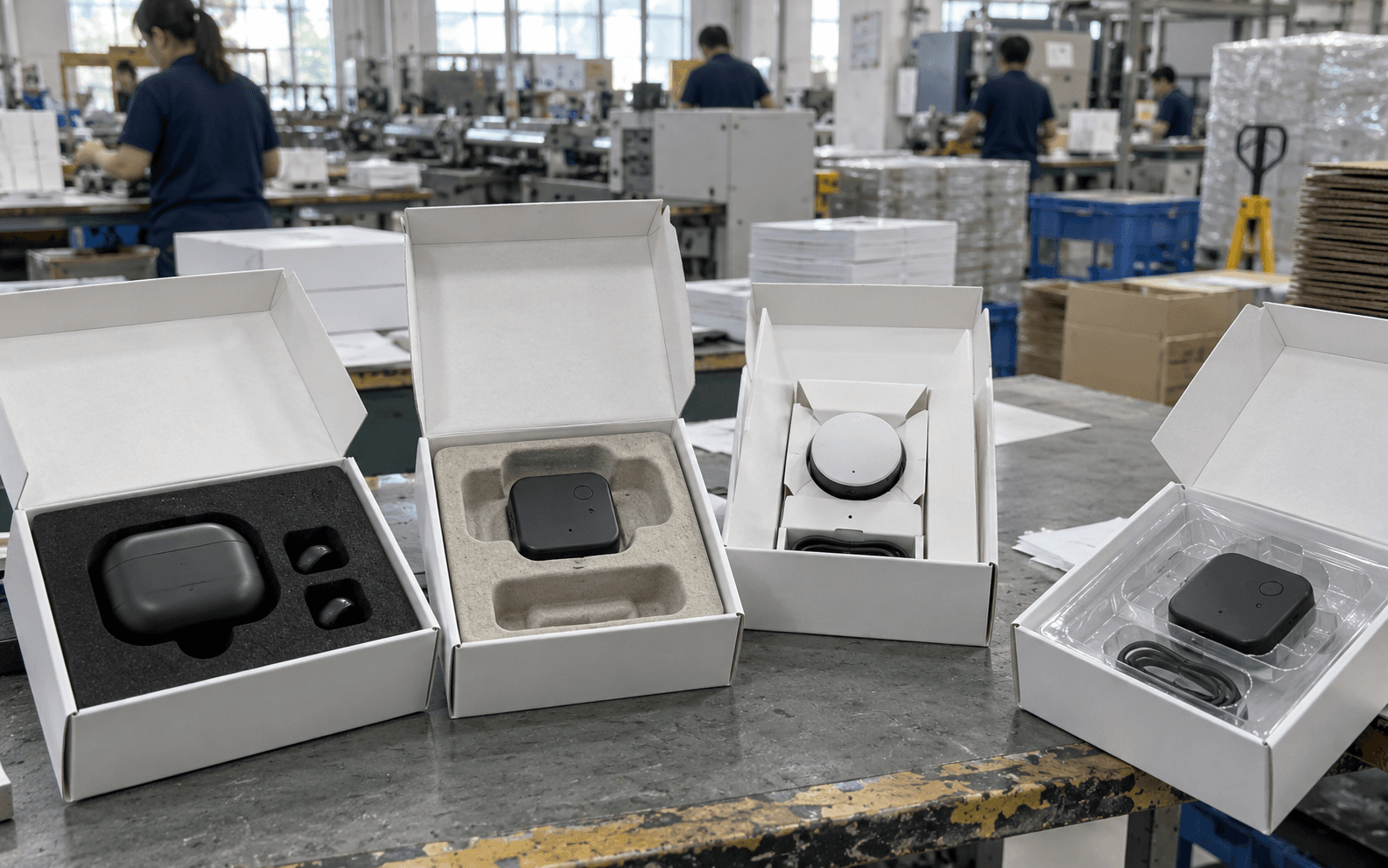
A box makes the first impression. The insert decides whether the product arrives in one piece. It's the tray, foam or cardboard frame inside the box that holds the device, its cable and its manual in their places.
In Chinese the insert is 内托 (nèituō) or 内衬 (nèichèn). On e-commerce blogs, "packaging inserts" can also mean thank-you cards and flyers. This guide is about the structural kind.
New to packaging? Start with How custom packaging is made.
What an insert has to do
- Stop movement. A product that can slide around will rub, scratch and eventually hit the box wall hard.
- Absorb shocks when the box is dropped.
- Present the product nicely when the lid comes off.
- Organise accessories: cable, charger, manual, spare tips.
- Pack quickly on the assembly line. A clever insert that takes a worker a minute to load is expensive at scale.
The main options
EVA foam (EVA海绵, EVA hǎimián)
A dense, closed-cell foam with a smooth surface, usually black or white. Cavities are cut to the product's shape with a cutting die or CNC, or the foam is heat-pressed into a 3D shape. It can be covered with flocking or fabric for a premium look.
- Pros: excellent hold and cushioning, looks premium, no mold needed for cut versions.
- Cons: plastic, hard to recycle in many places, higher unit cost than paper options.
- Good for: premium electronics, tools, kits in rigid boxes.
EPE foam ("pearl cotton", 珍珠棉, zhēnzhūmián)
A lighter, softer white polyethylene foam with a slightly rough look. Very common in China as a protective packing material.
- Pros: cheap, light, good cushioning.
- Cons: looks utilitarian; less precise than EVA.
- Good for: protecting heavy or fragile items in shipping cartons; inner packaging customers won't focus on.
Paperboard and corrugated inserts (卡纸内托, 瓦楞内卡)
Die-cut paperboard or corrugated board, folded into a frame with cut-outs. Can be printed.
- Pros: cheapest, recyclable with the box, uses the same dieline process as the box itself, no mold.
- Cons: less shock absorption; complex folding can slow down packing.
- Good for: light products, accessories, cost-sensitive and plastic-free packaging.
Molded pulp (纸浆模塑 or 纸托, zhǐtuō)
Molded pulp is wet paper fibre formed in a mold and dried, like a high-end egg carton. Two broad grades:
-
Wet-pressed (湿压, shīyā): smooth, thin, crisp edges. The premium "looks-like-plastic-but-is-paper" tray.
-
Dry-pressed (干压, gānyā): rougher, thicker, more like an egg box; cheaper.
-
Pros: paper-based and recyclable, good protection, increasingly expected for "plastic-free" claims.
-
Cons: needs its own mold, which adds tooling cost and lead time, and design changes later mean mold changes.
-
Good for: mid- to high-volume products where sustainability matters.
Plastic trays (吸塑, xīsù)
Thin plastic sheet (often PET) heated and vacuum-formed over a mold. Can be clear, black or white, or flocked (植绒, zhíróng) with a velvety surface.
- Pros: precise, light, cheap per unit at volume, product is visible if clear.
- Cons: needs a mold (typically simpler than a pulp mold), plastic, can look cheap if thin.
- Good for: accessories, cables, retail displays.
Anti-static foam (防静电海绵, fáng jìngdiàn hǎimián)
Foam treated to avoid static electricity. It's needed for bare circuit boards and modules, where a static spark could damage components. A finished product inside a closed enclosure usually doesn't need it, but ask your engineer. See What is PCBA?
Comparison table
| Insert | Chinese | Protection | Look | Needs a mold? | Recyclable with paper? | Relative unit cost |
|---|---|---|---|---|---|---|
| EVA foam | EVA海绵 | High | Premium | No (cut) / yes (pressed) | No | Medium to high |
| EPE foam | 珍珠棉 | High | Utilitarian | No | No | Low |
| Paperboard | 卡纸内托 | Low to medium | Clean | No | Yes | Lowest |
| Molded pulp | 纸托 | Medium to high | Natural, modern | Yes | Yes | Low to medium at volume |
| Plastic tray | 吸塑 | Medium | Clean, precise | Yes | No | Low at volume |
Relative costs are a general ranking. Your volume, size and design change the picture, especially once mold costs are spread over many units.
Which suits your electronics product?
- First small batch, premium feel: cut EVA foam in a rigid box. No mold, quick to change if the product changes.
- Larger volume and a sustainability story: molded pulp, once the product design is frozen.
- Light product, tight budget: a well-designed paperboard insert.
- Heavy or fragile device: foam or pulp, plus a proper shipping carton, and a drop test.
- Bare PCBs or modules: anti-static packaging.
Because pulp and plastic trays need molds, don't commit to them until your product dimensions are final. A late change to the enclosure can mean a new insert mold. See ECOs and design freeze.
Getting the fit right
- Send real units or exact dimensions, including cable and accessories, to the insert supplier.
- Test fit on the white sample. The product should sit snugly but come out easily. Too tight, and customers pull hard and drop it; too loose, and it rattles.
- Add a finger notch or pull tab so the product can be lifted out.
- Protect cosmetic surfaces. Glossy screens and anodized parts can scuff against foam or pulp. A protective film or bag may be needed.
- Drop test the packed box. Many brands and retailers reference ISTA test procedures (from the International Safe Transit Association) for drop and vibration testing. Ask your retailer or logistics partner which they expect, and see Quality inspection explained.
What drives the cost
- Material and thickness
- Tooling: cutting dies are cheap; pulp and thermoform molds cost more and take longer
- Number of cavities and compartments
- Covering: flocking, fabric or printing
- Packing time on the line, which shows up in your assembly cost rather than the insert quote
FAQ
What's the best packaging insert for electronics? There's no single best. EVA foam gives the most secure, premium hold; molded pulp gives good protection with a paper-based story; paperboard is cheapest for light items.
Is molded pulp strong enough for electronics? For many consumer devices, yes, when designed well and tested. Heavy or very fragile products need careful design and drop testing.
Do I need anti-static foam? For bare boards and modules, yes. For a finished product in a closed housing, usually not.
Key words
| English | Chinese | Pinyin |
|---|---|---|
| Insert | 内托 / 内衬 | nèi tuō / nèi chèn |
| EVA foam | EVA海绵 | EVA hǎi mián |
| EPE foam | 珍珠棉 | zhēn zhū mián |
| Molded pulp tray | 纸托 / 纸浆模塑 | zhǐ tuō / zhǐ jiāng mó sù |
| Plastic tray | 吸塑 | xī sù |
| Flocking | 植绒 | zhí róng |
| Anti-static foam | 防静电海绵 | fáng jìng diàn hǎi mián |
Keep reading
- How custom packaging is made (pillar)
- Rigid box vs folding carton vs mailer box
- What is a dieline? Dielines, white samples and printed proofs
- Quality inspection explained
Next steps
- Read the packaging hub
- Browse packaging suppliers
- See the Packaging stage of the Path
- Glossary: 纸浆模塑 molded pulp
- Not sure where to start? Get an intro
Updated 3 October 2026