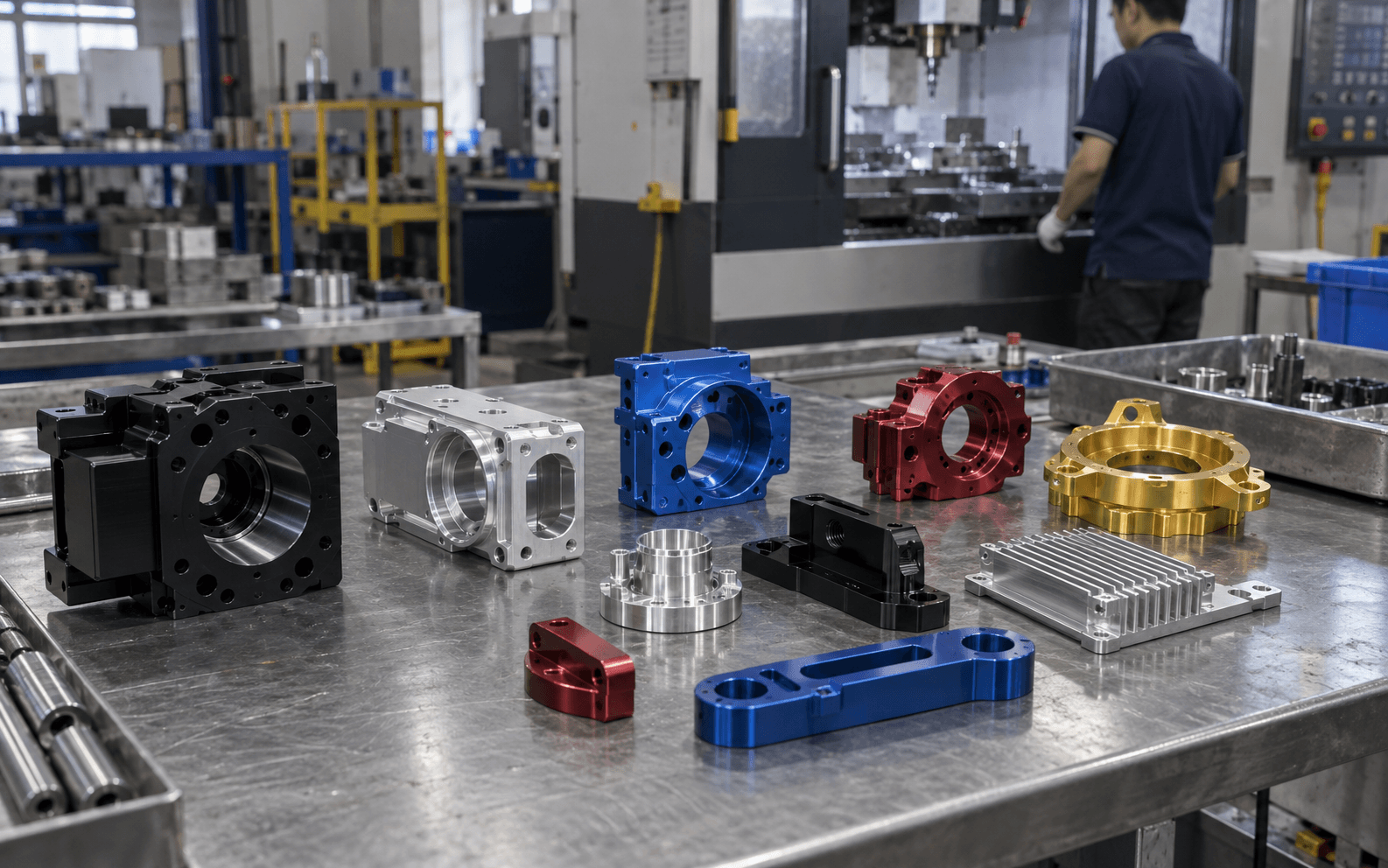
Pick up an aluminum laptop, a flashlight or a bike part with a smooth, coloured metal surface, and you're very likely holding something anodized. It's the most common finish for aluminum parts, from one-off prototypes to millions of consumer products.
This guide explains what anodizing actually is, why it behaves differently from paint, and what you need to tell a finishing shop to get the result you want.
Anodizing in one sentence
Anodizing is an electrical and chemical process that grows a thin, hard layer of aluminum oxide on the surface of an aluminum part.
That layer is not added on top like paint. It's grown out of the aluminum itself. A helpful comparison: paint is like wearing a coat, while anodizing is more like a tan. You can't peel a tan off, because it's part of your skin.
In Chinese it's 阳极氧化 (yáng jí yǎng huà), often shortened to 氧化 on quotes.
Why aluminum needs it
Raw aluminum already forms a very thin oxide film when it meets air. That natural film is weak: it scratches, looks dull and stains from fingerprints. Anodizing makes that oxide layer much thicker and more even, on purpose. The result:
- Harder surface: more scratch- and wear-resistant than bare aluminum.
- Better corrosion resistance: useful outdoors or near sweat and salt.
- Colour: the new layer is porous at first, like a sponge, so it can soak up dye before it's sealed.
- Electrical insulation: the oxide doesn't conduct electricity. This matters more than first-timers expect (see below).
How it works, step by step
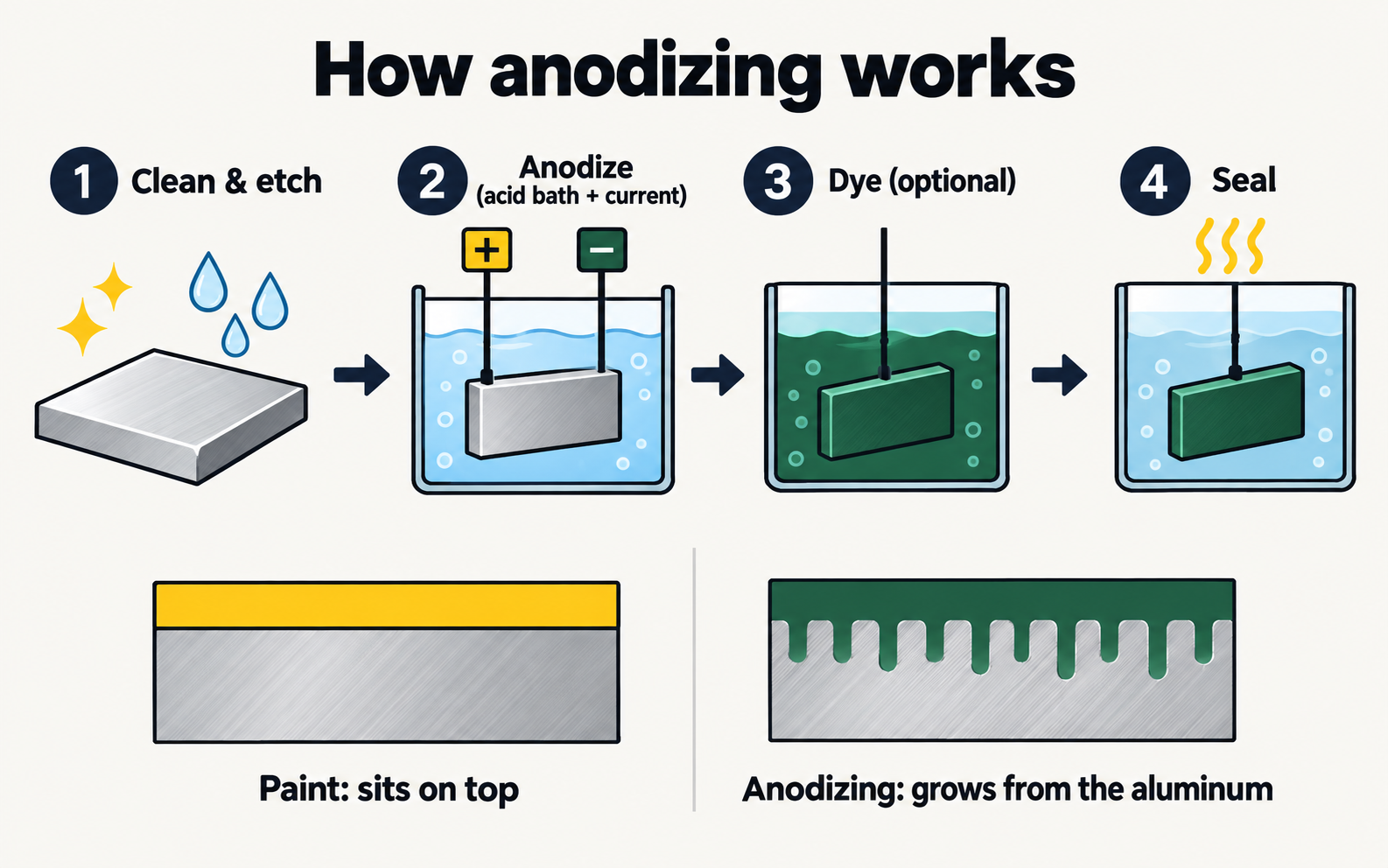
- Cleaning and etching. The parts are degreased and lightly etched in chemical baths so the surface is uniform.
- Optional texturing. Many parts are bead blasted (喷砂, pēn shā) first: fine glass beads are blasted at the surface to give an even matte look and hide machining marks.
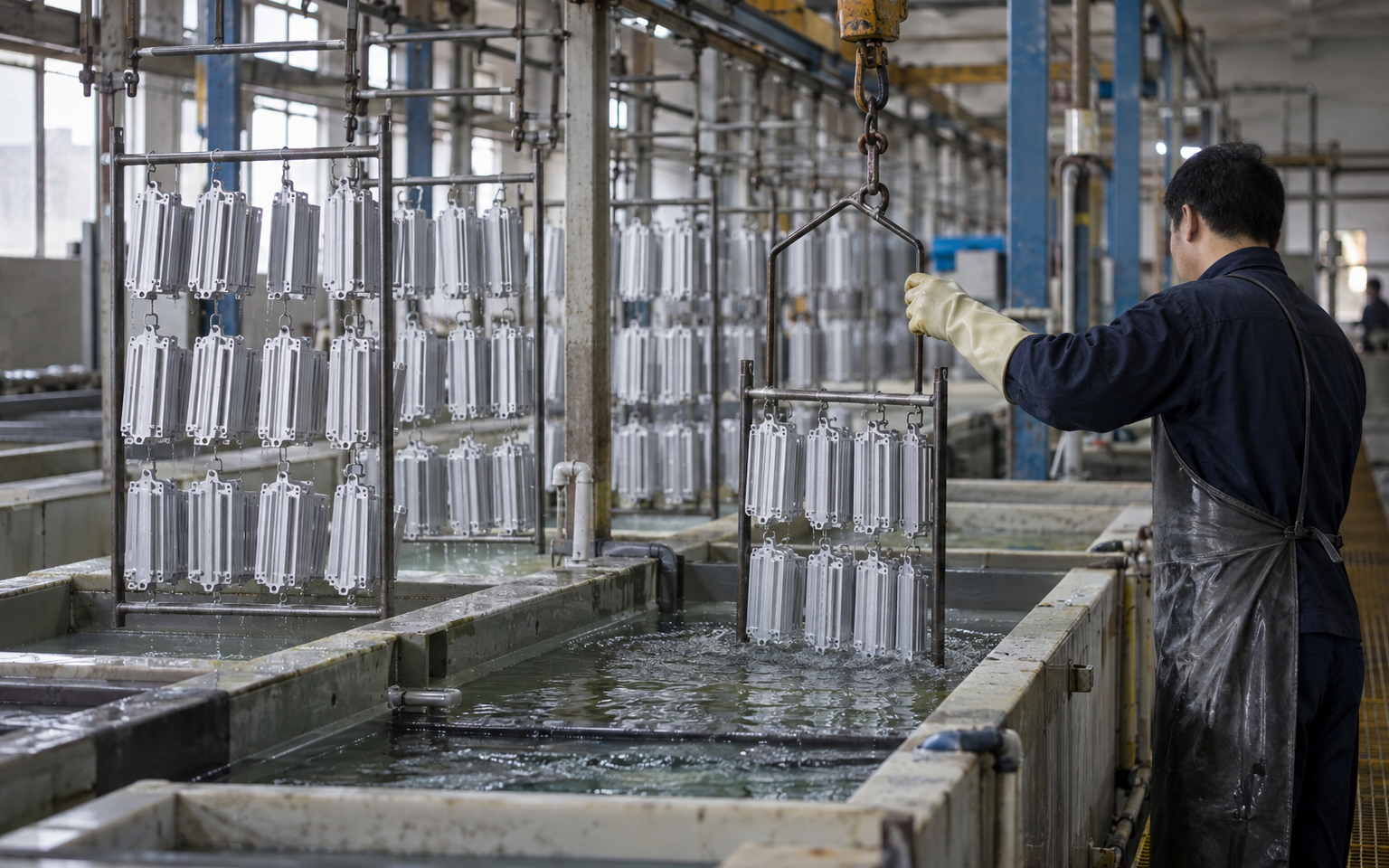
- The anodizing bath. Parts hang on racks in an acid bath (usually sulfuric acid). Electric current runs through them. The part is the anode (the positive electrode), which is where the name comes from. Oxygen at the surface combines with the aluminum and the oxide layer grows.
- Dyeing (optional). The porous layer is dipped in dye. Black, blue, red, gold and many other colours are possible. "Clear" or "silver" anodizing skips this step.
- Sealing. The pores are closed (often in hot water or a sealing chemical) to lock in the dye and improve corrosion resistance.
The whole line is a batch process: many parts go through each tank together.
Types of anodizing
- Type II (decorative / standard): the everyday kind, used for colour and general protection. The layer is thin, typically in the range of roughly 5–25 microns (a micron is a thousandth of a millimetre). Typical, confirm with your supplier.
- Type III (hard anodizing, 硬质氧化): a thicker, harder layer, grown at lower temperature. It's used for parts that slide or wear, like pistons or guides. The colour options are limited, and the natural colour tends to be grey, bronze or dark.
- Type I (chromic acid): a thinner, older process used in some aerospace work. You're unlikely to need it for a consumer product.
The "Type" names come from a US military specification, but Shenzhen shops understand them. You can also simply say "standard anodizing" or "hard anodizing".
Things first-timers get wrong
1. The part grows. Roughly half the oxide layer grows outwards and half grows into the metal. For standard anodizing that's a tiny change, but for tight holes, press fits or threads it matters. Tell your machinist the part will be anodized so they can leave room. (See tolerances explained.)
2. It doesn't conduct. If a surface must carry electricity, for example a ground (earth) connection or a battery contact, it has to be masked: covered with tape or plugs so it stays bare. Mark those areas on your drawing.
3. Rack marks. Each part hangs on a clip or wire that carries the current. The spot where it touches stays bare. Ask the shop to put the contact point on a hidden surface.
4. Alloy changes the colour. The same black dye looks slightly different on 6061 and 7075 aluminum. Cast aluminum, which contains a lot of silicon, usually anodizes badly: grey, blotchy or uneven. If you plan to die cast, expect to paint or powder coat instead.
5. Colour varies batch to batch. Dye baths drift. If parts from two batches will sit side by side in one product, ask for them to be run together, or agree a colour sample (see How to specify colour and finish).
6. It only works on some metals. Anodizing is mainly for aluminum. Titanium and magnesium can be anodized too, with different processes. Steel, stainless steel and plastics can't be anodized the same way; they need plating, painting or powder coating instead.
What anodizing costs
Because it's a batch process, pricing usually has two parts:
- A minimum lot charge per batch or per colour. One small prototype can cost almost as much as ten.
- A per-part price that depends on size, how the part is hung on the rack, and extra labour like masking.
Hard anodizing, unusual colours, colour matching and masking all add cost. For prototypes, many CNC shops include anodizing in their quote and send parts to a nearby finishing partner. Ask whether finishing is included and whether it adds days to the lead time (it often adds a few days; typical, confirm with your supplier).
Anodizing vs other finishes
Anodizing gives a thin, metallic-looking finish that doesn't chip. Powder coating and painting add a thicker layer on top, which can cover more metals and hide surface flaws but can chip. The full comparison is in Anodizing vs powder coating vs painting.
How to order anodized parts in Shenzhen
- Decide the look: colour, gloss (shiny or matte), and whether you want bead blasting first.
- Mark your drawing: which surfaces are cosmetic, which must be masked, and where rack marks are acceptable.
- Name the alloy and anodize type, for example "6061-T6, bead blast + black Type II anodize".
- Send a physical colour sample or reference if colour matters, not just a colour name.
- Approve a first sample before the full batch.
Many CNC and sheet-metal shops arrange anodizing for you. You can also contact surface finishing shops directly if you already have parts.
Key words
| English | Chinese | Pinyin |
|---|---|---|
| Anodizing | 阳极氧化 | yáng jí yǎng huà |
| Hard anodizing | 硬质氧化 | yìng zhì yǎng huà |
| Bead blasting | 喷砂 | pēn shā |
| Colour sample | 色板 | sè bǎn |
| Laser engraving | 镭雕 | léi diāo |
Keep reading
- Anodizing vs powder coating vs painting
- How to specify colour and finish
- What is CNC machining?
- Choosing a material for CNC parts
Next steps
- Read the surface finishing hub
- Browse surface finishing shops in Shenzhen and Dongguan
- See the Prototyping stage of the Path
- Glossary: 阳极氧化 anodizing, 镭雕 laser engraving
- Not sure where to start? Get an intro
Updated 29 September 2026