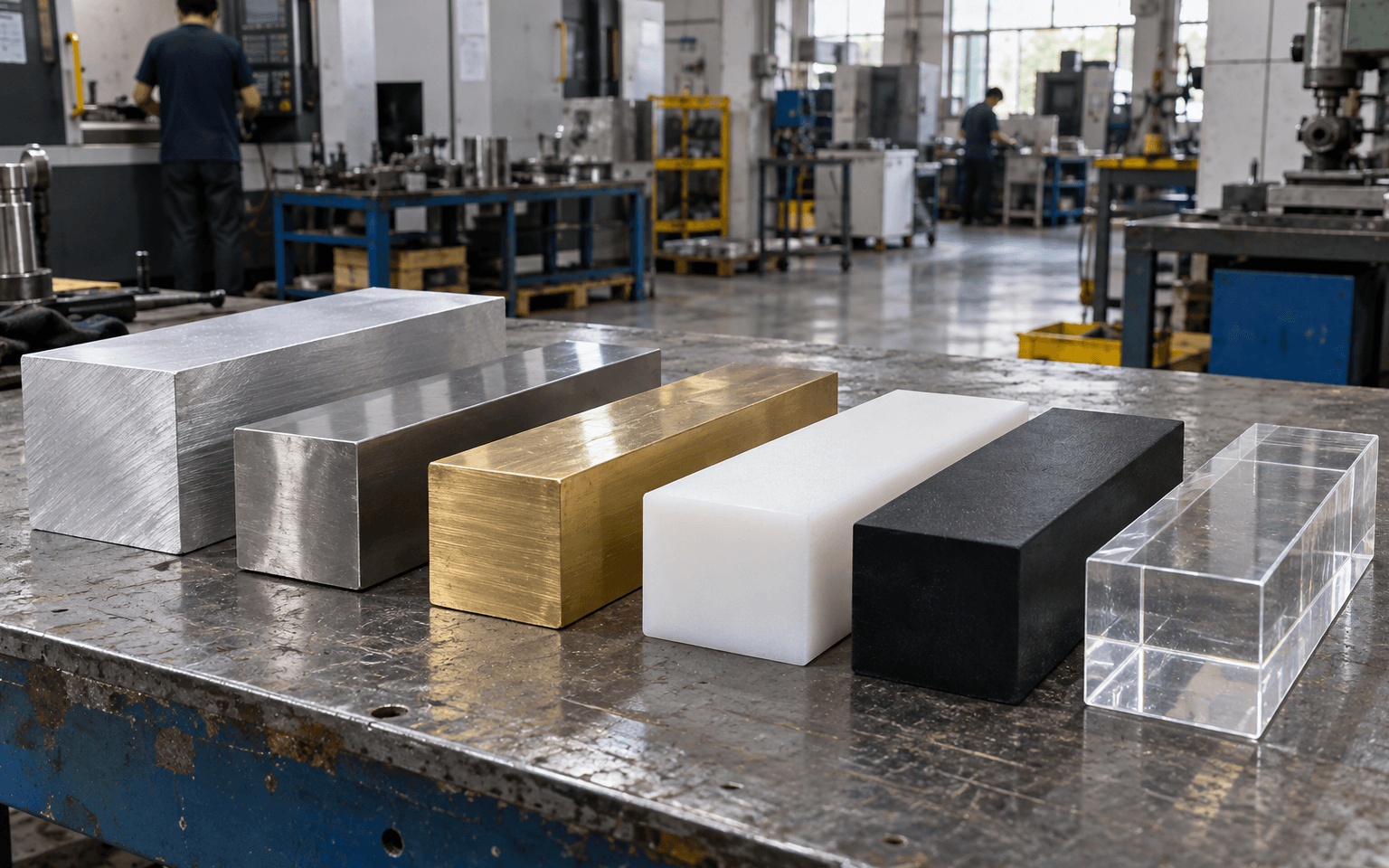
The material you pick changes how strong, light, heavy, expensive and good-looking your part will be. It also changes how fast it can be machined, which is a big part of the price. Here are the materials Shenzhen CNC shops use most, in plain terms.
Aluminum: the default choice
- 6061: the most common. Light, fairly strong, machines quickly (so it's cheap), resists corrosion, and anodizes well. Anodizing is an electrochemical finish that adds colour and a hard surface. Start here unless you have a reason not to.
- 7075: much stronger, used for high-stress parts (drones, bike parts). Costs more and anodizes slightly less evenly.
- 5052: mostly used for sheet metal, because it bends well.
Good for: enclosures, brackets, heat sinks, prototypes of almost anything.
Steel: strong and heavy
- Stainless steel 304: tough, corrosion-resistant, common for food-contact and outdoor parts. Harder to machine, so pricier than aluminum.
- Stainless steel 316: better corrosion resistance (marine, medical). More expensive.
- Carbon/mild steel: strong and cheap as a material, but it rusts unless coated or plated.
Good for: high-strength parts, wear parts, anything that must survive harsh conditions.
Brass and copper
- Brass machines very easily and looks great, and it's common for small precise parts, connectors and decorative pieces.
- Copper conducts heat and electricity extremely well (heat spreaders, bus bars), but it's soft and gummy to machine.
Engineering plastics
Machined plastic is ideal for prototypes of parts that will later be molded, and for low-volume functional parts.
- POM (Delrin): stiff, slippery, dimensionally stable. Great for gears and sliding parts.
- ABS: cheap, easy to machine, the same family as many molded cases.
- PC (polycarbonate): tough, can be clear.
- Nylon (PA): tough and wear-resistant, but absorbs some moisture.
- PEEK: high-temperature, very strong, very expensive.
- Acrylic (PMMA): clear, glass-like, but brittle.
Quick chooser
| If you need… | Try… |
|---|---|
| A light, cheap, good-looking case | Aluminum 6061, anodized |
| Maximum strength in metal | Aluminum 7075 or stainless steel |
| Outdoor or food-contact | Stainless 304 / 316 |
| A clear part | PC or acrylic |
| A slippery moving part | POM |
| A prototype of a future molded part | ABS or PC (to match the molding plastic) |
Tips
- Ask the shop what they stock. Common materials are cheaper and faster than special orders.
- Prototype in the production material when the part is structural. A plastic look-alike won't tell you if a metal hinge will hold.
- Material certificates: for medical or aerospace work, ask for a material certificate (mill cert) proving the grade.
Next steps
Updated 29 September 2026