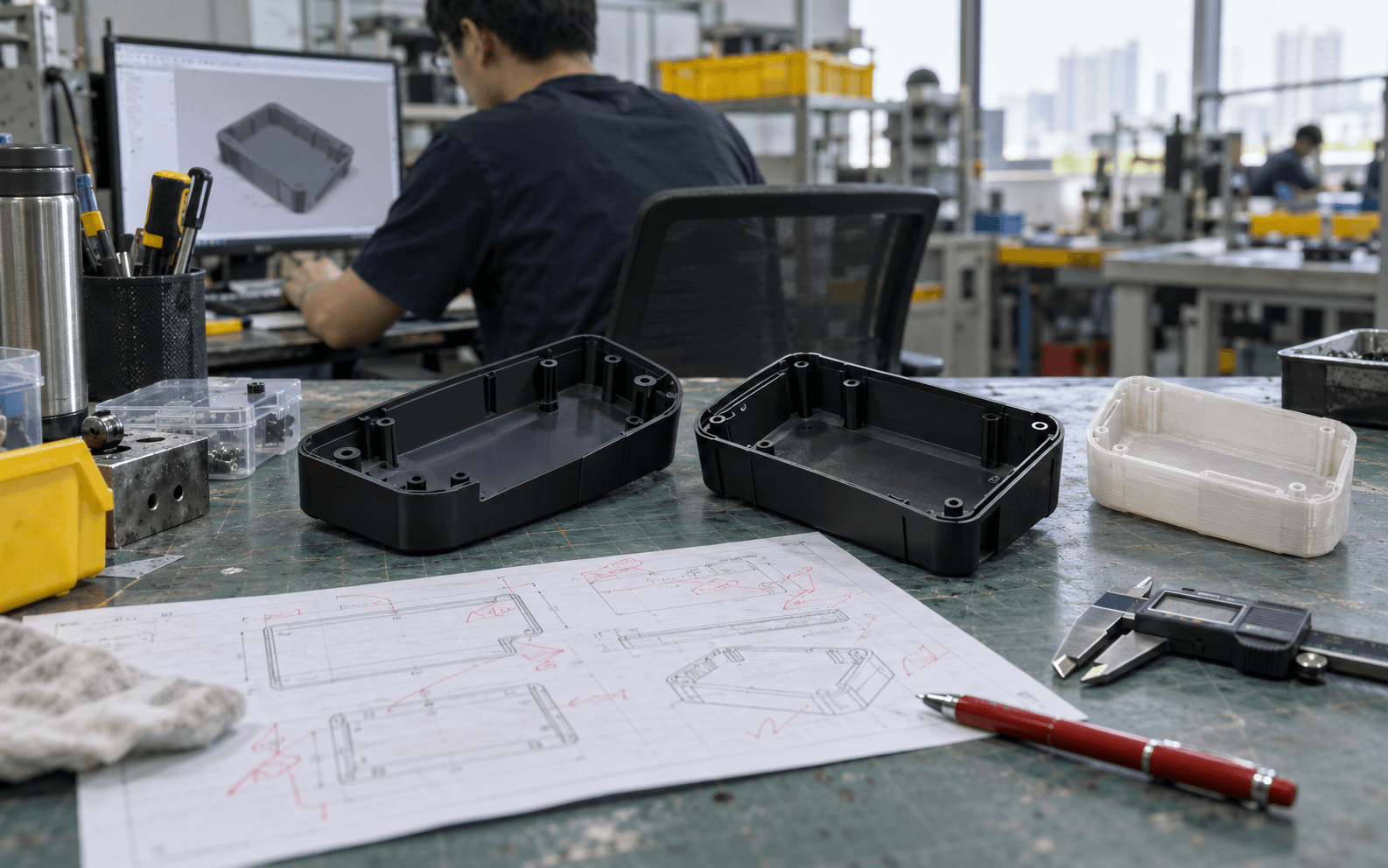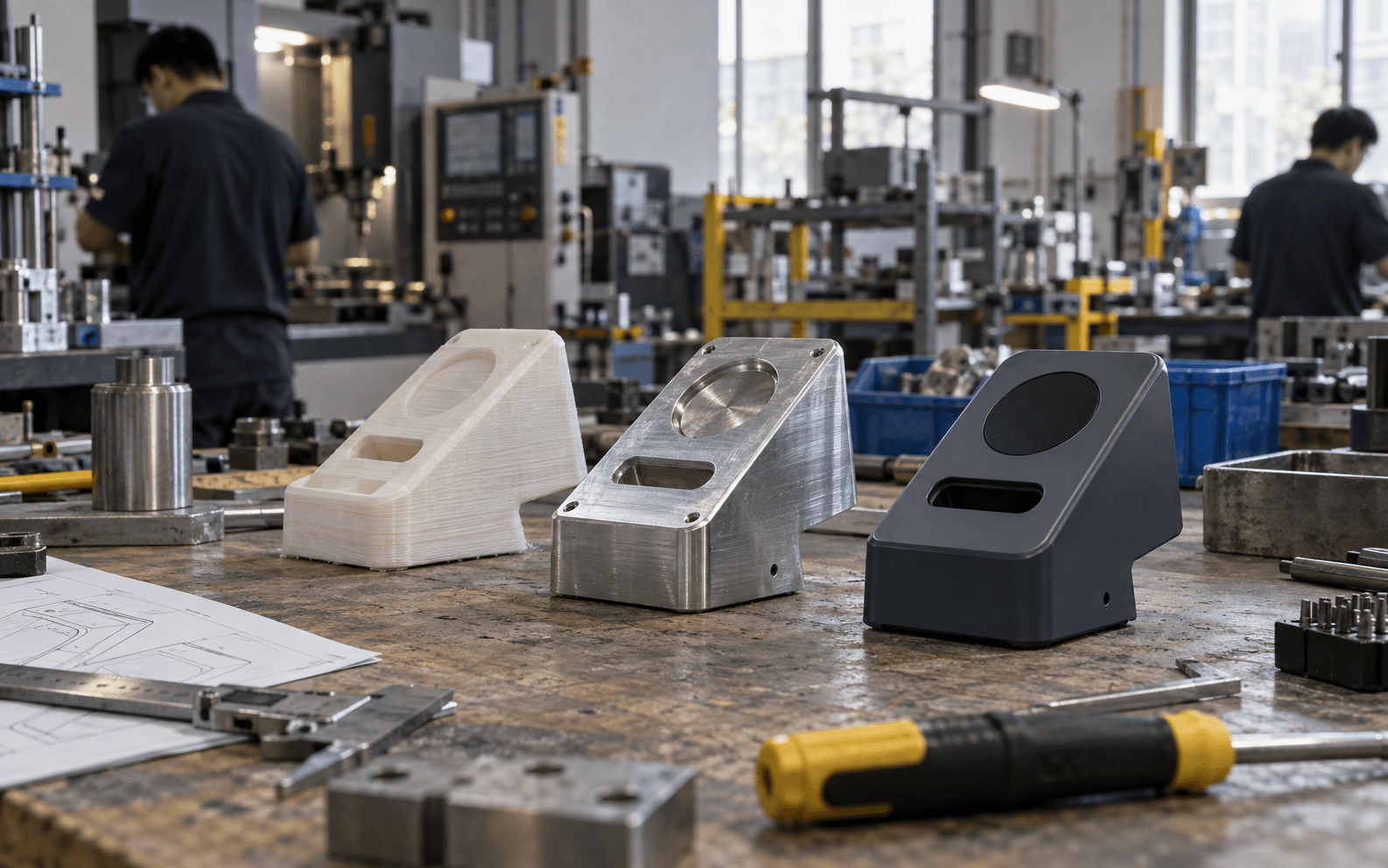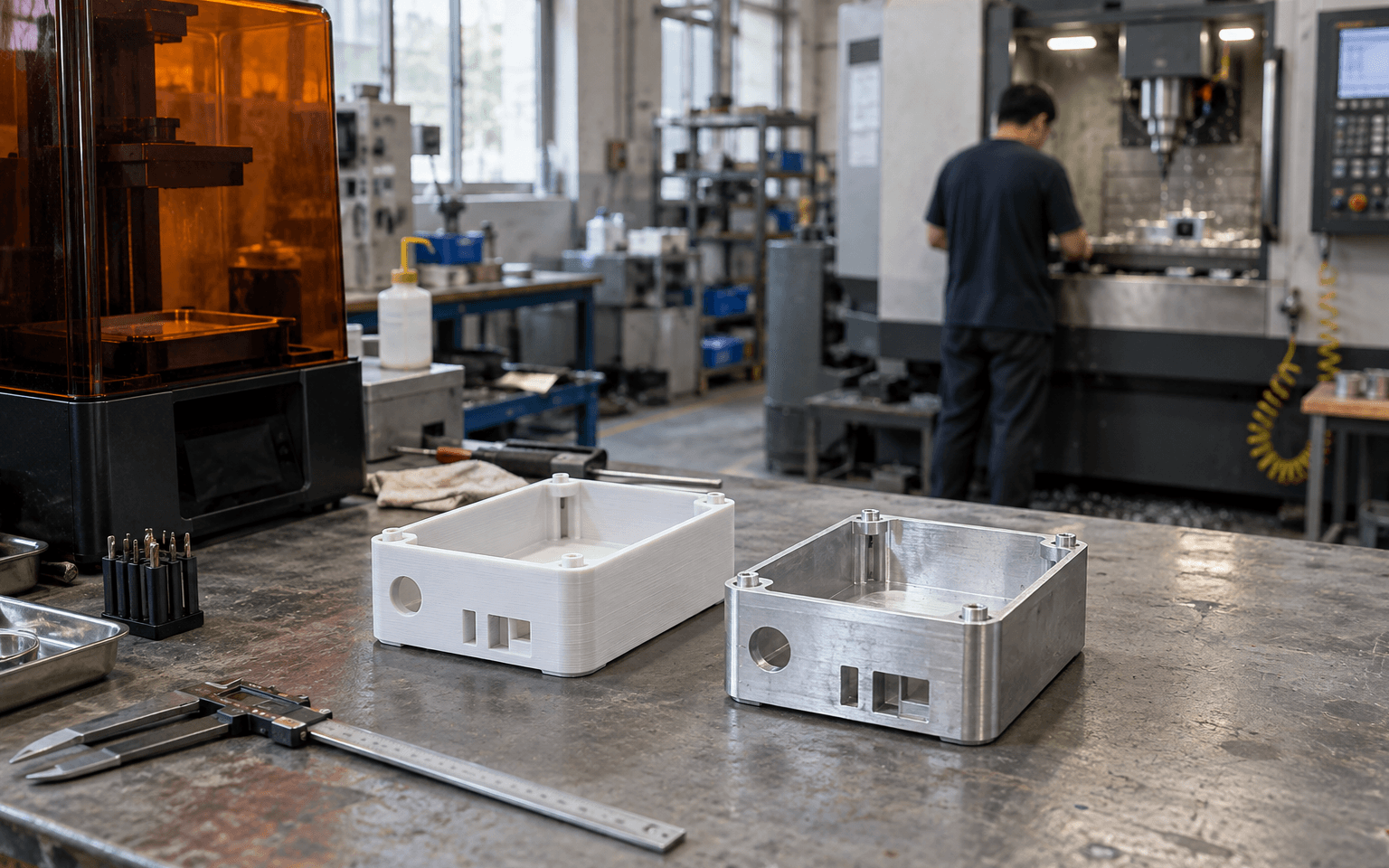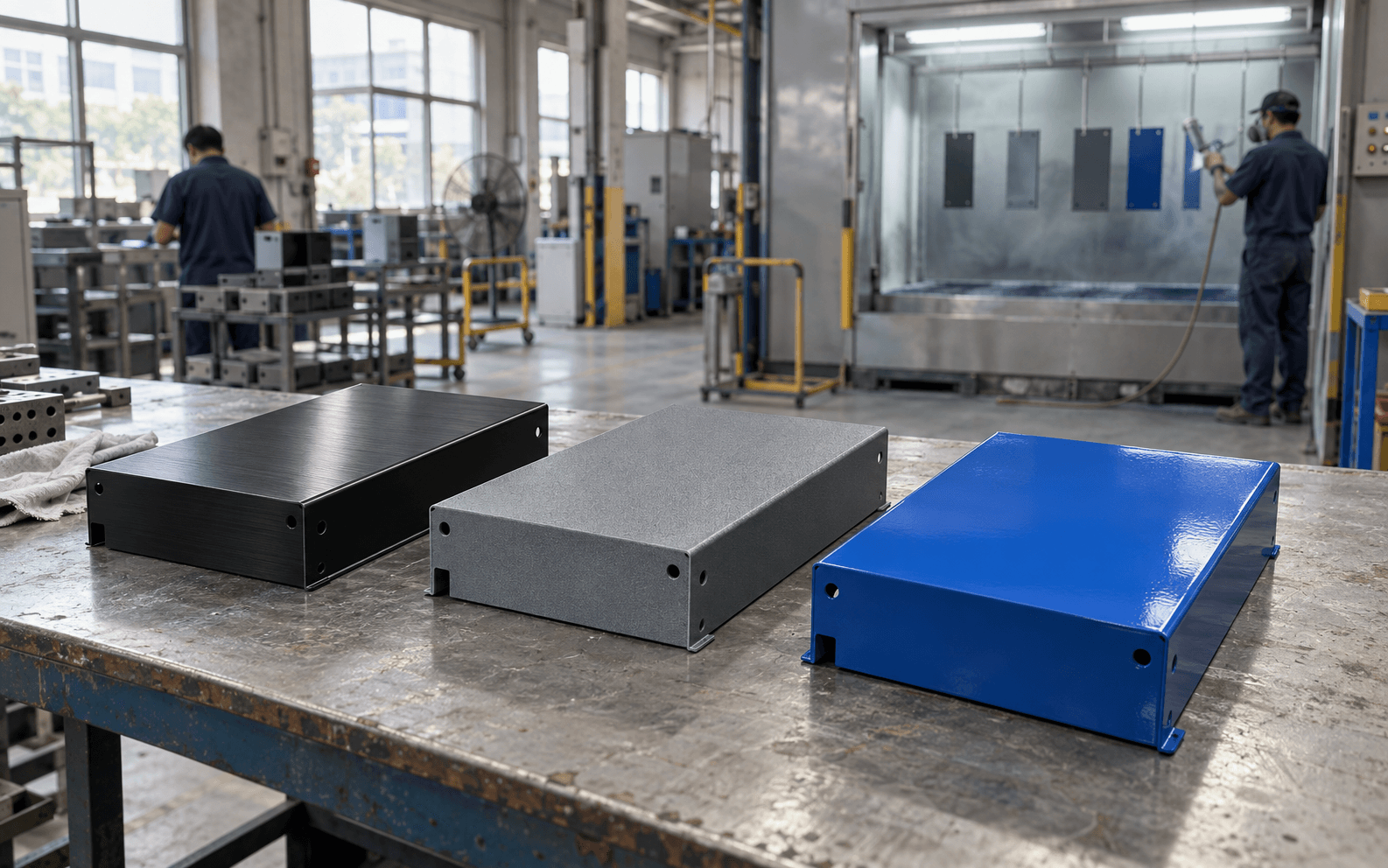
Almost every part you make will need some kind of surface finish: a treatment that changes how it looks, feels and survives daily use. For metal and plastic enclosures, the three options you'll hear most often are anodizing, powder coating and wet painting.
They can look similar in photos, but they work very differently. Choosing the wrong one can mean chipped edges, a colour you can't match, or a finish that simply can't be applied to your material.
New to finishes? Start with What is anodizing?
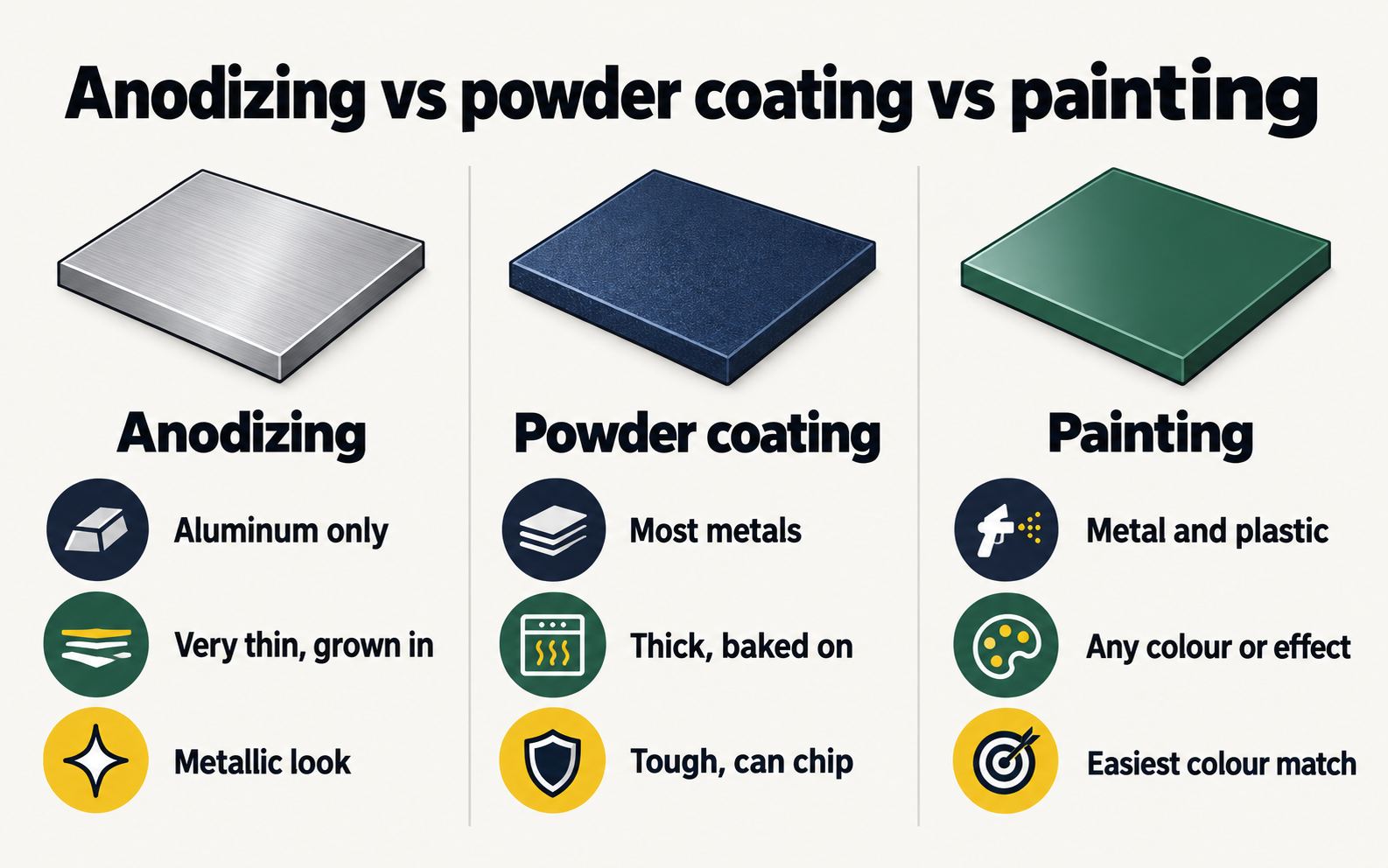
The key difference: grown in, or sitting on top
- Anodizing grows a thin oxide layer out of the aluminum itself. Nothing sits on top, so it can't peel.
- Powder coating and painting both add a new layer on top of the part. That layer can cover almost anything, but it can also chip or scratch through to the material underneath.
Think of a wooden table. Anodizing is like staining the wood: the colour is in the surface. Powder coating and paint are like varnish or paint: a separate film you could, in theory, chip off.
Anodizing
What it is: an electrochemical process in an acid bath that thickens aluminum's natural oxide layer, which can then be dyed and sealed. In Chinese, 阳极氧化.
Works on: aluminum (and, with different processes, titanium and magnesium). Not on steel or plastic.
Looks like: metallic. You can still see the metal's texture through the colour, which is why anodized products look "premium". Matte if bead blasted first, shinier if polished.
Strengths
- Very thin, so it keeps fine details and sharp edges.
- Hard and scratch-resistant; doesn't chip or peel.
- Good corrosion resistance once sealed.
Weaknesses
- Aluminum only.
- Colours can vary between batches and between alloys; exact colour matching is harder than with paint.
- Doesn't hide scratches or tool marks; it can even make them more visible.
- Electrically insulating, so contact areas need masking.
- Cast aluminum often anodizes poorly (grey or blotchy).
Powder coating
What it is: a dry, coloured powder (tiny particles of plastic resin and pigment) is sprayed onto the part with an electrostatic gun. The static charge makes the powder cling to the metal, like dust sticking to a TV screen. The part is then baked in an oven, and the powder melts into a smooth, tough skin.
Works on: metals that can take the oven heat and hold a charge: steel, aluminum, die-cast parts. Not normally on plastics.
Looks like: a solid, even colour. Available in gloss, satin, matte and textured ("sand" or "wrinkle") finishes. Colours are often chosen from the RAL system, a standard numbered colour chart common in industry.
Strengths
- Thick and tough; good for outdoor use and hard knocks.
- Hides small surface flaws and casting marks.
- Wide colour range and good colour consistency.
- Works on steel, which anodizing can't do.
Weaknesses
- Much thicker layer than anodizing, typically tens of microns and sometimes more (typical, confirm with your supplier). It can fill small holes, soften sharp edges and bury fine text.
- Threads and mating surfaces must be masked.
- Can chip on sharp edges if hit hard, exposing bare metal.
Wet painting (spray painting)
What it is: liquid paint sprayed on with a spray gun, usually in several coats (primer, colour, sometimes a clear top coat), then dried or baked at a lower temperature. In Chinese, 喷涂 (pēn tú) or 喷油.
Works on: almost anything, including plastics. This is how most plastic enclosures and prototypes get their colour.
Looks like: anything you want: gloss, matte, metallic, pearl, and special coatings like soft-touch (a slightly rubbery, velvety feel). Colours are often specified with Pantone codes.
Strengths
- The most flexible option for colour and effect.
- Works on plastic parts and on mixed-material assemblies.
- Easy to colour-match to a reference.
Weaknesses
- Usually less hard-wearing than powder coating or anodizing.
- Quality depends heavily on preparation and the painter's skill: dust spots, runs and thin edges are common defects.
- Soft-touch coatings can wear shiny or turn sticky over time, depending on the paint and use.
Side-by-side summary
| Anodizing | Powder coating | Wet painting | |
|---|---|---|---|
| Materials | Aluminum (mainly) | Most metals | Metals and plastics |
| Layer | Grown in, very thin | On top, thick | On top, thin to medium |
| Look | Metallic, shows texture | Solid, even colour | Any colour or effect |
| Durability | Hard, no chipping | Tough, can chip at edges | Varies by paint system |
| Keeps fine detail | Yes | Less so | Mostly |
| Colour matching | Harder | Good (RAL) | Easiest (Pantone) |
How to choose
Ask these questions in order:
- What is the part made of? Plastic? Painting (or a colour molded into the plastic). Steel? Powder coating or painting (or plating). Machined aluminum? All three are possible, and anodizing is the usual default. Die-cast aluminum? Usually powder coat or paint.
- Do you want it to look like metal? Choose anodizing.
- Will it be knocked around or used outdoors? Powder coating is often the tougher, cheaper option for steel enclosures and brackets.
- Does it need an exact brand colour? Painting or powder coating match references more easily than dye.
- Are there fine details, threads or tight fits? Anodizing changes dimensions least.
Many products mix finishes: an anodized aluminum front, a powder-coated steel chassis inside, and painted plastic buttons.
Other finishes you'll hear about
- Plating (电镀, diàn dù): a thin metal layer such as nickel, chrome or zinc, applied electrically. Common on zinc die castings and steel screws.
- E-coating (电泳, diàn yǒng): paint applied in an electrically charged bath; very even coverage, often used as a primer on steel.
- Silk-screen printing (丝印) and laser engraving (镭雕): used to add logos and labels after the main finish.
Keep reading
- What is anodizing? (pillar)
- How to specify colour and finish
- Zinc vs aluminum die casting
- What is sheet metal fabrication?
Next steps
- Read the surface finishing hub
- Find surface finishing shops
- See the Production stage of the Path
- Not sure where to start? Get an intro
Updated 29 September 2026