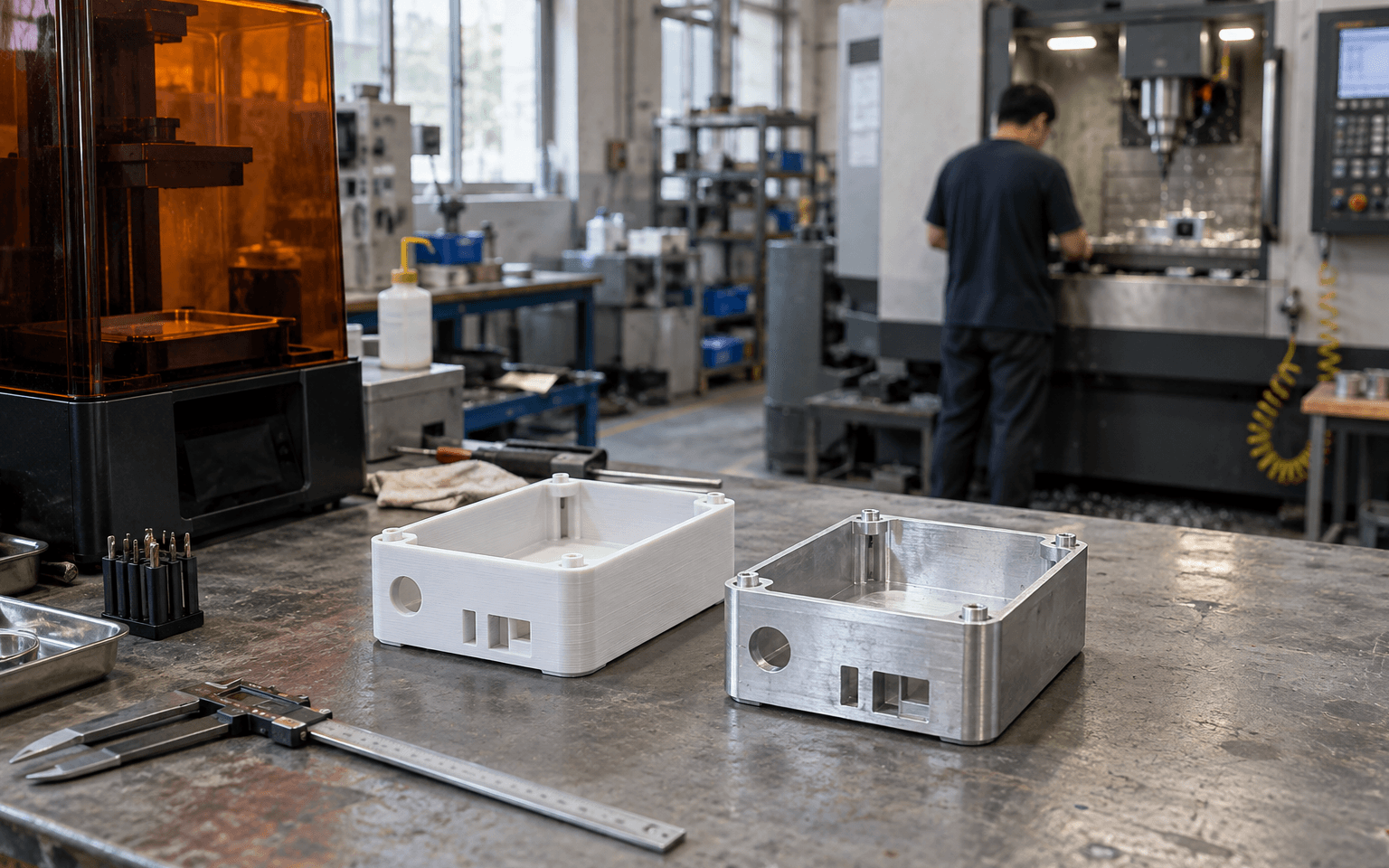
3D printing and CNC machining are the two workhorses of prototyping. Both can turn your CAD file into a physical part within days, and both are offered by hundreds of shops around Shenzhen. But they're opposites in how they work, and each is clearly better for certain jobs.
Adding vs removing
- 3D printing builds the part layer by layer, adding material only where it's needed (additive). No tooling, no fixtures, very little set-up.
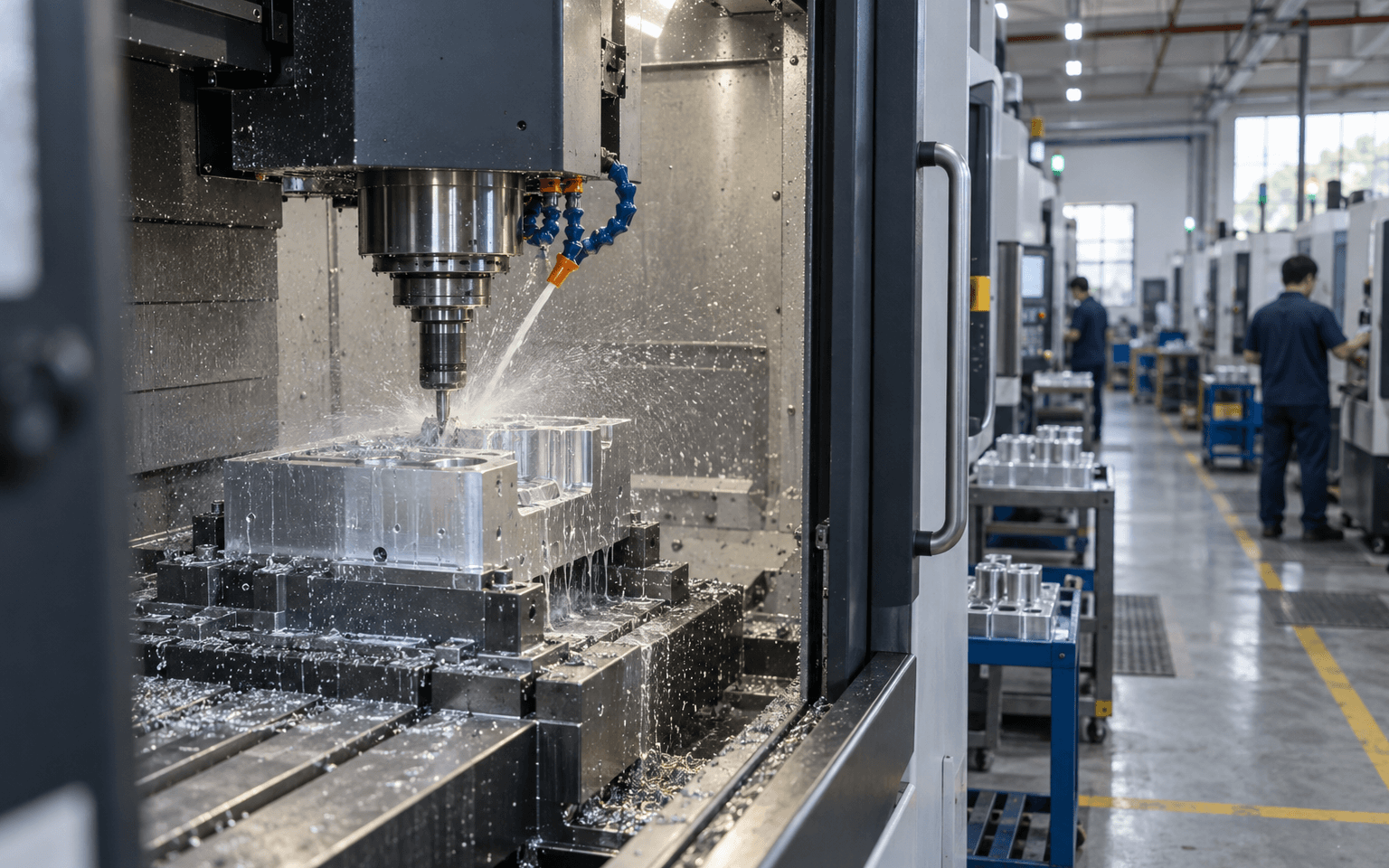
- CNC machining starts with a solid block and cuts material away with spinning tools (subtractive). A programmer plans the tool paths, and the block is clamped in the machine.
An analogy: 3D printing is like building a sandcastle with a bucket, adding sand where you want it. CNC is like carving a sculpture from a block of stone.
For the details of each, see Which 3D printing process? SLA vs SLS vs MJF and What is CNC machining?
Materials: printed plastic vs the real thing
This is often the deciding factor.
- 3D printing uses special printing materials: photopolymer resins (SLA), nylon powders (SLS, MJF) and printing filaments (FDM). Some imitate ABS or polypropylene, but they are not the same material as your final molded part. Metal printing exists but is usually pricier.
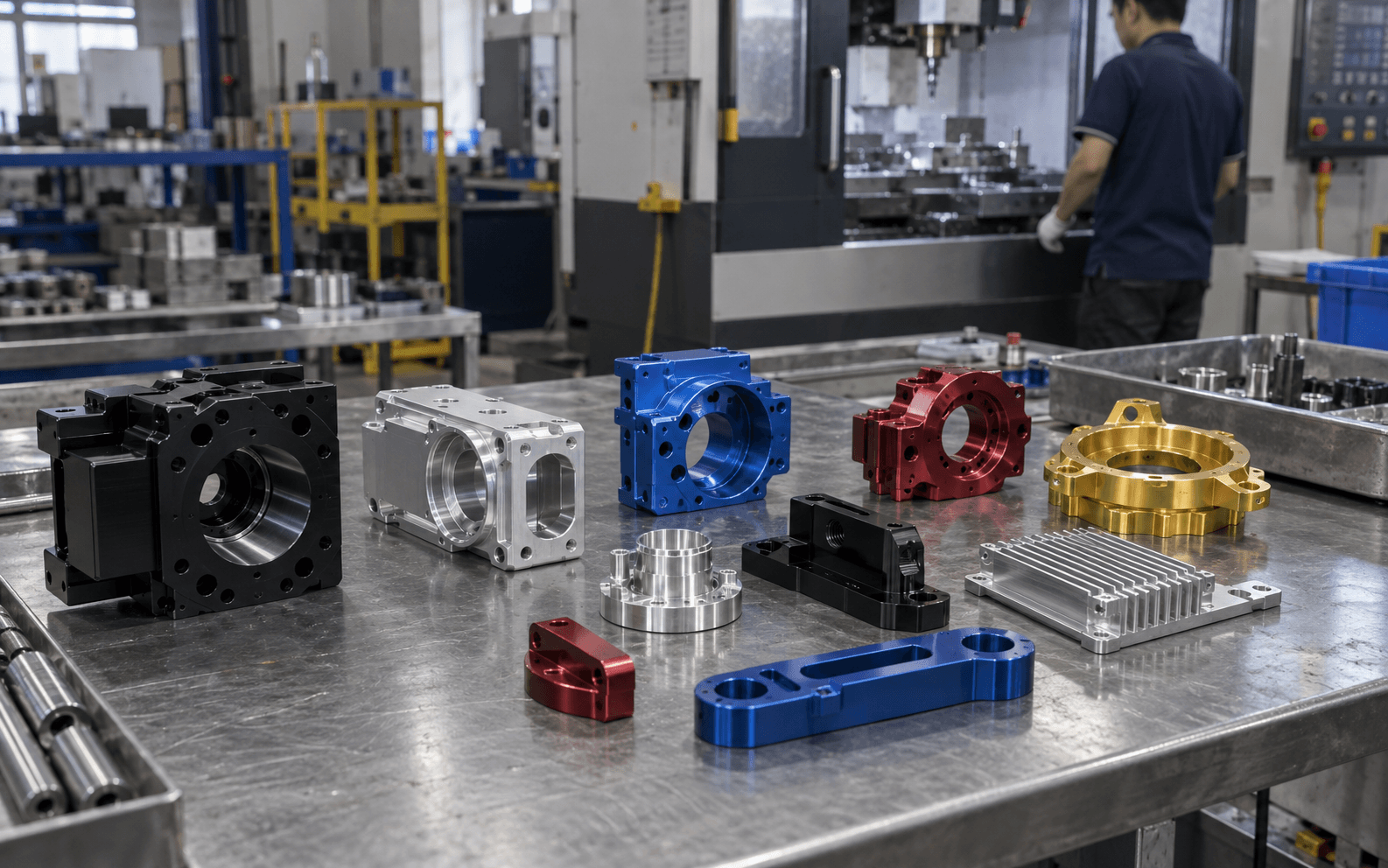
- CNC cuts real engineering materials: aluminum, stainless steel, brass, and plastics like POM, ABS, PC and PEEK, often the same grade you'll use in production.
If your test depends on the actual material (heat resistance, stiffness, screw threads, a metal feel), CNC usually gives a more realistic answer. See Choosing a material for CNC parts.
Strength and precision
- Printed parts can be weaker in one direction, because layers are bonded together. SLS and MJF nylon are tough; standard SLA resin can be brittle. Accuracy is good for most prototypes, but small parts can warp or shrink a little.
- Machined parts are solid all the way through and very precise. CNC routinely holds tighter tolerances than most printing processes.
If a part must press-fit a bearing, seal with an O-ring, or carry real load, CNC is the safer choice.
Shape freedom
- 3D printing wins for complex shapes: internal channels, lattices, organic curves, hollow parts and several parts combined into one. The printer doesn't care how complicated a layer is.
- CNC is limited by what the tool can reach. Deep, narrow pockets, sharp inside corners and enclosed cavities are hard or impossible. Every extra setup (re-clamping the part to cut another side) adds cost.
Cost and speed
Rough patterns (typical, confirm with your supplier):
- Small, complex plastic parts: printing is usually cheaper and faster, often a few days.
- Simple blocky parts, or any metal part: CNC is often competitive, and sometimes cheaper than printing a big solid part.
- Large plastic parts: printing cost rises with volume and height; CNC cost rises with machining time. Get both quoted.
- Quantity: printing cost per part barely drops with quantity. CNC shares programming and setup across the batch, so 10 parts cost much less each than 1.
Surface finish and looks
- SLA prints are smooth and paint well, great for looks-like models after sanding.
- SLS/MJF have a grainy, matte surface, usually dyed black.
- CNC parts show fine tool marks, but can be bead blasted, polished and anodized for a production-quality metal finish. See What is anodizing?
Quick decision guide
| Your prototype needs to… | Usually better |
|---|---|
| Check shape and size quickly | 3D printing |
| Have complex internal features | 3D printing |
| Look like the final product (plastic) | SLA print, then paint |
| Be metal | CNC |
| Use the production-grade material | CNC |
| Hold tight tolerances or threads | CNC |
| Survive real loads or heat | CNC (or SLS/MJF for tough plastic) |
| Be made 20–50 times, molded-looking | Consider vacuum casting |
Use both
Most real projects mix them. A typical first build might have:
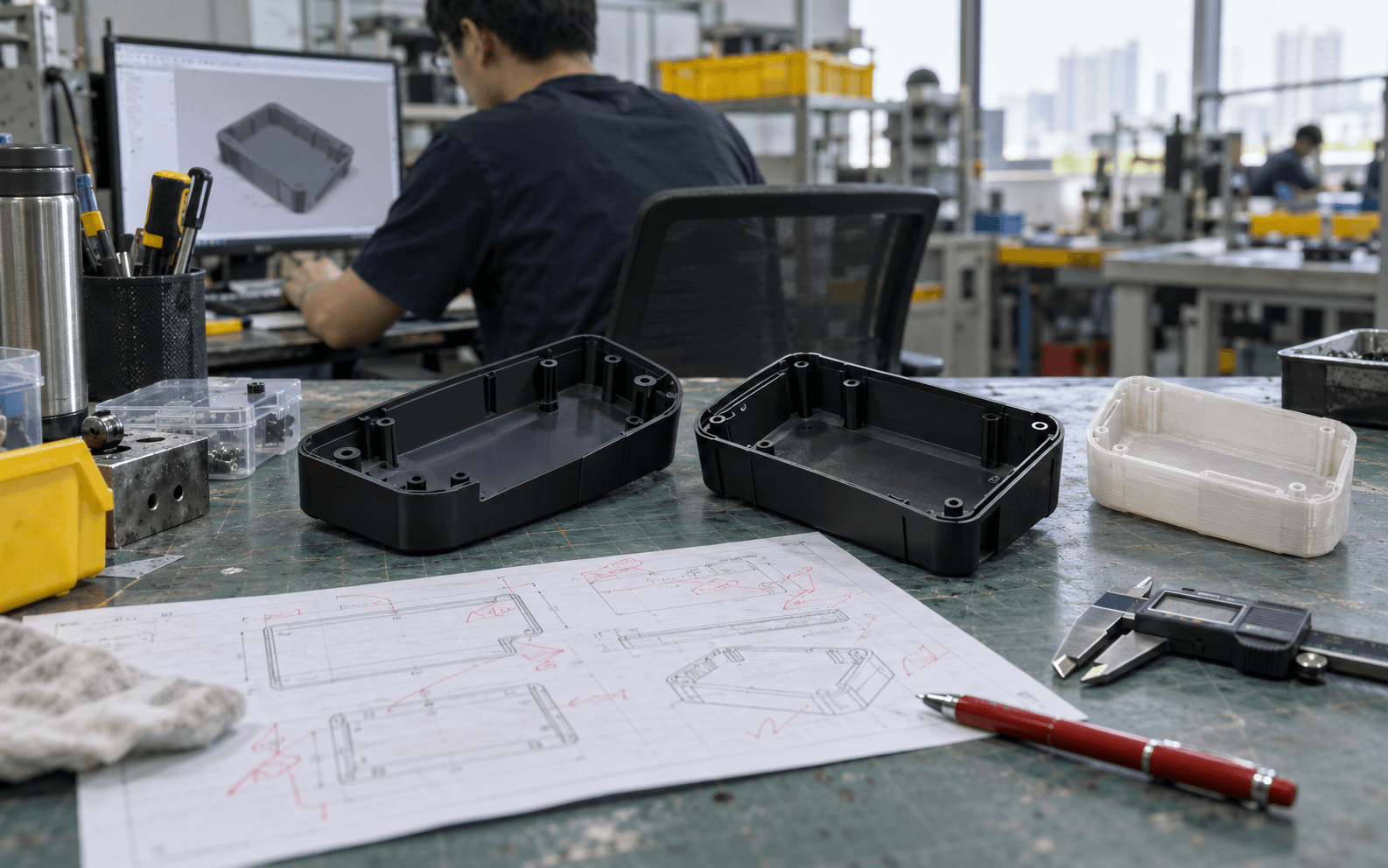
- an SLA-printed outer shell, sanded and painted, to show the look,
- MJF internal brackets that clip together,
- a CNC-machined aluminum heatsink or mounting plate.
Many Shenzhen prototype shops (手板厂) offer both processes under one roof, and can advise which to use for each part if you send the full assembly.
Keep reading
- Which 3D printing process? SLA vs SLS vs MJF (pillar)
- 50 parts: casting vs printing vs molding
- Choosing a prototyping method
- How much does CNC machining cost?
Next steps
- Read the 3D printing hub and the CNC machining hub
- Browse 3D printing services and CNC shops
- See the Prototyping stage of the Path
- Not sure where to start? Get an intro
Updated 29 September 2026