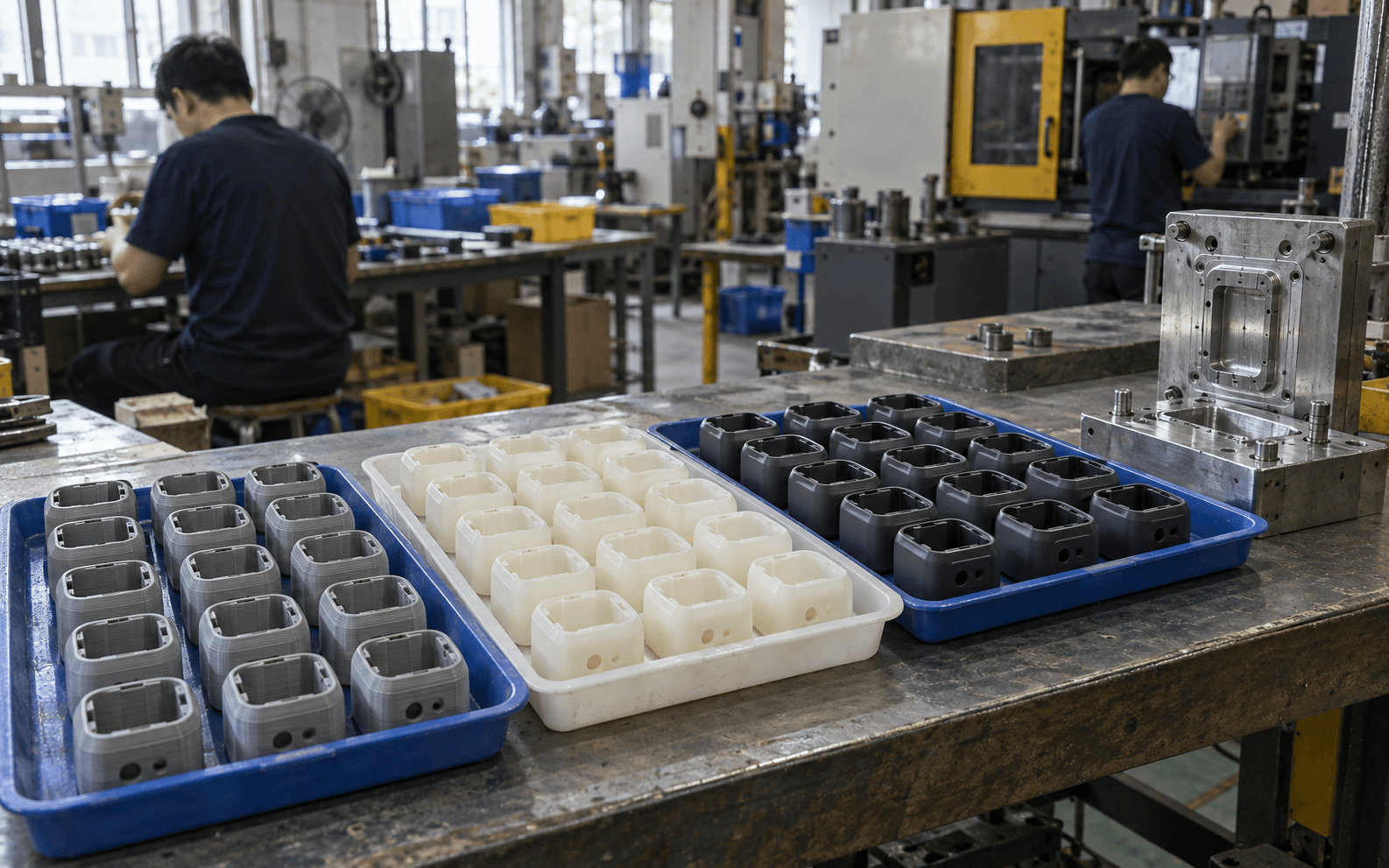
Fifty is an awkward number in manufacturing. It's too many to treat each part as a hand-made prototype, but far too few for most factories to get excited about. It's also exactly the quantity many hardware teams need: for a beta programme, a pilot with a customer, a trade show, or a small crowdfunding reward tier.
At this quantity there are three realistic options for plastic parts: 3D printing, vacuum casting and injection molding (usually with a cheaper "rapid" mold). Each wins in different situations.
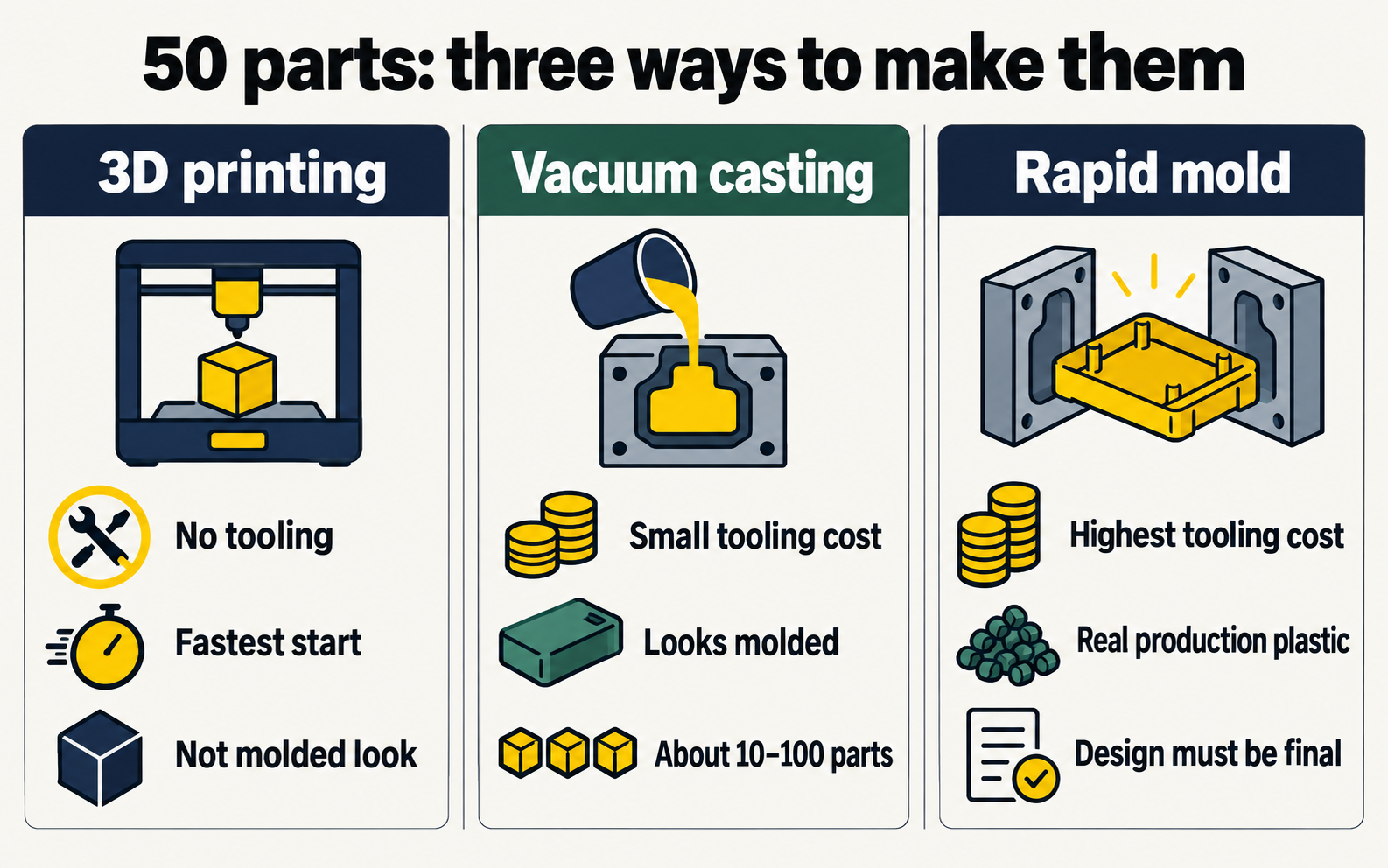
Option 1: 3D printing all 50
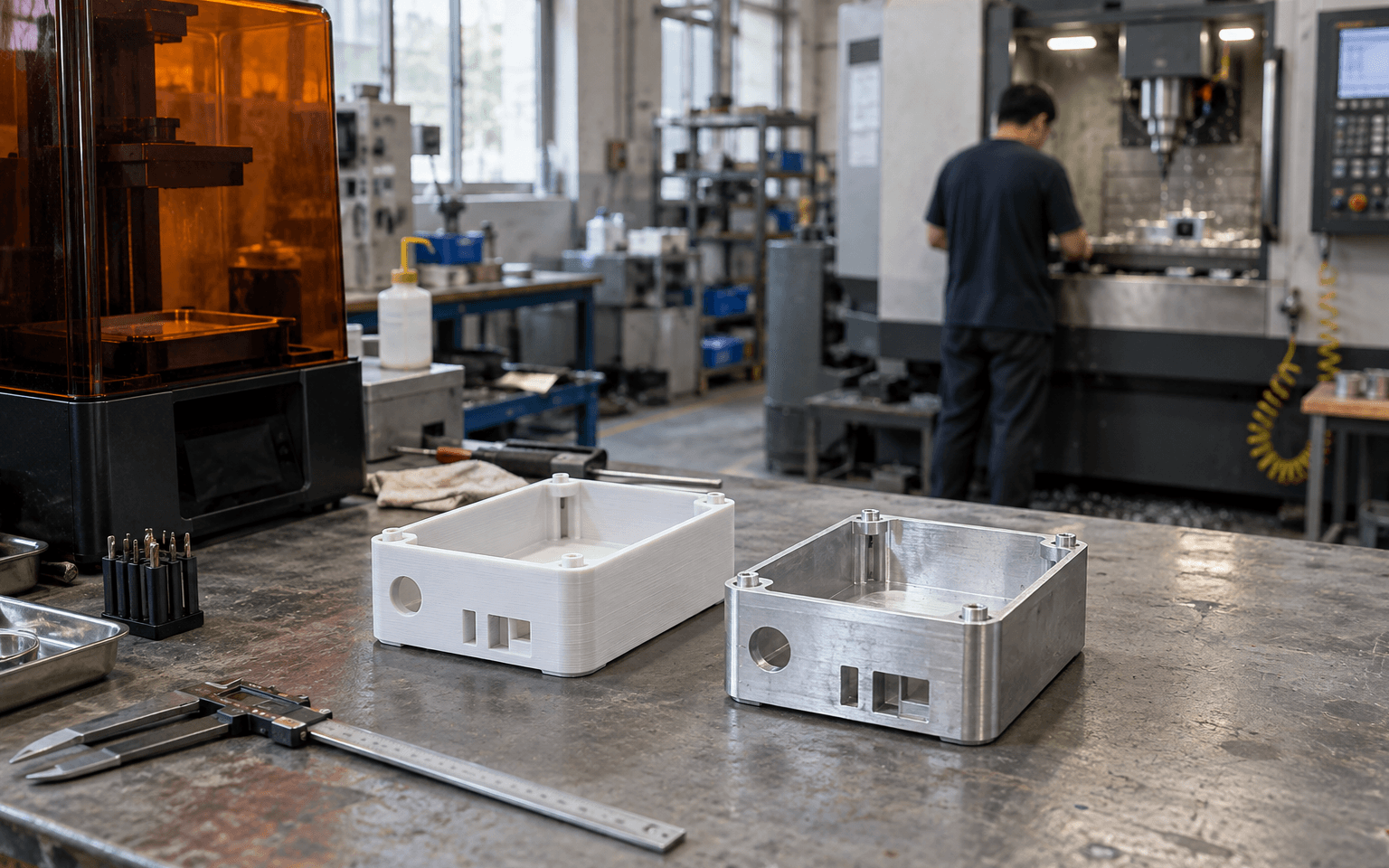
How it works: each part is printed from your file, layer by layer. For 50 parts, you'd usually choose MJF or SLS (nylon powder processes that can pack many parts into one build) or SLA (smooth resin). See Which 3D printing process? SLA vs SLS vs MJF.
Pros
- No tooling cost. Part 1 costs about the same as part 50.
- Fastest start. Often a few days (typical, confirm with your supplier).
- Design changes are free. Change the file, and the next build uses it.
- Complex shapes are no problem.
Cons
- Doesn't look molded. SLS/MJF parts are grainy; SLA parts need sanding and painting to look finished, which is labour for each part.
- Not the production material.
- Cost per part stays flat, so 50 large parts can get expensive.
Best when: the design may still change, the parts are small or internal, or looks don't matter much.
Option 2: vacuum casting
How it works: a master model is made (usually SLA or CNC), a silicone mold is poured around it, and polyurethane resin is cast into the mold under vacuum. Each silicone mold typically makes roughly 15–25 parts (typical, confirm with your supplier), so 50 parts usually means two or three molds from the same master. See What is vacuum casting?
Pros
- Looks like molded plastic, with a smooth or textured surface and colour through the part.
- Many resin options: ABS-like, clear, rubber-like and more.
- Small tooling cost compared with a steel or aluminum mold.
- Can cast soft materials over rigid parts.
Cons
- Per-part cost is fairly high because every casting involves hand work.
- Resins only imitate production plastics.
- Looser tolerances than molding or CNC.
- Usually a week or two for the first batch.
Best when: you need parts that look and feel like the final product, the design is nearly stable, and you need somewhere around 10–100 parts.
Option 3: injection molding with a rapid mold
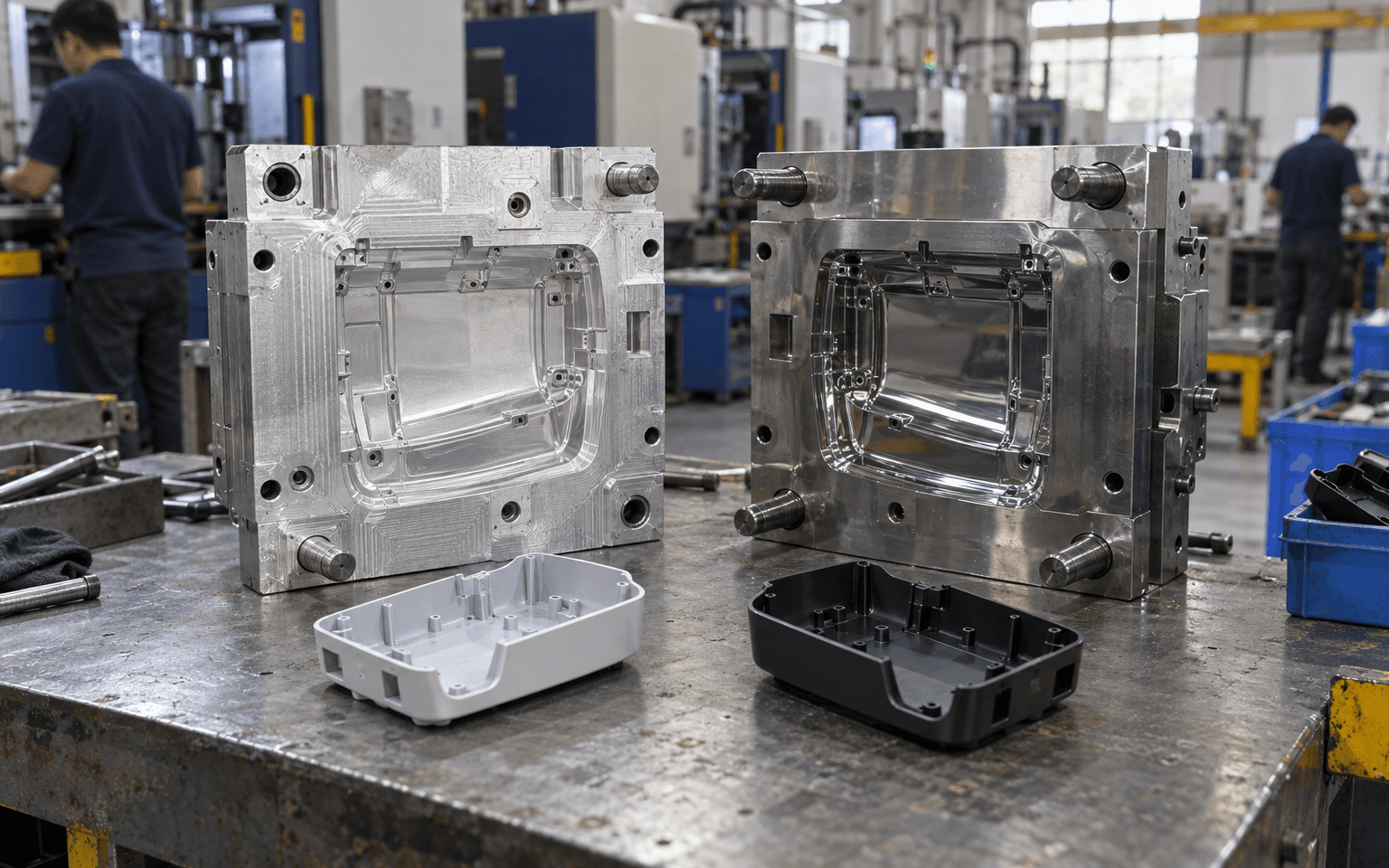
How it works: a mold is machined from aluminum or soft steel, then molten production plastic is injected into it. For small quantities this is often called rapid tooling or a prototype mold. In Chinese, opening any mold is 开模. See What is injection molding? and Aluminum vs steel molds.
Pros
- Real production plastic, so you can do meaningful drop tests, heat tests and even early certification work.
- Parts are truly molded: consistent, accurate and cheap per part.
- The mold can often make many more parts later.
Cons
- Highest up-front cost by far: you pay for the mold even if you only need 50 parts.
- Slowest start: weeks to make and trial the mold.
- Design changes are expensive once the mold is cut (改模).
- The design must follow molding rules (draft, even walls). See Design rules for injection-molded parts.
Best when: the design is locked, you need the real material, or you know you'll need hundreds or thousands more soon.
How to compare quotes
For each option, write down the one-time cost (tooling, master, molds) and the per-part cost (including finishing). Then:
Total = one-time cost + (per-part cost × quantity)
Here's the method with made-up numbers, just to show how it works:
| One-time cost | Per part | Total for 50 | |
|---|---|---|---|
| 3D printing (painted) | $0 | $60 | $3,000 |
| Vacuum casting | $600 (master + molds) | $30 | $2,100 |
| Rapid injection mold | $4,000 | $3 | $4,150 |
In this made-up example, casting wins at 50. At 500, the molding line (about $5,500) would beat casting (about $15,600). Your numbers will be different, so do the sum with real quotes at two or three quantities (for example 50, 200 and 1,000). That shows you where each option stops making sense.
Beyond price: questions that often decide it
- Will the design change after these 50? If yes, avoid molding. Printing or casting keeps you flexible.
- Must the parts pass real tests (drop, heat, chemical, certification)? Molding in the production plastic is the most realistic.
- Will customers see and hold them? Casting or painted SLA looks the most finished without a mold.
- How soon do you need them? Printing is fastest; molding is slowest.
- What happens after the 50? If a production run is coming, the rapid mold may be money you'd spend anyway.
A common path
Many teams use all three, in order: print during early design, vacuum cast 20–50 units for beta testing, then mold once feedback is in and the design is frozen. This matches the build stages described in EVT, DVT, PVT explained.
Keep reading
- What is vacuum casting? (pillar)
- Which 3D printing process? SLA vs SLS vs MJF
- How much does injection molding cost?
- Choosing a prototyping method
Next steps
- Read the urethane casting hub
- Get quotes from vacuum casting shops, 3D printing services and mold makers
- See the Pilot stage of the Path
- Not sure where to start? Get an intro
Updated 29 September 2026