You've got a prototype that looks right. Now you need 20 of them: for user testing, for a trade show, for a crowdfunding video, or for an early batch of beta units. Printing 20 is slow and they don't look like molded plastic. An injection mold is expensive and takes weeks. This gap is exactly what vacuum casting fills.
Vacuum casting in one sentence
Vacuum casting makes a soft silicone mold from a master model, then fills that mold with liquid polyurethane resin inside a vacuum chamber, so the copies come out bubble-free and looking like molded plastic.
It's also called urethane casting, polyurethane casting or silicone molding. In Chinese it's 复模 (fù mó, "copy mold") or 真空复模 (zhēn kōng fù mó, "vacuum copy mold").
An analogy: think of making chocolates at home. You press a shape into a flexible silicone tray, then pour in melted chocolate. The tray is cheap, flexible enough to release tricky shapes, and good for a limited number of batches before it wears out.
How it works, step by step
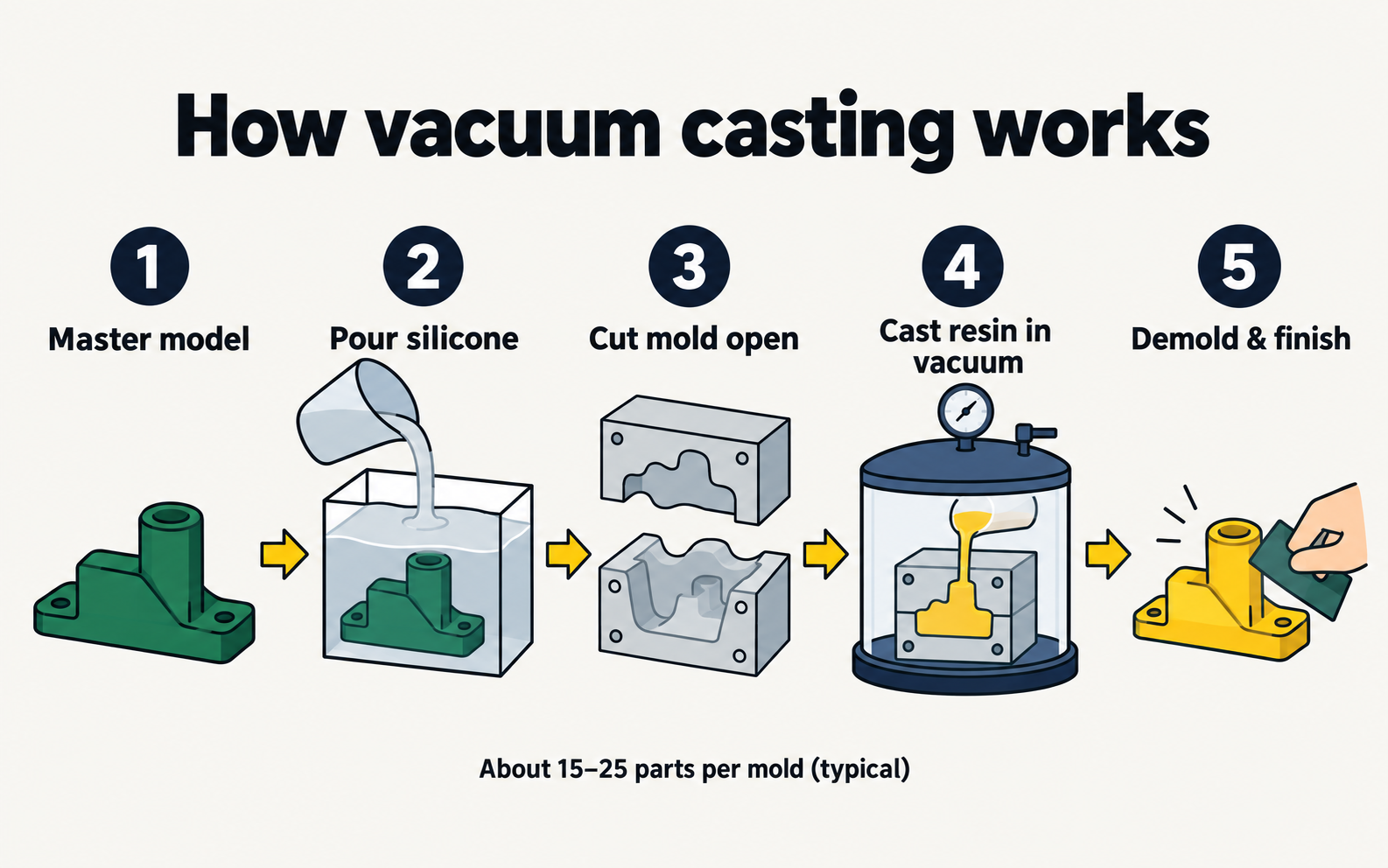
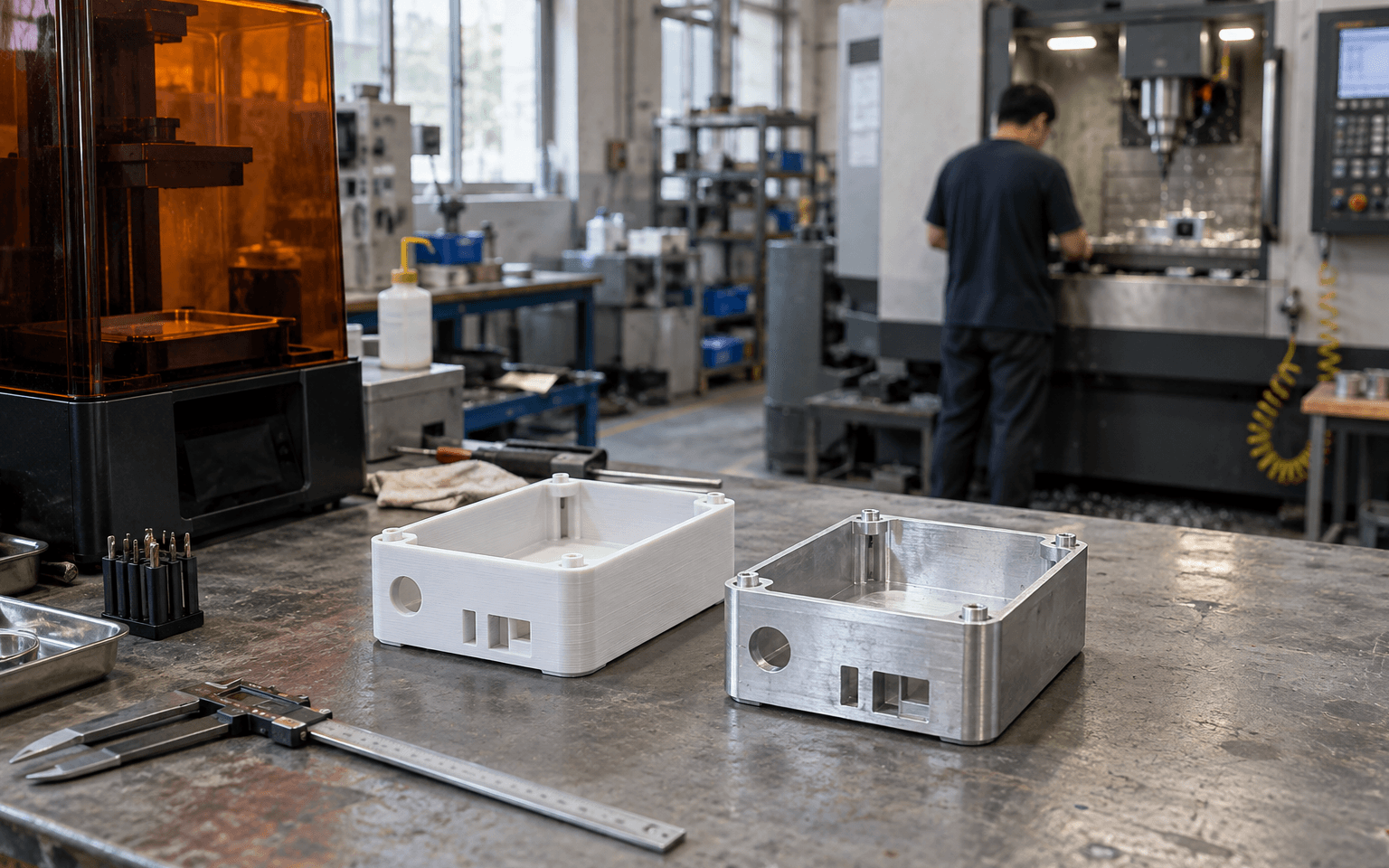
- Make a master model. A single, perfect copy of your part, usually SLA 3D printed or CNC machined, then sanded and polished. Every flaw on the master will be copied, so this step matters.
- Build the mold box. The master is suspended in a box, with small channels added for resin to flow in and air to escape.
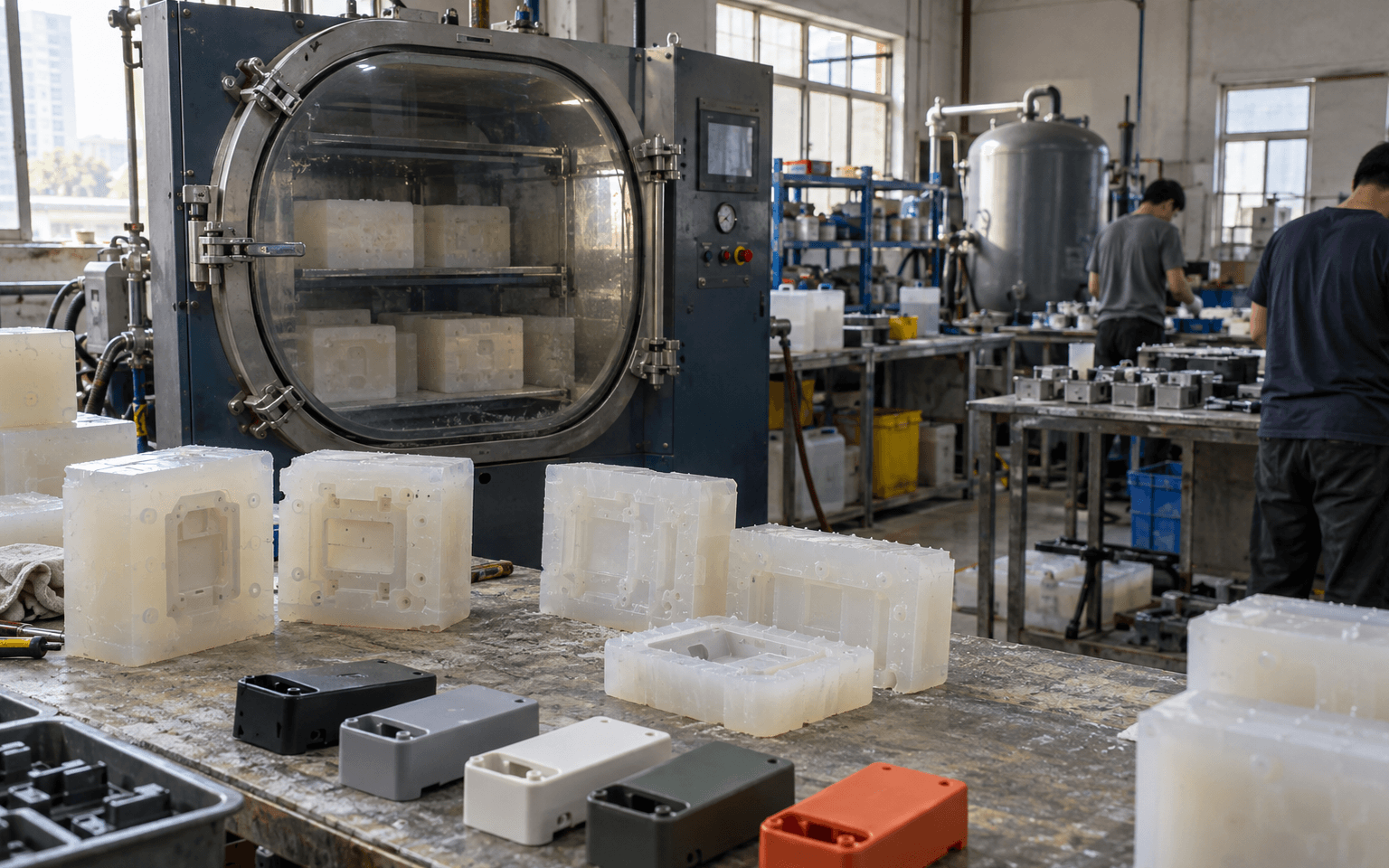
- Pour the silicone. Liquid silicone rubber is poured around the master, de-gassed in a vacuum to remove bubbles, and cured (often in an oven).
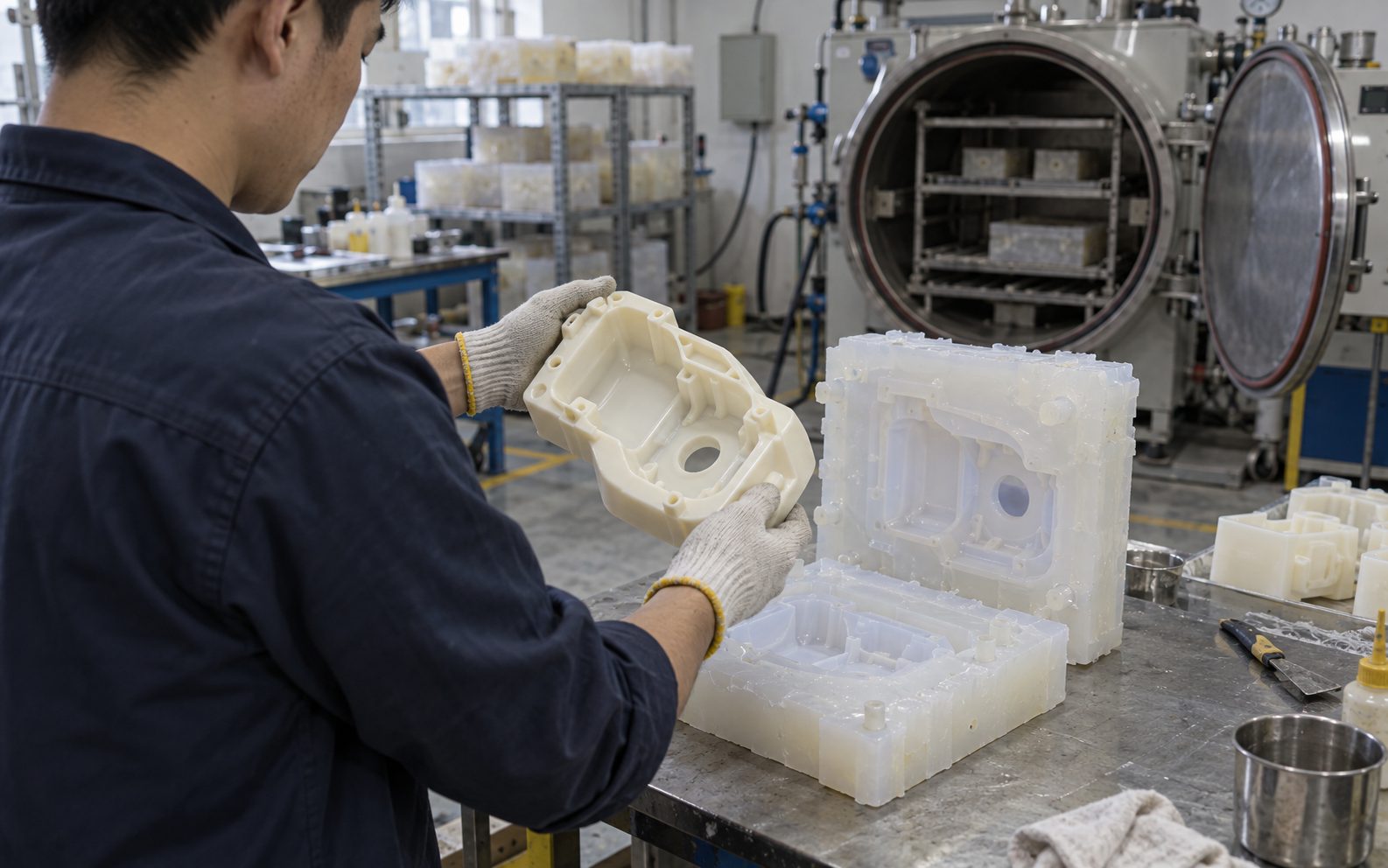
- Cut the mold open. A technician cuts the silicone block along a planned line (the parting line) and removes the master. What's left is a hollow cavity in the exact shape of your part.
- Cast the parts. The mold is closed and placed in a vacuum chamber. Two-part polyurethane resin is mixed and poured in under vacuum, which pulls out air so the resin fills every detail without bubbles.
- Cure and demold. The mold goes into an oven to harden the resin, then the part is peeled out. Because the mold is flexible, it can often release shapes with small undercuts that would need moving parts in a steel mold.
- Finish. Excess material from the pour channels is trimmed, and parts are sanded, painted, printed or assembled as needed.
How many parts per mold?
Silicone molds wear out. The hot resin slowly degrades the surface, and fine details soften. A common rule of thumb is roughly 15–25 parts per mold, depending on the resin, the part's shape and how smooth the finish must be (typical, confirm with your supplier). For more parts, the shop simply makes another mold from the same master.
That's why vacuum casting is usually quoted for about 10 to 50 parts, and sometimes up to a hundred or so.
Materials: resins that imitate plastics
Polyurethane resins come in many grades designed to simulate production plastics:
- ABS-like: the everyday choice for enclosures and housings.
- PC-like (clear): transparent parts like lenses, light covers and windows.
- PP-like: a bit more flexible, for clips and living hinges (thin flexible sections).
- Rubber-like (elastomers): soft parts like grips, seals and feet, available in a range of Shore A hardness values (a scale for how soft a rubber is; lower is softer).
- Heat-resistant and flame-retardant grades for specific tests.
The important word is simulate: these are not the actual production plastics. They're good for looks, fit and many functional tests, but final certification and long-term tests should use real molded parts.
Colour and finish
Colour can be added in two ways:
- Pigment in the resin, so the colour goes all the way through (scratches don't show a different colour underneath).
- Painting after casting, which gives the most accurate colour match and allows gloss, matte, metallic or soft-touch finishes.
Texture can be copied from a textured master, and logos can be added by silk-screen printing or painting. See How to specify colour and finish.
What vacuum casting is great for
- 10–50 parts that look injection molded, for user trials, demos and beta units.
- Soft-touch and overmold-like parts: a rigid part can be placed in a mold and a rubbery resin cast around it. See Overmolding explained.
- Clear parts that need to look glass-like.
- Testing a design before you commit to an injection mold.
What it's not great for
- Large quantities. Each part involves hand work, so the cost per part stays fairly high. See 50 parts: casting vs printing vs molding.
- Very tight tolerances. Silicone molds flex and resins shrink slightly; accuracy is usually looser than CNC or injection molding.
- Final material testing and certification. The resin isn't the production plastic.
- Very thin walls or very long, thin features, which may not fill evenly or may warp.
Cost and lead time
The quote usually includes the master model, the silicone mold and the per-part casting cost, plus finishing. The master and mold are shared across all parts in that mold, so the per-part price falls as you approach the mold's life.
Lead times of one to two weeks for a first batch are common, longer if the parts need painting or many different colours (typical, confirm with your supplier).
Getting vacuum casting done in Shenzhen
Vacuum casting is a core service of Shenzhen's prototype shops (手板厂). Many also make the SLA or CNC master in-house, so you can send just your CAD file.
- Send your 3D files, quantity, resin type (e.g. "ABS-like, black") and finish.
- Ask how many parts each mold will make, and whether a second mold is included.
- Approve the master model's surface before the silicone is poured, if appearance is critical.
- Check the first casting before the full batch.
Key words
| English | Chinese | Pinyin |
|---|---|---|
| Vacuum casting | 真空复模 | zhēn kōng fù mó |
| Silicone mold | 硅胶模 | guī jiāo mú |
| Master model | 原型 / 母模 | yuán xíng / mǔ mó |
| Polyurethane (PU) | 聚氨酯 | jù ān zhǐ |
| Prototype model | 手板 | shǒu bǎn |
Keep reading
- 50 parts: casting vs printing vs molding
- Which 3D printing process? SLA vs SLS vs MJF
- Choosing a prototyping method
- Aluminum vs steel molds
Next steps
- Read the urethane casting hub
- Browse vacuum casting shops in Shenzhen and Dongguan
- See the Prototyping stage and Pilot stage of the Path
- Glossary: 复模 urethane casting, 真空复模 vacuum casting
- Not sure where to start? Get an intro
Updated 29 September 2026