When you upload a file to a 3D printing service in Shenzhen, you'll usually be asked to pick a process: SLA, SLS or MJF (and sometimes FDM or metal). The names sound alike, but the parts they produce look, feel and behave very differently.
This guide explains each one from scratch, so you can pick the right process for what your prototype needs to do.
First, what all 3D printing has in common
3D printing builds a part layer by layer from a digital file, adding material only where it's needed. That's why it's called additive manufacturing, the opposite of CNC machining, which cuts material away.
Because there's no mold and no cutting tool, you can print one part as cheaply as ten, and shapes that would be impossible to machine (internal channels, lattices) are often easy.
You may already know FDM (fused deposition modeling): the desktop kind that squeezes melted plastic filament through a nozzle, like a hot glue gun drawing in layers. It's cheap and great for rough checks, but the layer lines are visible and parts are weaker between layers. For professional prototypes, most people move up to one of the three processes below.
SLA: liquid resin cured by light
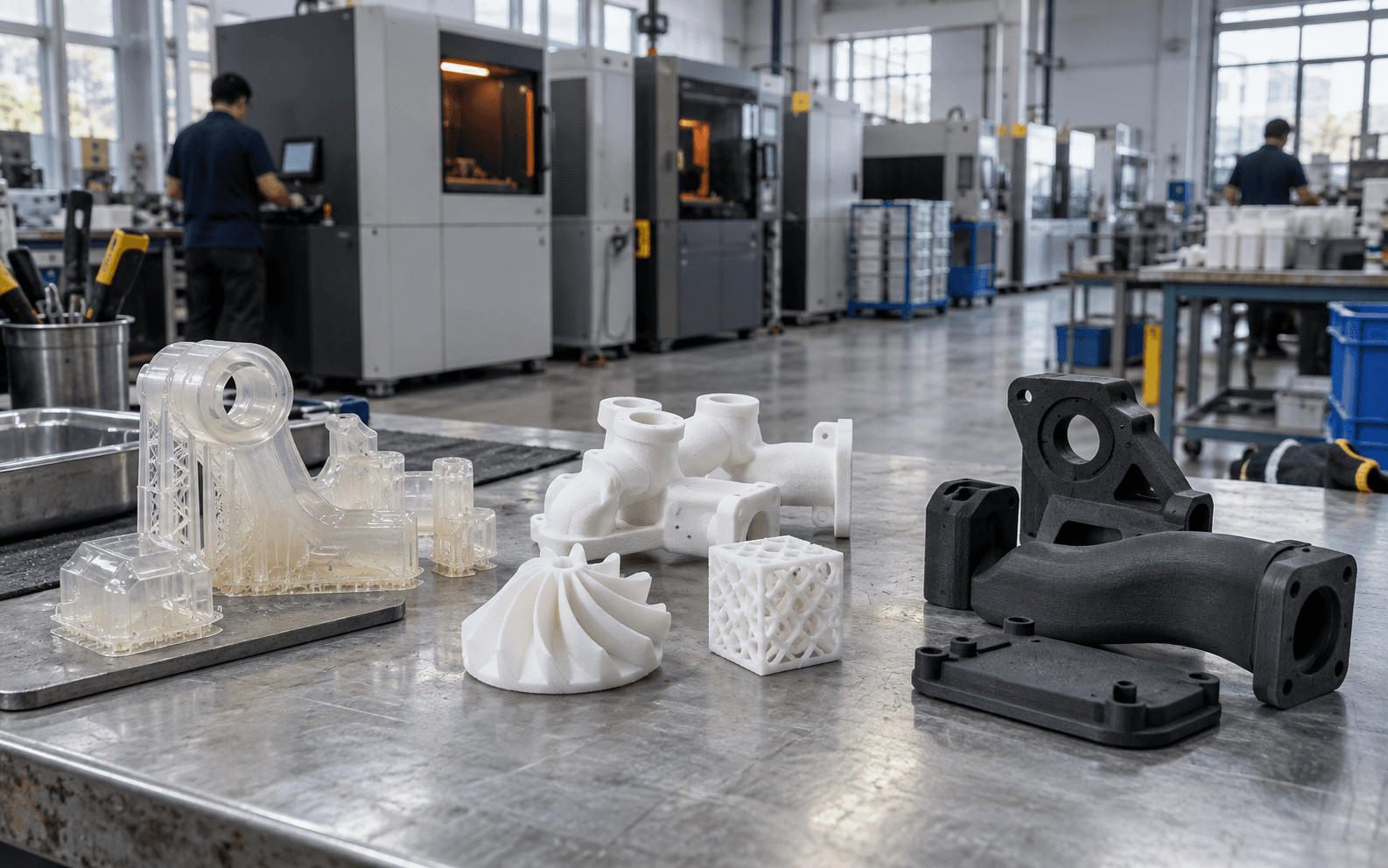
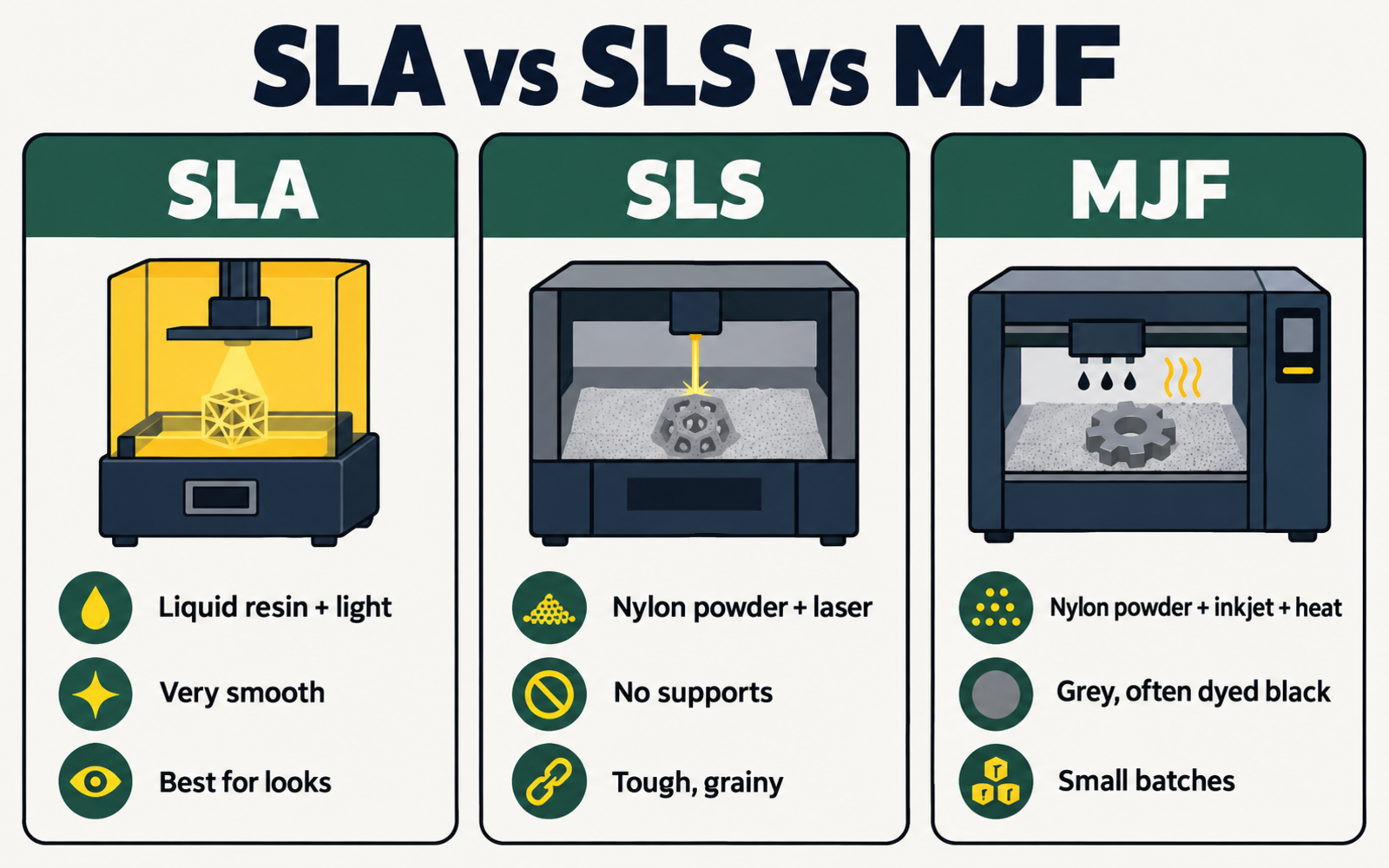
How it works: the printer holds a vat of liquid photopolymer resin, a plastic that turns solid when light hits it. A laser (or a projected light image) traces each layer, hardening the resin exactly where the part should be. The part rises or sinks one thin layer at a time. SLA stands for stereolithography. In Chinese, it's usually called 光固化 (guāng gù huà, "light curing"), and it's the classic process for 手板 (prototype models).
Supports: overhanging areas need thin support structures, like scaffolding, which are snapped off afterwards. This leaves small marks that are sanded smooth.
What the parts are like
- Very smooth surface and fine detail. Great for parts that must look like the final product.
- Easy to sand, paint and polish. Clear resins can be polished to near glass-like transparency.
- Often more brittle than molded plastic, depending on the resin. Standard resins can snap if you bend them.
- Can yellow and weaken in sunlight over time.
Best for: looks-like prototypes, presentation models, fine details, clear parts, and master models for vacuum casting.
SLS: nylon powder fused by a laser
How it works: a thin layer of fine nylon powder is spread over a bed. A laser melts (sinters) the powder where the part should be, fusing it together. Another layer of powder is spread on top, and the process repeats. SLS stands for selective laser sintering.
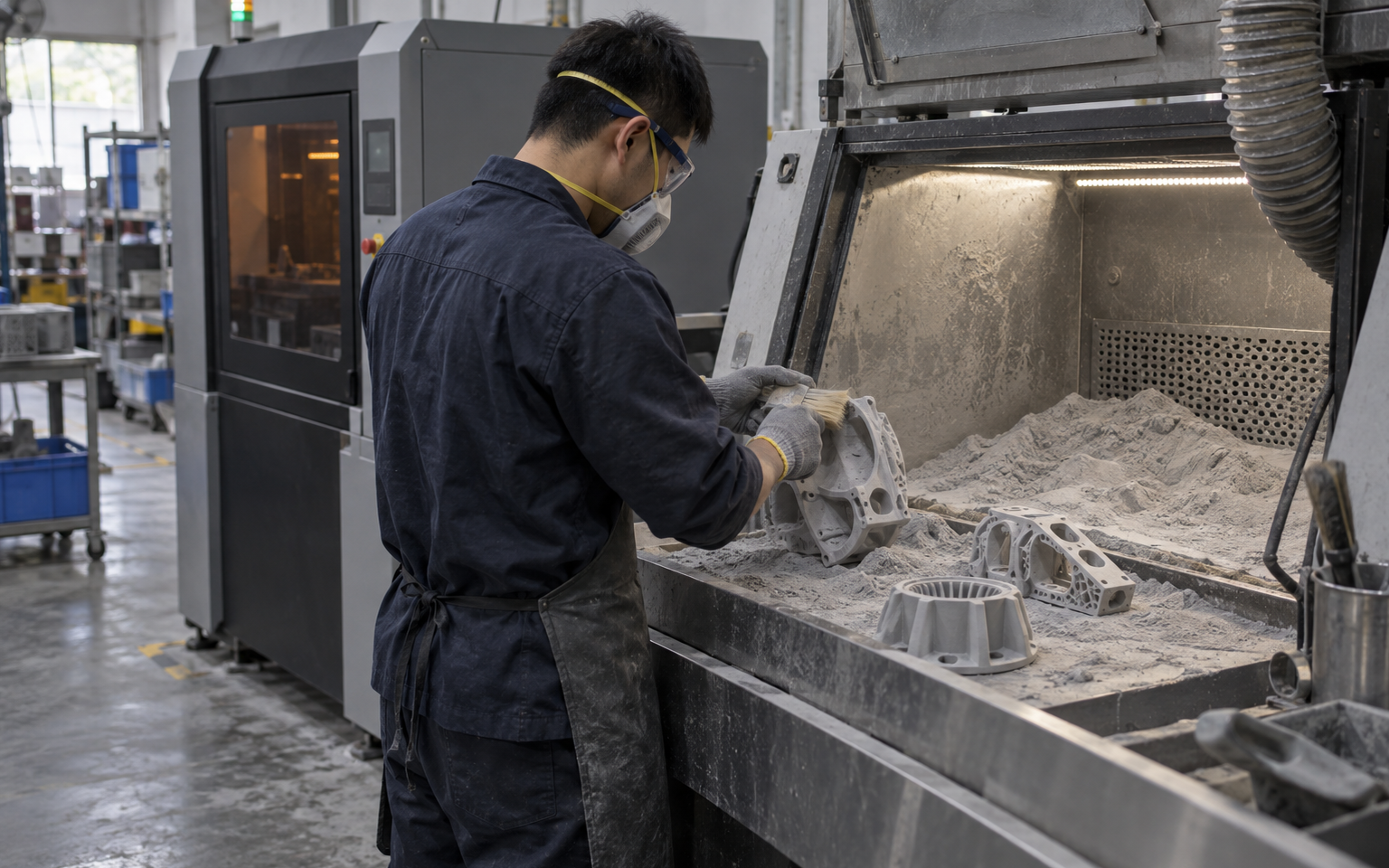
Supports: none needed. The loose powder around the part holds it up. This means you can pack many parts into one build, even nested inside each other.
What the parts are like
- Strong and tough. Nylon (usually PA12 or PA11) can flex a little without snapping, a lot like a molded part.
- Slightly grainy, matte surface, a bit like fine sandpaper. Usually white or off-white, and commonly dyed black.
- Good for working parts: clips, hinges and brackets.
- Can't show very fine cosmetic detail as crisply as SLA.
Best for: functional prototypes, snap fits, complex shapes, and small production batches.
MJF: nylon powder fused by inkjet and heat
How it works: like SLS, it starts with a bed of nylon powder. But instead of a laser, an inkjet head sprays a fusing agent (a liquid that absorbs heat) where the part should be, plus a detailing agent at the edges to keep them sharp. Then a heat lamp passes over, and the treated powder fuses. MJF stands for Multi Jet Fusion, a technology developed by HP.
Supports: none, same as SLS.
What the parts are like
- Similar strength to SLS, with typically very consistent properties.
- Grey as printed, and usually dyed black. The surface is slightly smoother than many SLS parts but still matte and grainy.
- Fast for batches: because the whole layer is fused in one pass, full builds of many parts can be economical.
Best for: functional prototypes and small production runs of tens to hundreds of nylon parts, such as brackets, housings for internal parts, and jigs (治具).
Side-by-side summary
| SLA | SLS | MJF | |
|---|---|---|---|
| Raw material | Liquid resin | Nylon powder | Nylon powder |
| How it fuses | Laser / light | Laser | Inkjet agent + heat |
| Supports | Yes | No | No |
| Surface | Very smooth | Grainy, matte | Grainy, matte |
| Colour as printed | Depends on resin | White | Grey (often dyed black) |
| Toughness | Often brittle | Tough | Tough |
| Best for | Looks, detail, clear parts | Working parts | Working parts, small batches |
How to choose
Ask what the prototype needs to do:
- Needs to look right (photos, investor demos, user tests of appearance)? SLA, then sand and paint.
- Needs to be clear? SLA with a clear resin, polished. (For many clear parts, vacuum casting or CNC-machined acrylic are also options.)
- Needs to snap, flex, or survive being dropped? SLS or MJF.
- Need 50–300 identical nylon parts? MJF or SLS. Also compare with casting: see 50 parts: casting vs printing vs molding.
- Needs to be metal? Look at metal printing (often called SLM or DMLS), or CNC machining.
Many projects use more than one: SLA for the outer shell that must look good, MJF for the internal brackets that must be strong.
What drives the price
- Part volume (how much material), and for powder processes, the bounding box (how much space it takes in the build).
- Height for SLA, since each layer takes time.
- Finishing: sanding, painting, dyeing, polishing and inserts all add labour.
- Material: engineering resins and special nylons cost more than standard grades.
Many Shenzhen services give instant online quotes. Simple parts often ship in a few days (typical, confirm with your supplier).
Key words
| English | Chinese | Pinyin |
|---|---|---|
| 3D printing | 3D打印 | sān D dǎ yìn |
| SLA / resin printing | 光固化 | guāng gù huà |
| Nylon printing (SLS/MJF) | 尼龙打印 | ní lóng dǎ yìn |
| Prototype model | 手板 | shǒu bǎn |
| Post-processing | 后处理 | hòu chǔ lǐ |
Keep reading
- 3D printing vs CNC for prototypes
- 50 parts: casting vs printing vs molding
- Choosing a prototyping method
- Looks-like vs works-like prototypes
Next steps
- Read the 3D printing hub
- Browse 3D printing services in Shenzhen and Dongguan
- See the Prototyping stage of the Path
- Glossary: 手板 prototype
- Not sure where to start? Get an intro
Updated 29 September 2026