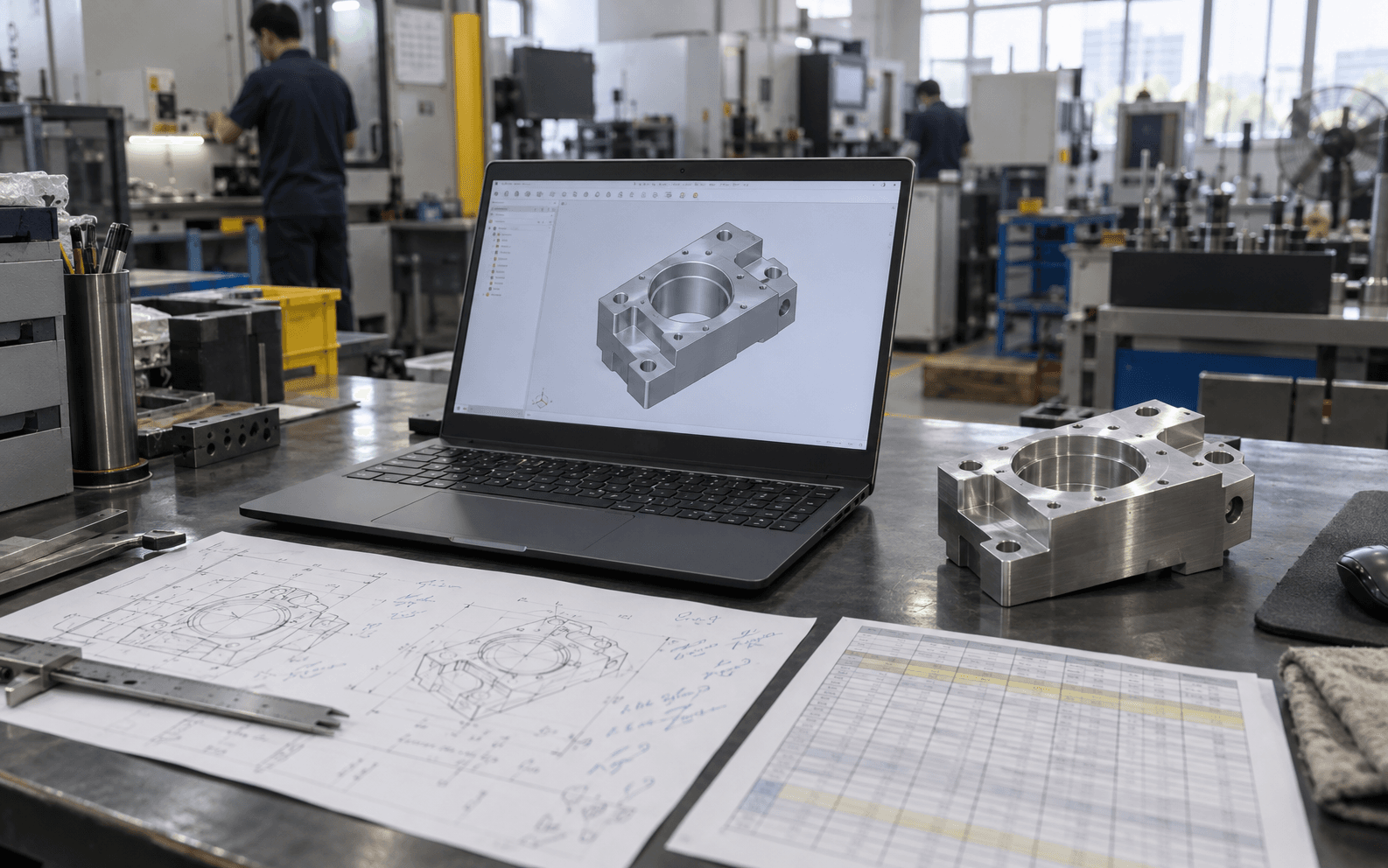
You send a message: "Hi, how much for this part?" with a screenshot of your CAD model. Three suppliers reply. One asks ten questions, one quotes a price with no details, one doesn't reply. Now you can't compare anything, and a week has gone.
A clear RFQ avoids this. It's the single most useful document you can write before contacting factories.
What an RFQ is
RFQ stands for Request for Quotation: a written package you send to suppliers asking them to price a specific job. A good RFQ gives every supplier the same information, so their quotes can be compared fairly. In Chinese a quote is 报价 (bào jià).
You may also hear RFP (request for proposal, when you want the supplier to suggest how to do it) and RFI (request for information, when you're just asking about capabilities). For custom parts, the RFQ is what you'll use most.
An analogy: asking three builders to price "a kitchen" gets you three prices you can't compare. Giving them the same floor plan, materials list and finish choices gets you three prices you can.
Why a good RFQ matters
- Comparable quotes. Same inputs, so the differences are about the supplier, not the question.
- Faster replies. Busy engineers answer complete requests first.
- Fewer surprises. Finishing, packaging, samples and shipping are priced up front, not added later.
- You look serious. A clear package signals a real project, which helps you get attention from good shops.
What to include
1. A short introduction
Two or three sentences: who you are, what the product is (at a level you're comfortable sharing), and where you are in development (prototype, pilot, production). Suppliers want to know whether this is a one-off or the start of a longer project.
2. Files
- 3D model in a neutral format, usually STEP.
- 2D drawing (PDF) for each part, showing material, finish, critical dimensions and tolerances.
- For electronics: Gerber files, BOM (物料清单) and pick-and-place files. See How to order PCB assembly.
- File names and revision numbers that match (for example, "Housing_RevB").
If your design is sensitive, consider sending the full files only after an agreement is in place. See NNN agreements explained.
3. Quantities, at several levels
Ask for prices at two or three quantities, for example 10 / 100 / 1,000. This shows how the price falls with volume and where tooling starts to make sense. Also mention expected annual volume if you know it.
4. Material and finish
Be specific: "Aluminum 6061-T6, bead blast, black anodize", not "metal, black". For plastics, name the resin grade if you know it, or the properties you need. For colour and texture, see How to specify colour and finish.
5. Quality requirements
- Critical dimensions and how they'll be checked.
- Cosmetic standards (which surfaces must be perfect).
- Any certifications or material declarations you need (for example, RoHS for electronics).
- Whether you want an inspection report with the parts.
6. Delivery and packaging
- Where the parts go (city and country), and your preferred Incoterm, such as EXW or FOB Shenzhen.
- Packaging needs: individual bags, foam, labelled boxes.
- Target delivery date, if you have one.
7. What you want back
This is the part most people forget. Ask each supplier to break the quote down so you can compare like with like:
- Tooling cost (if any), and who owns the tooling
- Unit price at each quantity
- Lead time (交期) for samples and for production
- MOQ (minimum order quantity, 起订量)
- Payment terms (for example, deposit percentage, 定金)
- What's included: finishing, inspection, packaging, shipping
- Validity: how long the price holds
- DFM comments: anything they'd change to make it easier or cheaper
A template you can copy
Subject: RFQ: [Product] enclosure, 3 parts, CNC + anodize
About us: [Company], [city]. Developing a [short description]. Currently at prototype stage; planning a pilot of about 200 units next quarter.
Parts: 3 parts (see attached STEP and PDF drawings, Rev B). Quantities: 10 / 100 / 500 sets. Material: 6061-T6 aluminum. Finish: Fine bead blast + black anodize (colour to match attached photo; physical sample available). Critical features: See drawing notes; tolerances shown on drawing. Packaging: Each part individually bagged, packed in foam. Delivery: FOB Shenzhen / or quote EXW your factory. Please include: unit price per quantity, any set-up/tooling cost, sample lead time, production lead time, MOQ, payment terms, quote validity, and any DFM suggestions. Reply by: [date].
Sending it
- Send the same package to three to five suppliers.
- Use a clear subject line and attach files directly (or a download link, if they're large).
- If a supplier asks a good question, answer it and share the answer with all of them, so everyone is quoting the same job.
- Keep a simple spreadsheet to compare the replies line by line.
Reading the quotes
The cheapest number isn't always the cheapest job. Check:
- Are finishing, packaging and inspection included, or extra?
- Are tooling costs separate, and who owns the tool?
- Did they quote the material you asked for, or suggest a substitute?
- Are lead times realistic, and do they include samples?
- Did they give DFM feedback? Thoughtful questions are often a good sign of engagement.
Then pick one or two for a small first order. See How to choose a factory in China.
Keep reading
- How to choose a factory in China
- How to prepare files for a CNC quote
- Incoterms for first-timers
- NNN agreements explained
Next steps
- Read the contract manufacturing hub
- Find a sourcing agent if you'd like help managing RFQs
- See the Prototyping stage of the Path
- Glossary: 报价 quote, 交期 lead time, 起订量 MOQ
- Not sure where to start? Get an intro
Updated 29 September 2026