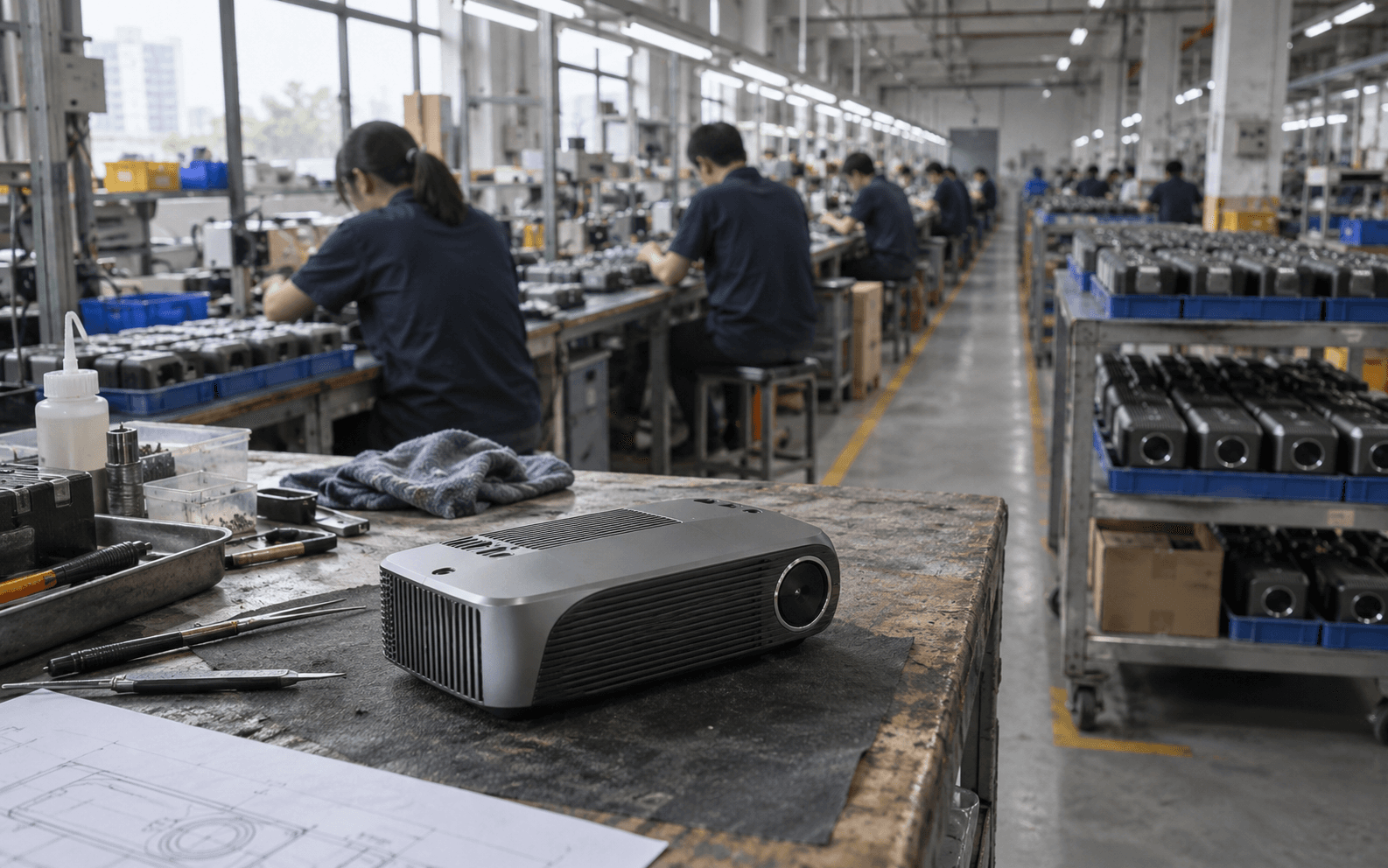
Ten prototypes that work on your desk feel like the finish line. They're closer to the starting line. A prototype proves your idea can work. Production has to prove that a thousand units, built by people who've never met you, from parts bought from a dozen suppliers, will all work the same way.
That's a different problem, and most of the surprises first-time founders hit come from treating it as the same one. This guide explains what changes, and why.
The big shift: from "does it work?" to "does it work every time?"
With 10 units, you can fix things by hand. A part doesn't quite fit? Sand it. A wire is too short? Solder a longer one. A board has a fault? You'll find it.
With 1,000 units, none of that scales. Every unit has to come out right without anyone's special attention. That means the variation that didn't matter at 10 suddenly does.
What changes, side by side
| 10 prototype units | 1,000 production units | |
|---|---|---|
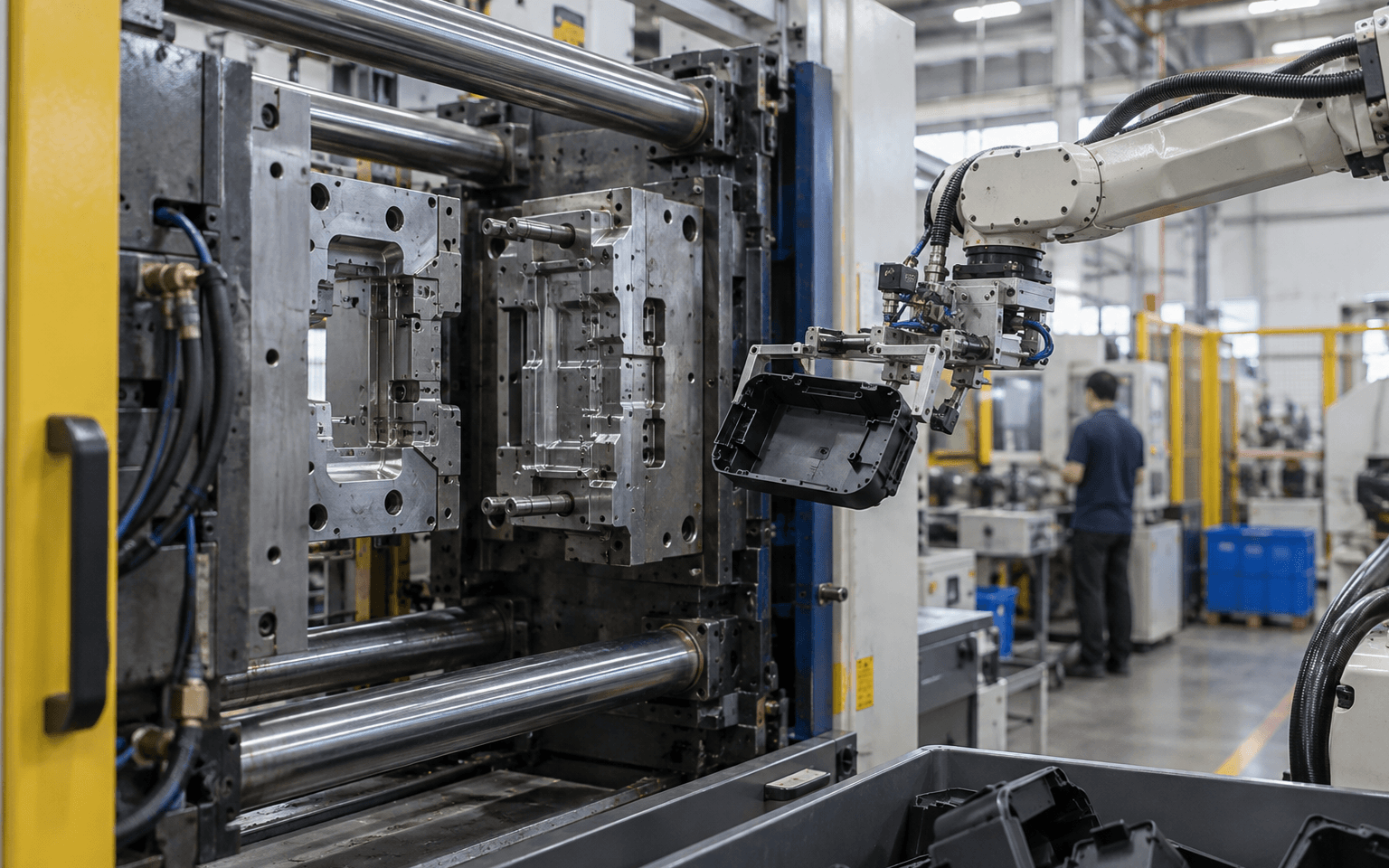
| How plastic parts are made | 3D printing, CNC machining, urethane casting | Injection molding from steel or aluminum molds |
| Who builds it | You, an engineer or a prototype shop | A contract manufacturer's line workers |
| How it's put together | By hand, with adjustments | Step-by-step at stations, using fixtures |
| Parts | Bought in small quantities, often from stock | Ordered in volume, with lead times and minimum orders |
| Testing | You try each one | A defined test at each station, with pass/fail limits |
| Documents | CAD files and your memory | Frozen drawings, BOM, assembly instructions, test plan |
| Quality | "Looks OK to me" | A signed golden sample and written inspection criteria |
| Cost per unit | High, mostly labour and set-up | Lower, mostly parts and tooling spread across units |
| Cash | Small amounts as you go | Large deposits for tooling and parts before you sell anything |
Let's go through the ones that cause the most trouble.
Parts change how they're made
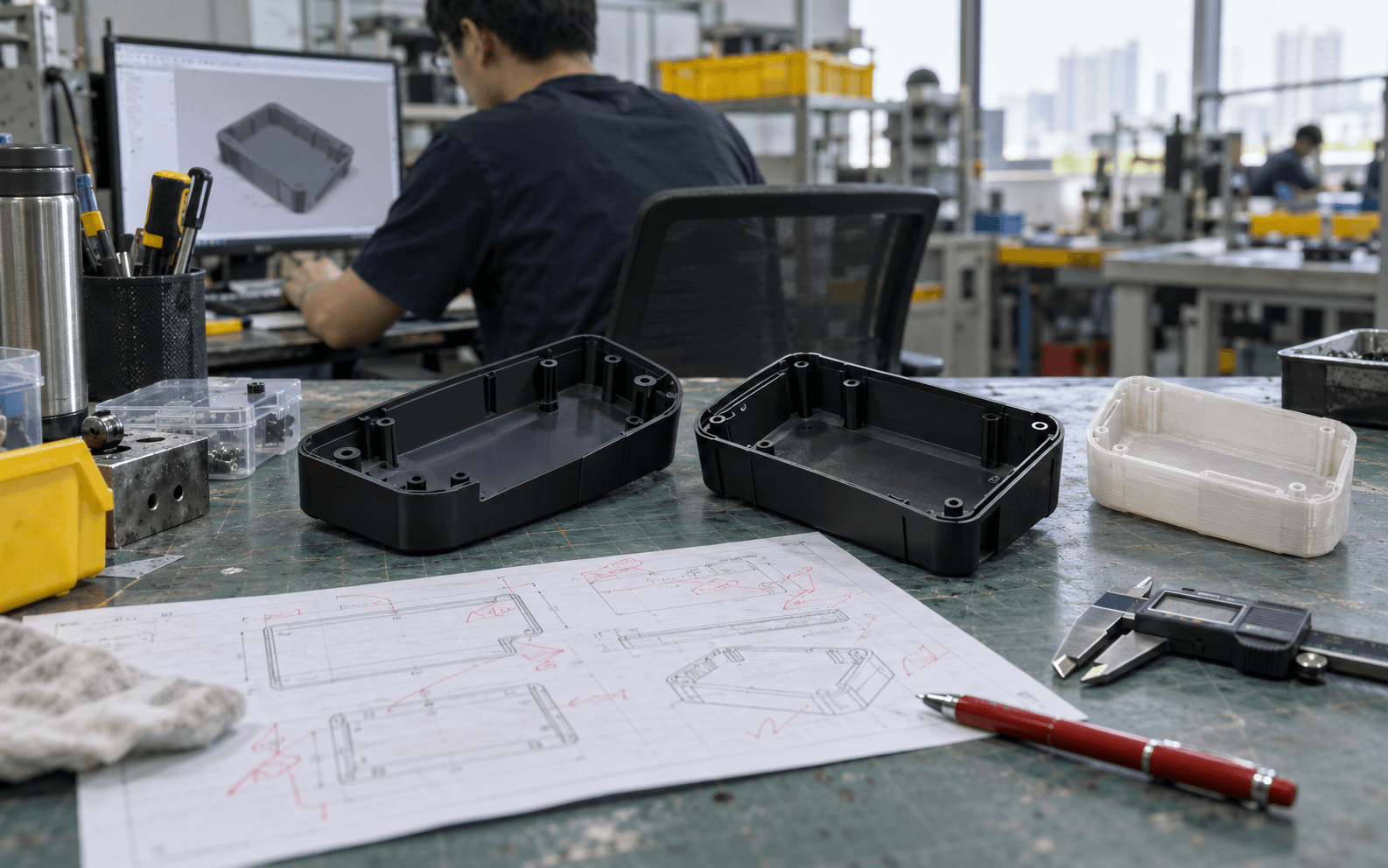
A CNC-machined or 3D-printed enclosure behaves differently from a molded one. Molded plastic shrinks as it cools, can warp, and needs features like draft (a slight slope on walls so the part releases from the mold). A design that fit perfectly as a prototype may need changes to work as a molded part. That's what DFM is for, and why you shouldn't open molds until the design is settled. See What is injection molding?
Small variations add up
Every manufactured part varies slightly from the next, within its tolerance (the allowed range, like ± 0.1 mm). With 10 units you might never get two "worst-case" parts together. With 1,000, you will. A button that's slightly tight on one unit and slightly loose on another becomes hundreds of complaints.
This is called tolerance stack-up: the small variations of several parts adding together. Engineers check it on paper before tooling. See CNC tolerances explained.
Buying parts becomes a project
For prototypes you buy what's in stock. For production:
- some components have lead times of weeks or months,
- suppliers have MOQs (minimum order quantities, 起订量 qǐ dìng liàng),
- parts can go end-of-life (no longer made),
- and prices depend on quantity.
Check availability and lead times for every part on your BOM before you commit, and approve alternates for anything risky.
The build has to be written down
Workers on a line don't know your product. They need work instructions (作业指导书, zuò yè zhǐ dǎo shū, often shortened to SOP): step-by-step pictures showing exactly how to do their station's job. Your contract manufacturer usually writes these, but they need clear drawings and a frozen design from you.
Testing becomes a system
You can't rely on trying each unit yourself. Production needs defined tests at set points, test fixtures, and clear pass/fail limits. Designing for this from the start is called design for test. See DFA and DFT: design for assembly and test.
Yield becomes a number you track
Yield (良率, liáng lǜ) is the share of units that come off the line good the first time. Early builds often have lower yield; it improves as problems are found and fixed. Every bad unit costs parts, labour and time to rework or scrap, so yield is worth watching from the first pilot build.
The steps in between
Most teams cross the gap through a series of trial builds:
- Freeze the design for tooling. See Engineering change orders and design freeze.
- DFM review and tooling. Molds and dies are made; first samples are checked and fixed. See the DFM & tooling stage.
- EVT, DVT and PVT pilot builds, growing from tens of units to hundreds. See EVT, DVT, PVT explained.
- Certification on units that match the final design. See the Certification stage.
- Sign a golden sample (金样, jīn yàng), the approved reference unit.
- First production run, with inspection before shipping. See Quality inspection explained.
Some founders add a bridge step: a few hundred units made with quicker, cheaper tooling (like aluminum molds) to start selling while steel tools are made. See Aluminum vs steel molds.
Choosing a partner for production
The shop that made your prototypes may not be the right partner for 1,000 units, and a factory set up for 100,000 units may not want an order of 1,000. Look for a contract manufacturer that's comfortable with your volume and stage. NPI partners (new product introduction) specialise in exactly this transition for first-time teams. See How to choose a factory in China.
FAQ
Can I make 1,000 units without injection molds? Sometimes. Urethane casting, 3D printing and CNC can make hundreds of parts, but cost per part stays high. See 50 parts: casting vs printing vs molding.
How many prototypes should I make before production? Enough rounds that the design stops changing in big ways. For most products that's several rounds, followed by pilot builds.
What's the minimum order for a contract manufacturer? It varies a lot by factory and product. Ask early, and be honest about your expected volumes.
Keep reading
- EVT, DVT, PVT explained
- DFA and DFT: design for assembly and test
- How long does it take to develop a hardware product?
- Product development stages: from idea to finished product
Next steps
- Browse contract manufacturers and NPI partners in the directory
- See the EVT · DVT · PVT stage of the Path
- Glossary: 试产 pilot production, 量产 mass production, 良率 yield, 起订量 MOQ
- Not sure where to start? Get an intro
Updated 3 October 2026